The boat pastime on Mānasī-gaṅgā: Kṛṣṇa as the boatman
मानसी-गंगा पर नौका-विहार: नाविक बने श्रीकृष्ण
In short
The boat pastime (naukā-vihāra) is a līlā, a divine pastime, in which Kṛṣṇa becomes a boatman and ferries Śrī Rādhā and the gopīs across Mānasī-gaṅgā at Govardhana. The Bhāgavatam does not tell it. It comes from the prayers of the Gosvāmīs, from the Bhakti-ratnākara and from two lives of Śrī Caitanya.[1–11]
On this page
At a glance
- The Tenth Canto of the Bhāgavatam tells no boat pastime of Kṛṣṇa with the gopīs.[1–4]
- The prayers of Śrīla Raghunātha dāsa Gosvāmī and Śrīla Rūpa Gosvāmī set it on Mānasī-gaṅgā.[5–7]
- Śrīla Rūpa Gosvāmī names a bathing place of the lake Pāraṅga, the crossing, where a boat called Suvilāsatarā shines.[12, 13]
- The Bhakti-ratnākara shows a ghāṭa of the lake near Cakra-tīrtha as the place where Kṛṣṇa ferried Śrī Rādhikā and Her friends.[9, 13]
- According to the commentators on the Tenth Canto, Kṛṣṇa ferried the gopīs across the Yamunā.[2, 14]
- In Śrīla Jīva Gosvāmī's Gopāla-campū, Kṛṣṇa makes a river and a boat on the gopīs' path.[15, 16]
What is the boat pastime of Mānasī-gaṅgā?
Many pastimes are remembered at Mānasī-gaṅgā, the big lake in the town of Govardhana. One of them is the boat pastime. Kṛṣṇa becomes a boatman, takes Śrī Rādhā and the gopīs (the cowherd girls of Vraja) across, and in midstream asks for His fare.[5 +4]
This is one of the confidential pastimes of Rādhā and Kṛṣṇa. So only its place, its sources and its meaning for devotees are given here, simply, as the ācāryas (the teachers of the tradition) teach.[5–7]
The Bhāgavatam does not tell it. It comes from the prayers and books of the Gosvāmīs, from the Bhakti-ratnākara, from two lives of Śrī Caitanya Mahāprabhu and from the commentators on the Tenth Canto. They tell it in different ways and on different waters.[1 +10] The lake itself is described in “How Mānasī-gaṅgā came to be: the Gaṅgā of the mind at Govardhana”.[5–7]
What does the Tenth Canto say?
The Tenth Canto tells no boat pastime of Kṛṣṇa with the gopīs. In one chapter the gopīs, feeling separation, tell Mother Yaśodā that her son is expert in the many ways of the cowherds (10.35.14).[1–4] Śrīla Prabhupāda's Kṛṣṇa book gives their words with no boat in them.[4]
General teaching (does not name the place)“your son is very expert among the cowherd boys. He knows all the different arts of how to tend the cows and how to play the flute.”
Śrīla Prabhupāda, Kṛṣṇa, the Supreme Personality of Godhead (Kṛṣṇa book), Chapter 35, 'The Gopīs’ Feelings of Separation' · vedabase.io
Two commentators read more into the same verses (summarised here, not translated). Śrīla Śrīnātha Cakravartī and the Bṛhat-krama-sandarbha, which is printed under Śrīla Jīva Gosvāmī's name, explain the scene. Yaśodā had often scolded these gopīs for making her son restless, by getting Him to ferry them across the Yamunā and to carry their pots of yogurt. Now the gopīs answer her.[2, 14]
Śrīla Śrīnātha Cakravartī also speaks of Kṛṣṇa's pastimes as the Yamunā's boatman. Neither commentator names Mānasī-gaṅgā.[2, 14]
Śrīla Prabhupāda mentions the boatman's fare once, when he explains one of Śrī Rādhā's moods of ecstatic love, and he too speaks of crossing a river.[18]
General teaching (does not name the place)To cross the river, She has to pay the boatman, and the spot where the boatman collects his fares is called the dāna-ghāṭi. Lord Śrī Kṛṣṇa stops Her from going, telling Her, “First You have to pay the fee; then You will be allowed to go.” This pastime is called dāna-keli-līlā.
Śrīla Prabhupāda, Śrī Caitanya-caritāmṛta, Madhya-līlā 14.173, purport · vedabase.io
That fare pastime at Govardhana is told in “Kṛṣṇa's toll pastime (dāna-līlā) at Govardhana and Varṣāṇā”.[18]
How do the Gosvāmīs' prayers remember it?
The prayers of the Gosvāmīs set the boat pastime on Mānasī-gaṅgā. They call the lake the Mānasa-jāhnavī or Mano-jāhnavī, the Gaṅgā of the mind. The points below are summarised here, not translated.[5–7]
- *Śrīla Raghunātha dāsa Gosvāmī, Vraja-vilāsa-stava* 64.** He prays to the lake: she is full of the joy of the boat pastimes of Rādhā and Kṛṣṇa. With her many waves she lifts the bright stones of Govardhana. He asks her to protect him.[5, 19]
- *His Govardhanāśraya-daśaka* 6.** He asks who would not take shelter of Govardhana, on which flows the Mano-jāhnavī, where Mādhava, as boatman, took Rādhā in His boat.[6, 20]
- *His Utkaṇṭhā-daśaka* 7.** He longs to serve Śrī Rādhā at the time of the boat pastime on the full lake.[7]
- *Śrīla Rūpa Gosvāmī, second Govardhanāṣṭaka* 6.** He prays to Govardhana, whose stones are washed by the waves of this river. The river shows on every side the love of the gopīs, through Kṛṣṇa's boat pastimes and the play over the fare.[6, 21]
- *Śrīla Viśvanātha Cakravartī Ṭhākura, Govardhanāṣṭaka* 7.** He remembers Kṛṣṇa's boat pastime with Rādhā along the Gaṅgā. The verse says only the Gaṅgā; the 2007 guidebook Śrī Vraja-maṇḍala Parikramā quotes it for Mānasī-gaṅgā.[7 +3]
In his Vraja-rīti-cintāmaṇi (3.23–24), Śrīla Viśvanātha Cakravartī Ṭhākura pictures Govardhana as a peacock and makes the lake its neck, where Rādhā and Kṛṣṇa always play in the boat.[23] If word of that boat play once reaches the ears, he says, it holds the mind so fast that nothing can make it let go (summarised here, not translated).[23] The hill as a peacock is described in “The body of Govardhana: mouth, eyes, neck and the peacock”.[23]
Where on the lake did it happen?
A ghāṭa is a bathing place with steps down to the water. In his Rādhā-Kṛṣṇa-gaṇoddeśa-dīpikā, a list of Kṛṣṇa's associates and places, Śrīla Rūpa Gosvāmī names the ghāṭa of Mānasa-gaṅgā Pāraṅga, the crossing. He says that the boat called Suvilāsatarā shines there (2.115–116, summarised here, not translated). He does not say where on the lake the ghāṭa is.[12, 13]
The Bhakti-ratnākara's two stops
The Bhakti-ratnākara of Śrīla Narahari Cakravartī Ṭhākura shows the place twice on Śrīla Śrīnivāsa Ācārya's tour of Govardhana (summarised here, not translated).[8, 9]
- First stop. His guide points to the Mānasa-gaṅgā, where Kṛṣṇa happily enjoys the boat pastime and other pastimes, and quotes the Vraja-vilāsa-stava verse.[8]
- Second stop. Later, at Cakra-tīrtha, after telling of Śrīla Sanātana Gosvāmī's stay there, the guide speaks of this ghāṭa of Mānasī-gaṅgā. Kṛṣṇa takes a boat here, he says, when Śrī Rādhikā comes with Her friends. As boatman He takes them all across, and Lalitā and the other sakhīs (Rādhā's girl-friends) have their wishes fulfilled.[9, 13]
At the second stop the guide quotes the Govardhanāśraya-daśaka verse. He gives the ghāṭa no name.[9, 13] Śrīla Sanātana Gosvāmī's place there is his bhajana-kuṭī, his hut for worship.[8, 9]
The 2007 guidebook Śrī Vraja-maṇḍala Parikramā puts the two together. It places Pāraṅga-ghāṭa at Cakra-tīrtha, where Cakreśvara Mahādeva presides, as the crossing where Kṛṣṇa as boatman ferried the gopīs.[13] Neither Śrīla Rūpa Gosvāmī nor the Bhakti-ratnākara says that their ghāṭas are one. Only that guidebook gives the name Pāraṅga-ghāṭa to this spot.[9 +2]
How do the lives of Śrī Caitanya tell it?
Two lives of Śrī Caitanya Mahāprabhu speak of the boat when they describe His visit to Govardhana. Both are summarised here, not translated.[10, 11]
In Śrīla Murāri Gupta's Kṛṣṇa-caitanya-caritāmṛta, the forests of Vraja are described to Him. Among them is a river called the Mānasa Gaṅgā, the purifier of the world, on the side of Govardhana hill. There Kṛṣṇa plays the boat episode and other pastimes (4.3.11–12).[24, 25]
At Govardhana His guide tells Him that Kṛṣṇa and Balarāma always play with Their friends on the bank of this river. Kṛṣṇa played at boating on the Gaṅgā when the cowherd people went to Mathurā and came back (4.8.2, 4.8.4). The edition's note explains this Gaṅgā as the Mānasa-gaṅgā.[10, 25]
In Śrīla Locana dāsa Ṭhākura's Caitanya-maṅgala, the guide says that the people of Vraja lived on both banks of the Mānasa-gaṅgā. The gopīs could not cross it by land, so Kṛṣṇa added to the fun by ferrying them back and forth in a boat.[11]
What does the Gopāla-campū tell?
Śrīla Jīva Gosvāmī's Gopāla-campū has one boat scene (Pūrva-campū 31, summarised here, not translated). When the gopīs tease Kṛṣṇa on their way, He gathers the mountain streams from all sides into a fine river across their path.[15, 26]
His friends bring a large boat made of palāśa leaves, He takes the helm, and in midstream He stops the boat and asks for a fare they cannot pay. The gopīs sing that He quickly makes a river and a boat on their path and makes them climb in.[15, 16]
The river has no name in the text, and the Gopāla-campū has no other boat scene.[15, 16]
Where the sources differ
The sources set the boat pastime on three kinds of water, and they are given here side by side.[2 +6]
- The Yamunā: according to the commentators on the Tenth Canto, and the river crossing of Śrīla Prabhupāda's purport.[2 +2]
- Mānasī-gaṅgā: according to the prayers of Śrīla Raghunātha dāsa Gosvāmī and Śrīla Rūpa Gosvāmī, the Vraja-rīti-cintāmaṇi, the Bhakti-ratnākara and the two lives of Śrī Caitanya.[5 +7]
- A river Kṛṣṇa makes for the occasion: the Gopāla-campū.[15, 16]
Accounts differ On which water Kṛṣṇa ferried the gopīs
- Śrīla Śrīnātha Cakravartī and the Bṛhat-krama-sandarbha (printed under Śrīla Jīva Gosvāmī's name) on ŚB 10.35.14–15back and forth across the Yamunā; Śrīnātha: His pastimes as the Yamunā's boatman
- Śrīla Sanātana Gosvāmī on ŚB 10.18.14ferrying the gopīs across among the midday games; no water named
- Śrīla Prabhupāda, CC Madhya 14.173 purportRādhārāṇī crosses the Yamunā and must pay the boatman at the dāna-ghāṭi
- Śrīla Viśvanātha Cakravartī, Vraja-rīti-cintāmaṇi 3.23–24the boat-play of Rādhā and Kṛṣṇa always takes place at Mānasa-jāhnavī (Mānasī-gaṅgā)
The guidebooks tell a longer story. According to Govardhana Hill (2001) and the undated notes Govardhana, Kṛṣṇa came to Mānasī-gaṅgā disguised as a young boatman, and a storm rose on the lake. Both books say that Śrīla Jīva Gosvāmī tells this in the Gopāla-campū.[16 +4] The Gopāla-campū has the boat, the midstream and the fare, but not the storm, and it does not name Mānasī-gaṅgā. No older source is known to tell the longer story, so it may be a later local telling.[15 +5]
Accounts differ Where Kṛṣṇa's boat pastime with the gopīs took place
- Śrīla Jīva Gosvāmī's Bṛhat-krama-sandarbha and Śrīla Śrīnātha Cakravartī on ŚB 10.35.14–15the gopīs had Kṛṣṇa ferry them across the Yamunā; Śrīla Śrīnātha speaks of His pastimes as 'the Yamunā's boatman'
- Śrīla Raghunātha dāsa Gosvāmī (Vraja-vilāsa-stava 64, Govardhanāśraya-daśaka 6, Utkaṇṭhā-daśaka 7) and Śrīla Rūpa Gosvāmī (Govardhanāṣṭaka 2.6)the boat pastime with Rādhā on the Mānasa-gaṅgā (Mano-jāhnavī)
- Gopāla-campū, Pūrva 31a river formed by Kṛṣṇa from the mountain streams among the gopīs; not named
- Śrīmad-Bhāgavatam, canto 10the verses tell no boat pastime
Places in this article
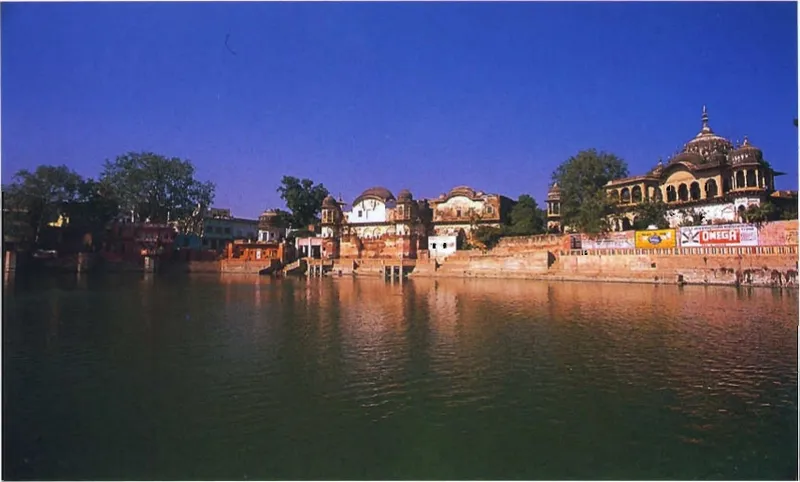
Mānasī-gaṅgā
मानसी-गंगाMānasī-gaṅgā is the large lake in the middle of Govardhana town, on Govardhana Hill.
Pāraṅga-ghāṭa
पारंग-घाटPāraṅga-ghāṭa is a ghāṭa, a bathing place with steps, of Mānasī-gaṅgā at Cakra-tīrtha, over which, according to the guidebook Śrī Vraja-maṇḍala Parikramā (2007), Cakreśva …
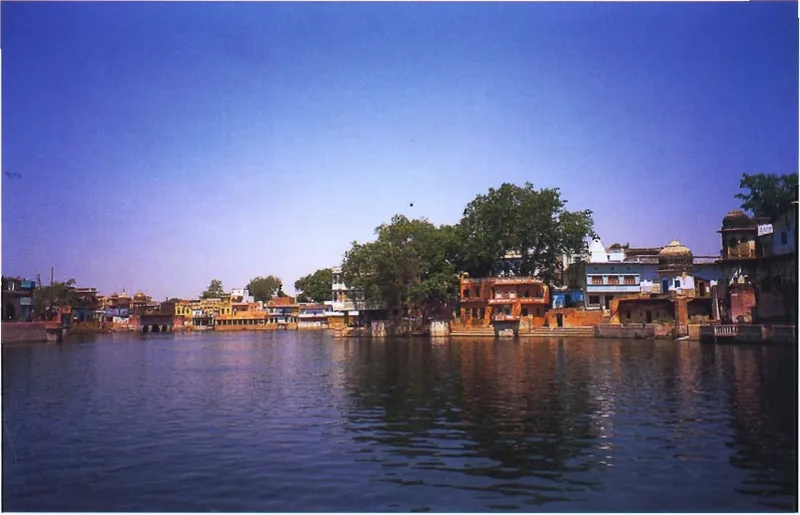
Cakra-tīrtha (Govardhana)
चक्र-तीर्थ (गोवर्धन)Cakra-tīrtha is a holy bathing place (tīrtha) on the northern bank of Mānasī-gaṅgā in Govardhana town, as the guidebooks place it.
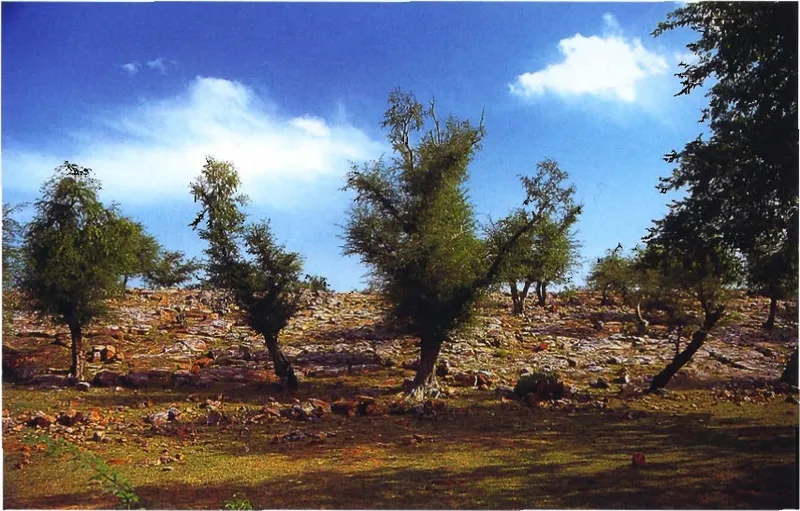
Govardhana
गोवर्धनGovardhana is the hill that Kṛṣṇa lifted with one hand and held up for seven days, so that the people and cows of Vraja could shelter under it from Indra's rain.
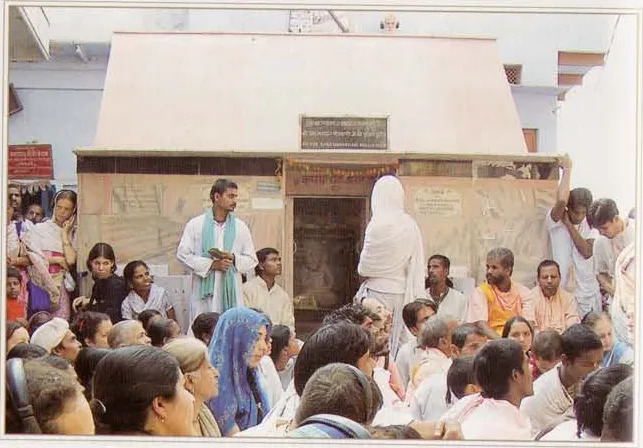
Sanātana Gosvāmī's bhajana-kuṭī (Govardhana)
सनातन गोस्वामी की भजन-कुटी (गोवर्धन)Śrīla Sanātana Gosvāmī's bhajana-kuṭī, his hut for chanting and prayer, is a small shrine at Cakra-tīrtha on Mānasī-gaṅgā, next to the Cakaleśvara Mahādeva temple.
Questions and answers
A pastime in which Kṛṣṇa becomes a boatman and ferries Śrī Rādhā and the gopīs across the water, stopping in midstream to ask His fare. The Gosvāmīs' prayers set it on Mānasī-gaṅgā at Govardhana.[5 +4]
No. The Tenth Canto does not tell it. Commentators on Bhāgavatam 10.35.14–15 speak of Kṛṣṇa ferrying the gopīs across the Yamunā.[1–4, 14]
It is told in the prayers of Śrīla Raghunātha dāsa Gosvāmī and Śrīla Rūpa Gosvāmī and in Śrīla Viśvanātha Cakravartī Ṭhākura's Vraja-rīti-cintāmaṇi. The Bhakti-ratnākara tells it too, and so do the lives of Śrī Caitanya by Śrīla Murāri Gupta and Śrīla Locana dāsa Ṭhākura.[5 +7]
Śrīla Rūpa Gosvāmī names Pāraṅga as the ghāṭa of Mānasa-gaṅgā without saying where it is. The 2007 guidebook places it at Cakra-tīrtha on the lake.[12, 13]
Yes, once: Kṛṣṇa makes a river from the mountain streams, ferries the gopīs in a boat of palāśa leaves and asks a fare in midstream. The river is not named.[15, 16]
The Gosvāmīs pray to the lake because it shows the love of the gopīs for Kṛṣṇa. Śrīla Viśvanātha Cakravartī Ṭhākura says that once word of the boat play reaches the ears, it holds the mind fast.[6, 23]
Sources
- Śrīmad-Bhāgavatam 10.18.14–15, GRETIL
- Śrīmad-Bhāgavatam 10.35.14–15, GRETIL
- Śrīla Prabhupāda, Kṛṣṇa, the Supreme Personality of Godhead (Kṛṣṇa book), Chapter 18, 'Killing the Demon Pralambāsura' · vedabase.io
- Śrīla Prabhupāda, Kṛṣṇa, the Supreme Personality of Godhead (Kṛṣṇa book), Chapter 35, 'The Gopīs’ Feelings of Separation' · vedabase.io
- Śrīla Raghunātha dāsa Gosvāmī, Vraja-vilāsa-stava, verse 64
- Śrīla Raghunātha dāsa Gosvāmī, Govardhanāśraya-daśaka, verse 6
- Śrīla Raghunātha dāsa Gosvāmī, Utkaṇṭhā-daśaka, verse 7
- Śrīla Narahari Cakravartī, Bhakti-ratnākara, Fifth Wave, 1912 ed. p. 204, 2nd ed., 1912
- Śrīla Narahari Cakravartī, Bhakti-ratnākara, Fifth Wave, 1912 ed. p. 209, 2nd ed., 1912
- Kṛṣṇa-caitanya-caritāmṛta of Murāri Gupta, prakrama 4, sarga 8, v.4
- Śrīla Locana dāsa Ṭhākura, Caitanya-maṅgala, Śeṣa-khaṇḍa, 1903 ed. printed p. 174, left column
- Śrīla Rūpa Gosvāmī, Rādhā-Kṛṣṇa-gaṇoddeśa-dīpikā, description of places (sthāna-vivaraṇa), vv.115-116
- Śrī Vraja-maṇḍala Parikramā (2007), PDF p. 120
- Śrīla Jīva Gosvāmī: commentary on ŚB 10.35.14-15, Bhagavata Vidya Pith edition, ed. Bhagavata Rishi and Krishna Shankar Shastri, 1996
- Śrīla Jīva Gosvāmī, Gopāla-campū, Pūrva-campū 31, prose [49]-[50] and verses 31.39-40, GRETIL
- the undated parikramā notes Govardhana, ¶50
- Śrīla Sanātana Gosvāmī: commentary on ŚB 10.18.14, Bhagavata Vidya Pith edition, ed. Bhagavata Rishi and Krishna Shankar Shastri, 1996
- Śrīla Prabhupāda, Śrī Caitanya-caritāmṛta, Madhya-līlā 14.173, purport · vedabase.io
- Śrīla Raghunātha dāsa Gosvāmī, Vraja-vilāsa-stava, Stavāvalī section (9) Vraja-vilāsa-stava, v.64
- Saptāhaṁ Murajit Karāmbuja (Govardhanāśraya-daśakam), verse 6 (Raghunātha dāsa Gosvāmī (as the song book credits it)) · song book
Show all 29 references
- Nīla Skandhojjvala Ruci Bharair (Dvitīya Govardhanāṣṭakam), verse 6 (Rūpa Gosvāmī (as the song book credits it)) · song book
- Śrīla Narahari Cakravartī, Bhakti-ratnākara, Fifth Wave, 1912 ed. p. 204-205, 2nd ed., 1912
- Śrīla Viśvanātha Cakravartī Ṭhākura, Vraja-rīti-cintāmaṇi 3.23-24
- Kṛṣṇa-caitanya-caritāmṛta of Murāri Gupta, prakrama 4, sarga 3, vv.11-12
- Kṛṣṇa-caitanya-caritāmṛta of Murāri Gupta, prakrama 4, sarga 8, vv.2 and 4
- Śrīla Jīva Gosvāmī, Gopāla-campū, Pūrva-campū 31, prose [50] with verses 31.39-40 (jgc_1,31.39-40), GRETIL
- Govardhana Hill: India's Most Sacred Mountain (2001), Rajasekhara dasa Brahmacari, PDF p. 74
- Govardhana Hill: India's Most Sacred Mountain (2001), Rajasekhara dasa Brahmacari, PDF p. 75
- Govardhana Hill: India's Most Sacred Mountain (2001), Rajasekhara dasa Brahmacari, PDF p. 76
Further sources
- Śrīmad-Bhāgavatam 10.35.14–15 (BBT), with Śrīla Śrīnātha Cakravartī's commentary and the Bṛhat-krama-sandarbha (Sanskrit; summarised here, not translated).
- Śrīla Prabhupāda, Kṛṣṇa, the Supreme Personality of Godhead, chapter 35; purport to Śrī Caitanya-caritāmṛta, Madhya 14.173 (BBT).
- Śrīla Raghunātha dāsa Gosvāmī, Stavāvalī; Śrīla Rūpa Gosvāmī, Stava-mālā and Rādhā-Kṛṣṇa-gaṇoddeśa-dīpikā; Śrīla Viśvanātha Cakravartī Ṭhākura, Govardhanāṣṭaka and Vraja-rīti-cintāmaṇi; Śrīla Jīva Gosvāmī, Gopāla-campū (summarised here, not translated).
- Bhakti-ratnākara, Fifth Wave (Bengali, 1912 edition); Śrīla Murāri Gupta, Kṛṣṇa-caitanya-caritāmṛta; Śrīla Locana dāsa Ṭhākura, Caitanya-maṅgala (summarised here, not translated).
- Guidebooks: Govardhana Hill: India's Most Sacred Mountain (2001), Śrī Vraja-maṇḍala Parikramā (2007), Govardhana (undated notes).