Nimai Pandita of Nabadwip, prodigy, prankster, and the Lord hidden in a brahmana's son
Sridhama Mayapur & Nabadwip, 1486 – c. 1500
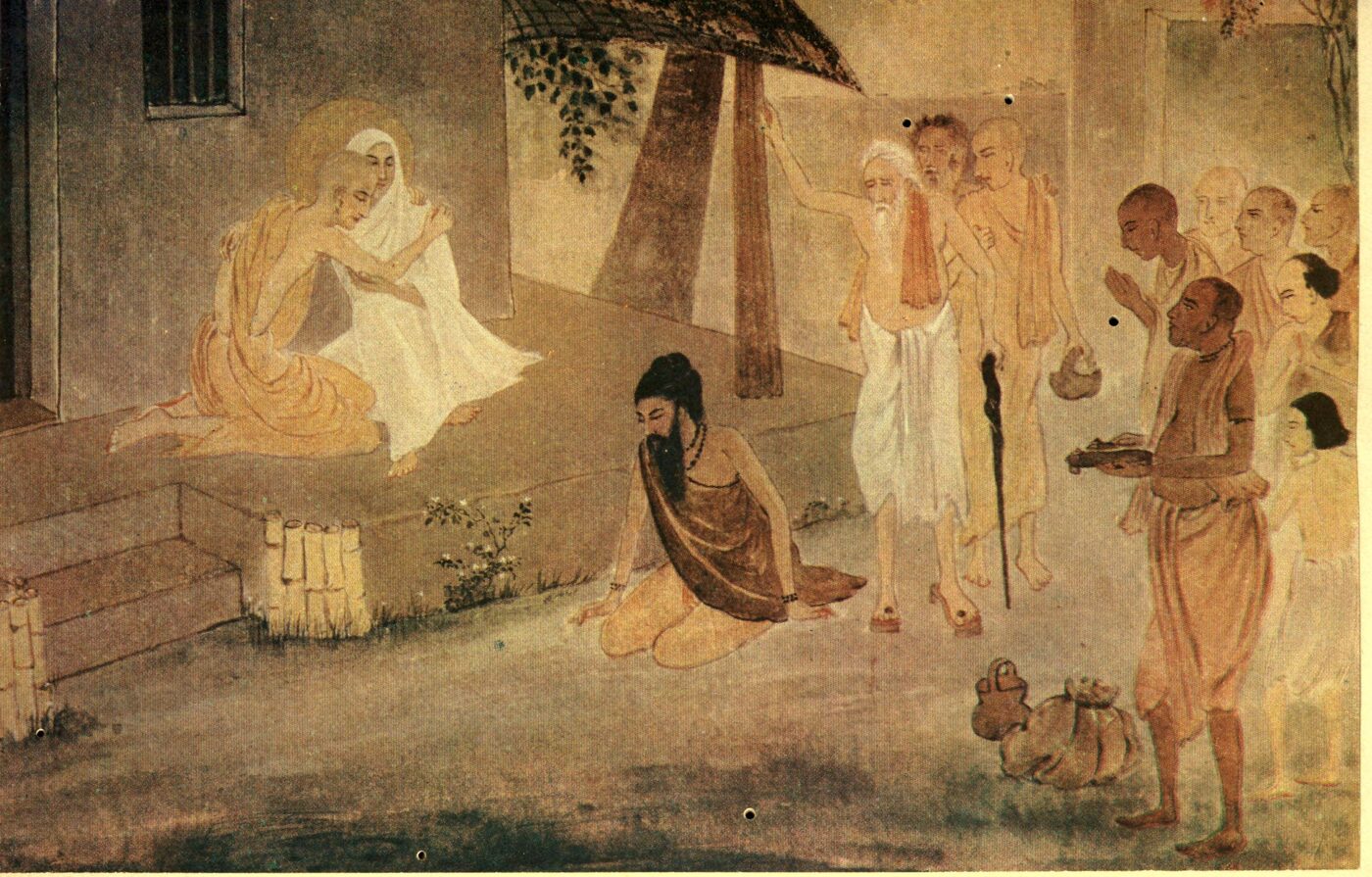
Bengal-school colour plate from Jadunath Sarkar's 'Chaitanya's Life and Teachings' (1922): a domestic scene outside a Nabadwip house - two women in white seated on the verandah (mother Sachi and Vishnupriya in the traditional reading), a devotee kneeling in the courtyard, an elderly ascetic with a staff and a group of brahmanas approaching, and a servant bringing offerings. Fits the Sachi-and-departure moment around the taking of sannyasa.Wikimedia Commons · public domain
Even before He could speak, the infant Vishvambhara showed a nature that no ordinary child has. Vaishnava biographers record that He would cry in His mother's arms and could not be comforted, sometimes for hours. Nothing would quiet Him except the sound of women in the neighbourhood calling out "Haribol! Haribol!" ("Chant the name of Hari!"). Sachi Devi soon learned to invite the neighbourhood women to gather and chant whenever her son wept. The crying would stop the moment the holy names were chanted. It was as if the child Himself, even from the cradle, was teaching Nabadwip what would become the medicine for the whole world's suffering.
As a toddler He was mischievous in ways that tried His family's patience, though looking back they saw them as miraculous. It is said that He was once found eating clay from the courtyard instead of the sweets His mother had left for Him. Sachi Devi scolded Him and asked why. He innocently replied that earth is used to make cooking pots, and cooking pots hold the food she gives Him, so He didn't see the difference. This mischievous reasoning already gave a hint of the brilliant mind that was to come.
On another occasion two travelling thieves saw the extraordinarily beautiful golden child playing alone. They wanted to steal the gold ornaments He wore, so they tried to lure Him away with the promise of sweets. The stories tell that they then became hopelessly lost, wandering in circles around Nabadwip. At last, terrified and sorry for what they had done, they had no choice but to bring the child safely back to His mother's door.
Before his son was born, Nimai's father Jagannatha Mishra had once dreamed that many sannyasis had come to worship the child in his house. Wandering holy men and Vaishnavas were indeed drawn to their home. One detail appears again and again in the biographies. Whenever a guest arrived and left food offerings unattended even for a moment, the infant would help Himself. His embarrassed parents were forced to keep the doors closed to visiting brahmanas. This went on until they discovered that Nimai only ever touched food that had truly been offered to Krishna in the heart of the devotee bringing it. He never touched the food of a hypocrite, or of a casual visitor whose devotion was insincere. For those who could understand, small incidents like these were clear signs that this was no ordinary brahmana boy.
At the age of five, Nimai was enrolled in the village pathasala and is said to have learned the entire Bengali alphabet within a single day of instruction, astonishing His teacher.
By eight He was sent to study under the famous pandit Gangadasa at his tola in the neighbouring village of Ganganagar. There, within about two years, He mastered Sanskrit vyakarana (grammar), the most difficult of the traditional sciences. He also learned the beginnings of rhetoric (alankara) and logic. The accounts agree that He was a restless and playful student. Still, He understood in a single hearing what other students needed weeks to memorise. His father passed away while Nimai was still a boy. After that, He continued His education largely by teaching Himself from His father's books, studying especially smriti (scriptural law) and nyaya (logic).
By His early teenage years Nimai had opened His own tola in Nabadwip. At that time Nabadwip was the leading centre of Sanskrit scholarship in all of Bengal, and He was already recognised there as one of its sharpest young logicians. This reputation prepared the way for His famous encounter with the visiting scholar Keshava Kashmiri Pandita, which is told in full on its own page. Besides His scholarship, Nimai was known among the townspeople for His wit, which could be gently cutting toward false pride and religious hypocrisy. He also had a playful sense of humour with His young friends and fellow students. Later, once He revealed Himself as Krishna Chaitanya, many of them remembered these moments as pastimes of clearly divine playfulness, not as ordinary childhood mischief.
These childhood pastimes are precious to Gaudiya Vaishnavas, and not only because they are charming. They show that the child born in Sachi Devi's house was never an ordinary brahmana boy who later "became" enlightened. This is clear even before the Lord ever lifts His arms in sankirtana. From His very first cry, which only the holy name could quiet, He was Krishna Himself. He was playing the part of a human child so that Nabadwip, and through Nabadwip the entire world, would have a human life to look to, learn from and love.
Scriptural sources for this pastime
চৌদ্দশত সাতশকে মাস যে ফাল্গুন ।
পৌর্ণমাসীর সন্ধ্যাকালে হৈলে শুভক্ষণ ॥ ৮৯ ॥
caudda-śata sāta-śake māsa ye phālguna
paurṇamāsīra sandhyā-kāle haile śubha-kṣaṇa
Word for word
caudda-śata sāta-śake: in 1407 of the Śaka Era (A.D. 1486); māsa: month; ye: which; phālguna: Phālguna; paurṇamāsīra: of the full-moon day; sandhyā-kāle: in the evening; haile: there was; śubha-kṣaṇa: an auspicious moment.
Thus in the year 1407 of the Śaka Era [A.D. 1486], in the month of Phālguna [February-March], in the evening of the full-moon day, the desired auspicious moment arrived.
jagat: the whole world; bhariyā: fulfilling; loka: people; bale: said; hari hari: the holy name of the Lord; sei-kṣaṇe: at that time; gaurakṛṣṇa: Lord Kṛṣṇa in the form of Gaurahari; bhūme: on the earth; avatari: advented.
When the whole world was thus chanting the holy name of the Supreme Personality of Godhead, Kṛṣṇa in the form of Gaurahari advented Himself on the earth.
nadīyā: the place known as Nadia; udayagiri: is the appearing place; pūrṇa-candra: the full moon; gaurahari: Lord Śrī Caitanya Mahāprabhu; kṛpā: by mercy; kari’: doing so; ha-ila: became; udaya: risen; pāpa: sinful; tamaḥ: darkness; haila: became; nāśa: dissipated; tri-jagatera: of the three worlds; ullāsa: happiness; jaga-bhari’: filling the whole world; hari-dhvani: the transcendental vibration of Hari; haya: resounded.
Thus by His causeless mercy the full moon, Gaurahari, rose in the district of Nadia, which is compared to Udayagiri, where the sun first becomes visible. His rising in the sky dissipated the darkness of sinful life, and thus the three worlds became joyful and chanted the holy name of the Lord.
vande caitanya-kṛṣṇasya
bālya-līlāṁ mano-harām
laukikīm api tām īśa-
ceṣṭayā valitāntarām
Word for word
vande: I worship; caitanya-kṛṣṇasya: of Lord Caitanya, who is Kṛṣṇa Himself; bālya-līlā: pastimes of childhood; manaḥ-harām: which are so beautiful; laukikīm: appearing ordinary; api: although; tām: those; īśa-ceṣṭayā: by manifestation of supreme authority; valita-antarām: quite fit although appearing differently.
Let me offer my respectful obeisances unto the childhood pastimes of Lord Śrī Caitanya Mahāprabhu, who is Lord Kṛṣṇa Himself. Although such pastimes appear exactly like those of an ordinary child, they should be understood as various pastimes of the Supreme Personality of Godhead.
One day while the Lord was enjoying His playful sports with the other little children, mother Śacī brought a dish filled with fused rice and sweetmeats and asked the child to sit down and eat them.
core: two thieves; lañā: taking; gela: went; prabhuke: the Lord; bāhire: outside; pāiyā: finding Him; tāra: their; skandhe: on the shoulders; caḍi’: rising; āilā: came back; tāre: them; bhulāiyā: misleading.
In His childhood the Lord was taken away by two thieves outside His home. The Lord, however, got up on the shoulders of the thieves, and while they were thinking they were safely carrying the child to rob His ornaments, the Lord misled them, and thus instead of going to their own home the thieves came back to the home of Jagannātha Miśra.
Our editorial team comprises trained devotees and researchers of the Hare Krishna Movement, Kota, who follow this same disciplic tradition in daily practice. Every biography is carefully researched, fact-checked against Vedic scriptures, and cites its sources.
Reviewed by
Temple & Scriptural Research Team
Each biography undergoes a detailed review by our senior devotees and scriptural researchers to verify factual accuracy and ensure alignment with Vaishnava philosophy and Srila Prabhupada's teachings.