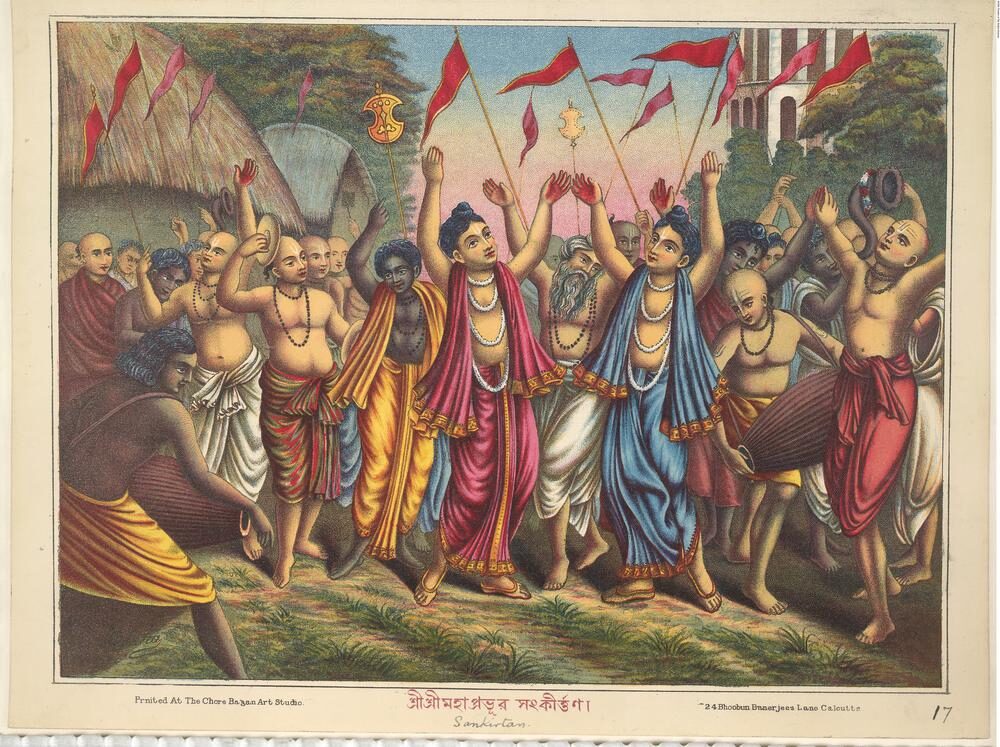
By about 1509, Nabadwip had changed beyond recognition. On Chaitanya Mahaprabhu's own instruction, what had begun as a closed nightly gathering in the courtyard of Srivasa Pandit had moved into the open. The Chaitanya-charitamrita says that congregational chanting was going on in every household of the town. It says that nothing else could be heard in Nabadwip but the words "Hari! Hari!", the beating of mridangas and the clash of hand cymbals. That part of the story is told, along with the beginnings of the movement, on its own page. This page tells of the episode that ended the town's short attempt to stop the chanting. It also tells of the conversation that ended that attempt, which Krishnadasa Kaviraja preserved in unusual detail.
| Detail | Description |
|---|---|
| Date | About 1509, at Nabadwip |
| The magistrate | Chand Kazi, a qadi of the Bengal Sultanate |
| The ban | The mridanga broken, and public sankirtana forbidden on pain of punishment |
| The relationship | Uncle and nephew, through Nilambara Chakravarti |
| Sources | Chaitanya-charitamrita gives three parties; the fourteen groups come from Chaitanya-bhagavata |
| Outcome | A standing instruction to his descendants never to stop the sankirtana movement |
The Complaints That Reached the Kazi #
Nabadwip was governed under the Bengal Sultanate. Its magistrate was a qadi, a judge applying Islamic law, remembered in the Vaishnava literature simply as Chand Kazi. The complaints that reached him came from two directions, and the second is the more surprising. Some of the town's Muslim residents, angered by the noise, complained to him. But the Kazi himself later revealed that a group of five or seven orthodox Hindus had also come to him. These men had known Nimai Pandita as a promising young scholar, and now they wanted Him removed from the town. Their objections are recorded almost word for word. They said that He had abandoned the religious principles of Sanatana Dharma and invented a form of worship that no scripture approved. They said that singing and dancing all night was proper for the worship of local goddesses such as Mangalachandi and Vishahari, but not for this. They said that since returning from Gaya He had begun singing, clapping, drumming, laughing, weeping, falling down and rolling on the ground, and had made the whole town as mad as Himself. They said that He had dropped His own name and taken to calling Himself Gaurahari, and that nobody in the neighbourhood could sleep. Their last objection goes to the heart of the matter. Lower-class people were now chanting the maha-mantra, they said, and a holy name heard by everyone would lose its potency. They asked the magistrate to make Him leave.
Breaking the Mridanga and the Ban #
The Kazi acted one evening. He came to a house where kirtana was going on and broke the mridanga with his own hands. The biographer preserves three statements he made. The first was a taunt: these people had never bothered to follow their own religion before, and he would like to know on whose support they were suddenly following it so eagerly. The second was an order: no one was to perform sankirtana in the streets of the town. The third was a threat: he was excusing the offence this once, but anyone found chanting in public again would have his property taken away and would be converted to Islam. Then he went home.
The Lord Calls for Torches #
The devotees brought the news to Chaitanya Mahaprabhu, and His first recorded response was not a gentle one: go and perform sankirtana, He said, and today I shall kill all the Muslims. What He actually did was something else. He saw that the townspeople were now chanting in fear, not in joy. So He called them together and gave instructions of a quite different kind. That evening the whole city was to be decorated. A torch was to be lit in every house. He would take responsibility for everyone's protection. And then, He said, let us see what sort of Kazi comes to stop our kirtana.
How Large the Procession Was #
The sources differ about the size of what followed. Krishnadasa Kaviraja gives only a short account. He says the Lord formed three parties: Haridasa Thakura dancing at the head of the procession, Advaita Acharya dancing in the middle, and the Lord Himself dancing at the rear with Nityananda Prabhu moving beside Him. He then stops to say that Vrindavana Dasa Thakura has already described the whole incident in detail in the Chaitanya-bhagavata, and that he will not repeat it. That is why the much larger figures known from popular retellings, commonly given as fourteen kirtana groups, come from the earlier biography, not from the Chaitanya-charitamrita. Both books agree on what kind of event it was. It was a night procession, lit by thousands of torches, moving slowly and with purpose through every quarter of the town and coming together at the magistrate's house.
The Crowd at the Kazi's House #
The Chaitanya-charitamrita does not make the crowd look better than it was. It records that the sound terrified the Kazi, who shut himself in his room and would not come out. It also records that the people, protected by the Lord and roaring in anger, became reckless, and that some of them wrecked his house and damaged his flower garden. The Lord had not ordered this, and the narrative gives no sign that He approved it. When He reached the house He did not go in. He sat down by the doorway and sent respectable men to ask the Kazi to come out.
The Kazi Comes Out #
The Kazi came, with his head down. What happened next, not the procession, is the reason this episode is remembered. The Lord stood, offered him respect, and gave him a seat. Then, in a friendly tone, He began with a complaint about manners: I have come to your house as your guest, and on seeing Me you hid in your room; what sort of etiquette is that? The Kazi answered honestly. He said that his guest had arrived very angry, and that hiding had seemed the surest way of allowing Him to calm down. Now that He had calmed down, the visit was an honour.
Uncle and Nephew Through Nilambara Chakravarti #
Then the Kazi brought up the fact on which the whole conversation turned. The scholar Nilambara Chakravarti, he said, was his uncle by village relationship, and he described this bond as stronger than a bodily one. Nilambara Chakravarti was Chaitanya Mahaprabhu's maternal grandfather. That made the Kazi His maternal uncle and the Lord his nephew. The Kazi drew the conclusion himself: when a nephew is angry the uncle tolerates it, and when the uncle gives offence the nephew does not take it seriously. From that point the two addressed each other as uncle and nephew for the rest of the exchange. Krishnadasa Kaviraja adds an interesting note. He says that a good deal of what they said to each other was spoken in hints, and that nobody outside could follow the inner meaning of the conversation.
The Question About Cow Killing #
The Lord's questions did not begin with kirtana. They began with cows. You drink cows' milk, He said, so the cow is your mother; the bull produces the grain that maintains you, so he is your father; how then can you kill and eat your own father and mother, and what religion is that? The Kazi answered as the trained judge of law that he was. You have your Vedas and Puranas, he said; we have the Koran. It distinguishes two paths, one of increasing worldly engagement and one of decreasing it. On the path of renunciation the killing of animals is prohibited. On the path of regulated activity it is permitted under scriptural sanction, and therefore it is not sinful. Then he argued back: your own Vedic scriptures sanction the killing of a cow in sacrifice, and the great sages performed such sacrifices.
Sacrifice and the Power to Restore Life #
The Lord agreed with the Kazi's starting point, but not with the way he applied it. The Vedas do prohibit cow-killing, and the exception for sacrifice depended on one condition. One may take a life for such a purpose only if one can restore it. The sages who performed those sacrifices took old and worn-out cows and revived them by the power of Vedic mantra. So what looked like killing was a benefit to the animal. Brahmanas of the present age have no such power, He said, which is why the sacrifice of a cow is among the acts specifically forbidden in the age of Kali. Since you cannot bring the animal back, the killing is simply killing, and the responsibility is yours.
The Kazi Concedes the Argument #
The Kazi, the biographer says, was stunned into silence. He thought the matter over and accepted defeat. He then admitted a great deal more than the argument required. What You have said is true, he answered; our scriptures are of recent composition and are not logical or philosophical; I know they contain a good deal of imagination and mistaken idea, and I accept them because I am a Muslim and for the sake of my community, though their support is thin. However one understands the theological content of this exchange, the record shows it as a debate that the Lord conducted entirely from His opponent's own beliefs. His opponent accepted defeat, and he was not humiliated in front of the crowd.
Why the Kazi Stopped Enforcing His Order #
Chaitanya Mahaprabhu then smiled and asked the question He had come to ask. Chanting goes on in your city day and night; as a Muslim magistrate you have the authority to stop Sanatana Dharma ceremonies, and you have stopped enforcing your own order. Why? The Kazi asked to be taken somewhere private. The Lord refused: these are all My confidential associates, speak in front of them. Then the Kazi, addressing Him by the name the town used, Gaurahari, told the whole story.
The Dream of the Man-Lion Form #
On the night he had broken the drum, he had dreamed of a roaring form with the body of a man and the face of a lion. It sprang onto his chest and set its claws on him. It said that it would tear him open exactly as he had broken the mridanga. It had spared him because the disturbance he had caused was not yet great, but it promised to return if he interfered again. He had woken terrified. Here, he said, and opened his shirt in front of the assembly to show the marks of the claws. The people who saw them, the biographer records, accepted the incident as wonderful.
The Orderlies With Scorched Faces #
Then his orderlies (attendants) had come to him one by one, each with the same report. When they went to stop the chanting, their faces had been scorched, their beards burned and their cheeks blistered. He had told them to go home and leave the chanting alone.
The Tongue That Would Not Stop Chanting #
And then the Muslims of the town had come back to complain again. One of them explained the reason for his own visit. He had started mocking the Hindus, who name their sons Krishnadasa and Ramadasa and Haridasa and go about calling "Hari, Hari," and since that day his own tongue had chanted the name without stopping. He could not make it stop. Another man said the same. The Kazi's conclusion was simple, and remarkable coming from a Muslim judge: I know that Narayana is the supreme God of the Hindus, and I think within my mind that You are that same Narayana.
The Pledge to His Descendants #
The Lord touched him. He told him that the three names he had just spoken, Hari, Krishna and Narayana, had wiped out the reactions of all his sinful activity, and that he was now supremely pure. The Kazi wept, took hold of the Lord's feet, and asked for one thing only: that his devotion should remain fixed. In return the Lord asked one favour of him. He wanted a pledge that the sankirtana movement would not be stopped, at least in the district of Nadia. The Kazi did not give this as a simple permission. He gave it as a binding instruction to his own line: to as many descendants as are born in my family in future, I give this grave admonition: no one is to stop the sankirtana movement. The Lord rose chanting, the whole assembly rose with Him, and the Kazi walked back with the kirtana party before being sent home.
The Kazi's Tomb at Nabadwip #
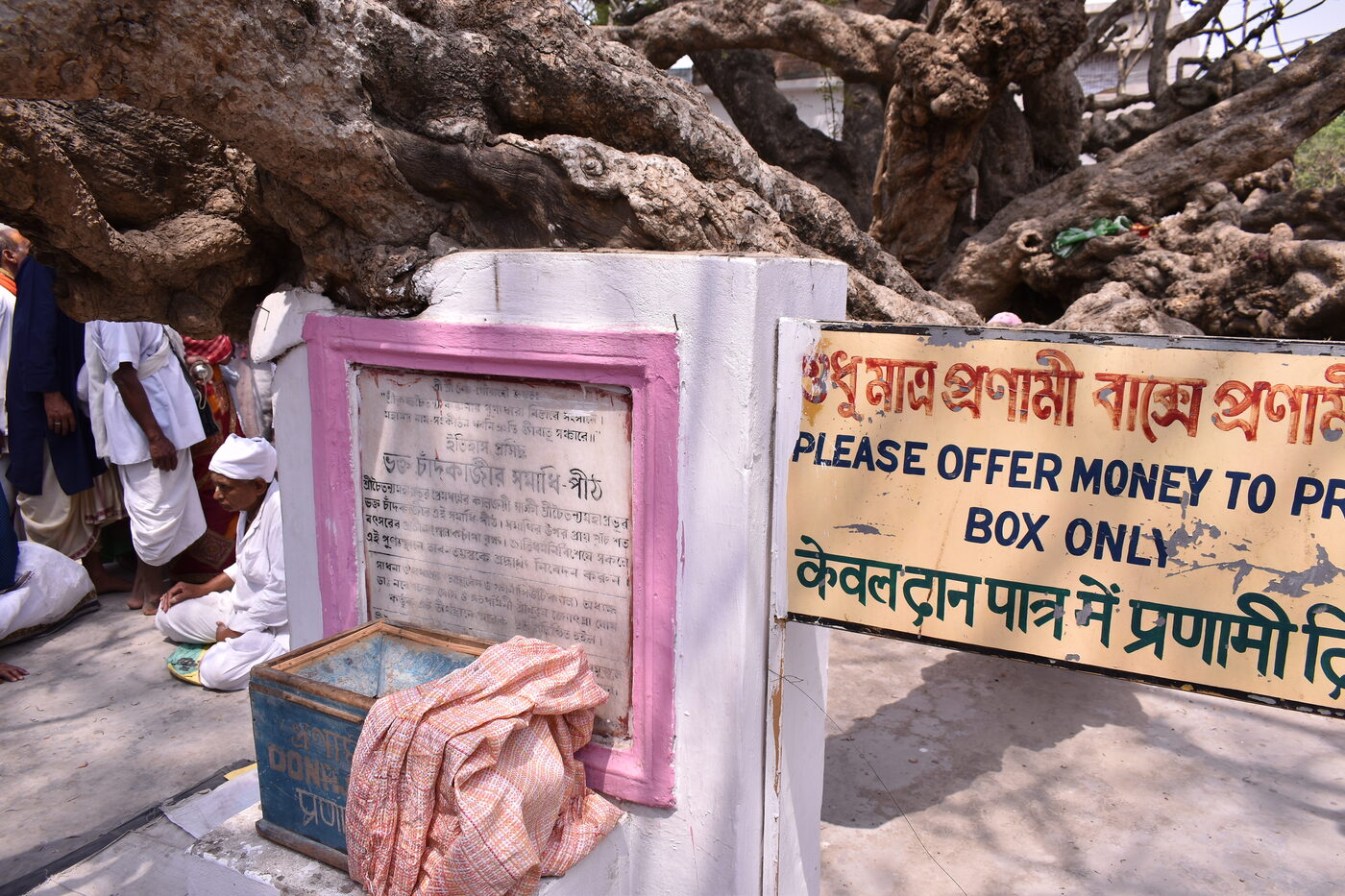
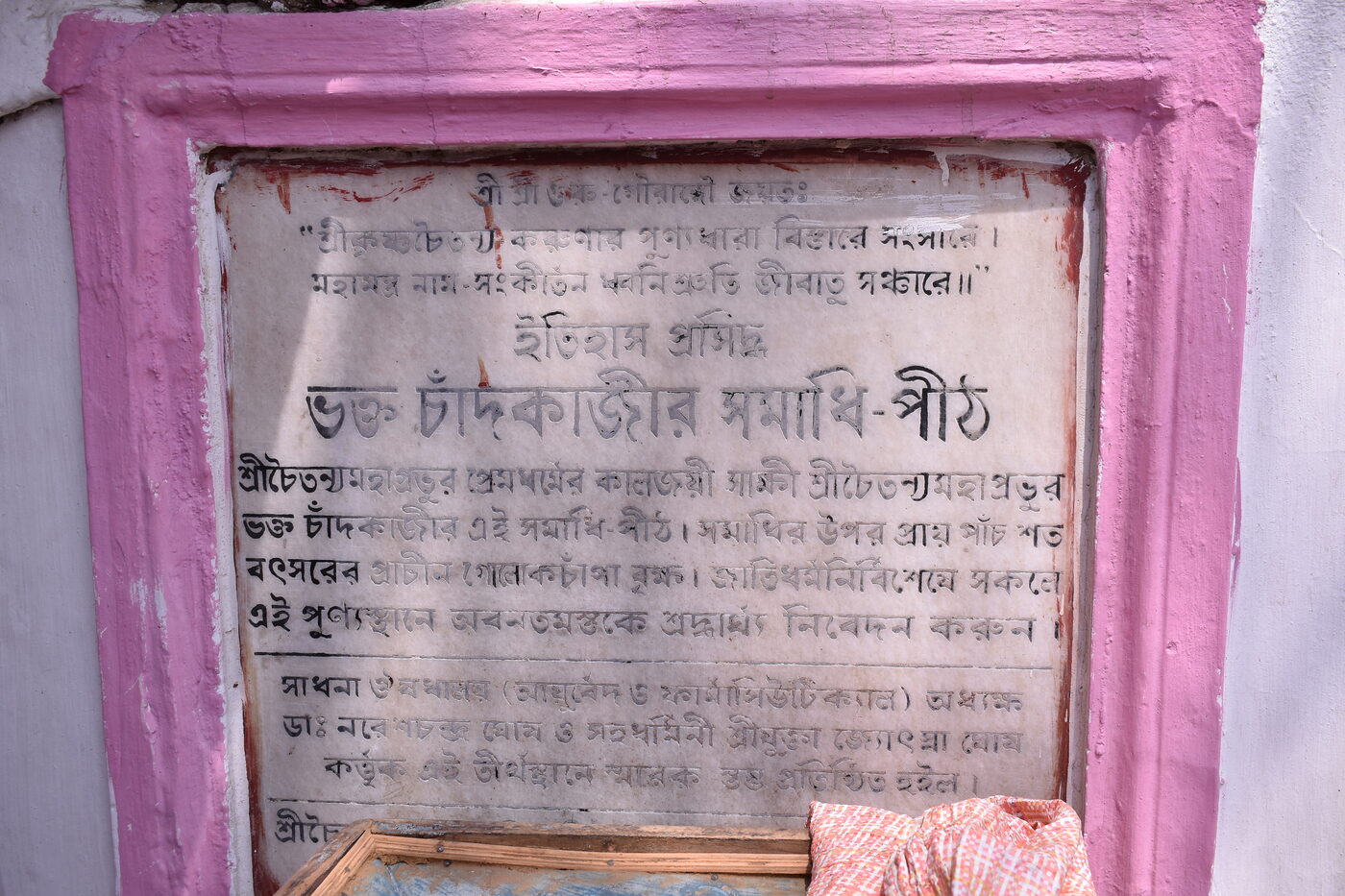
The memory of the episode has lasted five centuries. The Kazi's tomb still stands at Nabadwip beneath an old champaka tree. Vaishnavas visit it, and local tradition holds that his descendants honoured the pledge for generations. Historians of Bengal read the incident as one of the better-documented examples of peaceful agreement, not confrontation, between the new devotional movement and the Sultanate's local government. Gaudiya Vaishnavas read it differently and more simply. Faced with a legal ban, Chaitanya Mahaprabhu neither obeyed it nor met it with violence. He broke it in public, on a large scale, with light and sound and so many people that it could not be quietly punished. Then He sat down in the dust outside the magistrate's door and talked to him, until the man who had imposed the ban withdrew it himself. The argument He used was not about the rights of Hindus. It was about cows, and then about the magistrate's own dream. What He finally asked for was not for Himself. It was for a practice to continue forever, in a district He was about to leave for good.
