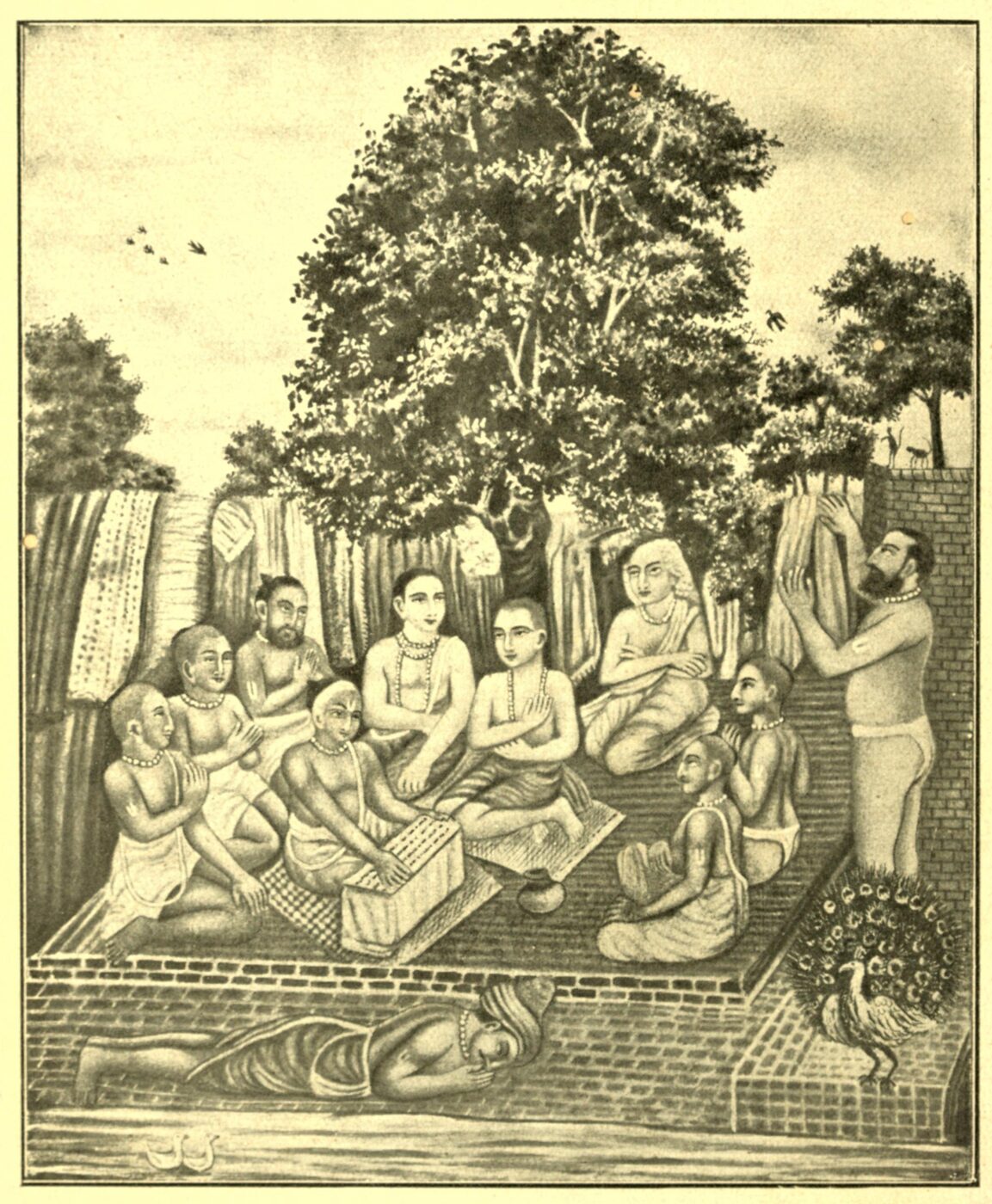
By the time Nimai was five He had been enrolled in the village school, and by eight He was studying at the tola of Gangadasa Pandita in the neighbouring village of Ganganagar. Vyakarana, Sanskrit grammar, was the foundation of the whole traditional course of study, and the hardest of its subjects. A student who could handle Panini's system and the commentaries built on it was considered fit for any other study that might follow. The biographies record that Nimai not only mastered grammar with unusual speed but also began writing His own commentaries on it. They also say that He would sometimes silence older students. He did this by showing that a rule they had taken as settled could be read in another way that could still be defended.
Detail
Description
Village school
Enrolled at the age of five
Teacher
Gangadasa Pandita, at his tola in Ganganagar, from the age of eight
Two griefs shaped this period of His life. The first was the departure of His elder brother. Vishvarupa, some years older, had grown into a young man of strong detachment. His parents were arranging his marriage, but instead of accepting it he left home and accepted sannyasa, taking the name Shankararanya. For Sachi Devi and Jagannatha Mishra it was a hard blow. The Chaitanya-charitamrita relates that Nimai afterwards comforted His mother with a promise that He would not do the same. Vaishnava readers have always found this promise sad and touching, because they know what He would do at twenty-four. The chapter also preserves an episode in which Vishvarupa appeared to Nimai in a dream and invited Him to take sannyasa and join him. Nimai declined, and Vishvarupa sent Him back home.
The second grief was the death of Jagannatha Mishra, while Nimai was still a boy. The family, never wealthy, was left in real difficulty. Nimai continued His education largely on His own. He worked through His father's books in smriti, the literature of religious and social law, and in nyaya, the very difficult school of Indian logic. At that time Nabadwip was the most famous centre of nyaya in India. He gained a good working knowledge of nyaya almost entirely without a teacher, and this is one of the details the biographers stress. Students of nyaya commonly spent a decade under a master.
By His mid-teens Nimai had opened His own tola and was teaching grammar to His own students on the bank of the Ganges. Accounts of Him as a teacher are vivid, and they agree with each other. They describe Him as brilliant, playful, quick and merciless in debate, and quite ready to enjoy His own superiority. He is described walking the streets of Nabadwip with a crowd of students behind Him. He would stop any scholar He met, challenge him on some fine point, and then break down whatever position the man defended. Sometimes, after doing so, He argued the opposite side with equal force, just to show that He could. Nabadwip's pandits found Him a fearsome opponent and rather hard to bear. By the time He was sixteen, the town had decided that He was the sharpest logician of His generation, and that no one in Nadia could stand against Him in argument.
His reputation was confirmed once and for all in His encounter with the travelling scholar Keshava Kashmiri Pandita. Keshava Kashmiri had toured the gatherings of learned men across India, and he came to Nabadwip undefeated. He left it having accepted defeat from a teenager on the bank of the Ganges. The full account is given separately.
The Chaitanya-charitamrita also records incidents from these years that already show, behind the scholar, where His life would lead. He forbade His mother to eat grains on Ekadashi, the fortnightly fast day observed by Vaishnavas. It was a small instruction at home, but a clearly Vaishnava one, coming from a boy whose fame rested entirely on worldly learning. On one Ekadashi He pretended to be ill and asked for the food being offered to Lord Vishnu at the house of the wealthy brothers Hiranya and Jagadisha, and they sent it to Him. He played in the Ganges with the other young men of the town and joked with the girls at the bathing ghats. Gaudiya commentators treat this last incident as more than youthful high spirits. This is because they read the whole of His household life as a time when the Lord conducted Himself in a fully human way, while always remaining, in His own nature, exactly what He was.
This stage of His life raises a difficult question, and the tradition does not try to smooth it over. The young Nimai Pandita was proud, and knew He was, and enjoyed it. Vaishnava writers do not read this pride as a fault that was later corrected. They read it as part of the design. The Lord established Himself as the finest scholar in the most learned town in Bengal. So when He later gave up scholarship for the chanting of the holy name, no one could say He had taken up devotion because He was not capable of anything more demanding. The man who taught Nabadwip to chant was the same man who had first beaten Nabadwip at its own game.
paugaṇḍa: of the age from five years to ten years; līlāra: of the pastimes; sūtra: synopsis; kariye: I do; gaṇana: enumerate; paugaṇḍa-vayase: in that age between five and ten years; prabhura: of the Lord; mukhya: chief; adhyayana: studying.
Let me now enumerate the activities of the Lord between the ages of five and ten. His chief occupation during this period was to engage Himself in study.
gaṅgādāsa: Gaṅgādāsa; paṇḍita-sthāne: at the place of the teacher; paḍena: studies; vyākaraṇa: grammar; śravaṇa-mātre: simply by hearing; kaṇṭhe: between the neck and the heart; kaila: did; sūtra-vṛtti-gaṇa: the aphorisms and their definitions.
When the Lord was studying grammar at the place of Gaṅgādāsa Paṇḍita, He would immediately learn grammatical rules and definitions by heart simply by hearing them once.
alpa-kāle: within a very short time; hailā: became; pañjī-ṭīkāte: in the commentary on grammar named Pañjī-ṭīkā; pravīṇa: very expert; cira-kālera: all older; paḍuyā: students; jine: conquers; ha-iyā: being; navīna: their junior.
He soon became so expert in commenting on the Pañjī-ṭīkā that He could win victory over all the other students, although He was a neophyte.
mātā bale: His mother said; tāi diba: I shall give that; yā: whatever; tumi: You; māgibe: should ask me; prabhu kahe: the Lord said; ekādaśīte: on the Ekādaśī day; anna: grains; nā: don’t; khāibe: eat.
His mother replied, “My dear son, I will give You whatever You ask.” Then the Lord said, “My dear mother, please do not eat grains on the Ekādaśī day.”
bhāla haila: it is very good; viśvarūpa: Viśvarūpa; sannyāsa: the renounced order of life; karila: has accepted; pitṛ-kula: father’s family; mātṛ-kula: mother’s family; dui: both of them; uddhārila: delivered.
“My dear mother and father,” the Lord said, “it is very good that Viśvarūpa has accepted the sannyāsa order, for thus He has delivered both His father’s family and His mother’s family.”
kata dina rahi’ miśra gelā para-loka
mātā-putra duṅhāra bāḍila hṛdi śoka
Word for word
kata dina: some days; rahi’: remaining; miśra: Jagannātha Miśra; gelā: passed away; para-loka: for the transcendental world; mātā: mother; putra: son; duṅhāra: of both of them; bāḍila: increased; hṛdi: in the hearts; śoka: lamentation.
After some days, Jagannātha Miśra passed away from this world to the transcendental world, and both mother and son were very much aggrieved in their hearts.
The passing of Jagannatha Mishra, which left the household in difficulty
এই ত’ কৈশোর–লীলার সূত্র–অনুবন্ধ ।
শিষ্যগণ পড়াইতে করিলা আরম্ভ ॥ ৪ ॥
ei ta’ kaiśora-līlāra sūtra-anubandha
śiṣya-gaṇa paḍāite karilā ārambha
Word for word
ei ta’: thus; kaiśora: the age of kaiśora (the age between the eleventh and fifteenth years); līlāra: of the pastimes; sūtra-anubandha: chronological synopsis; śiṣya-gaṇa: students; paḍāite: to teach; karilā: did; ārambha: begin.
At the age of eleven Śrī Caitanya Mahāprabhu began to teach students. This marks the beginning of His kaiśora age.
Our editorial team comprises trained devotees and researchers of the Hare Krishna Movement, Kota, who follow this same disciplic tradition in daily practice. Every biography is carefully researched, fact-checked against Vedic scriptures, and cites its sources.
Reviewed by
Temple & Scriptural Research Team
Each biography undergoes a detailed review by our senior devotees and scriptural researchers to verify factual accuracy and ensure alignment with Vaishnava philosophy and Srila Prabhupada's teachings.