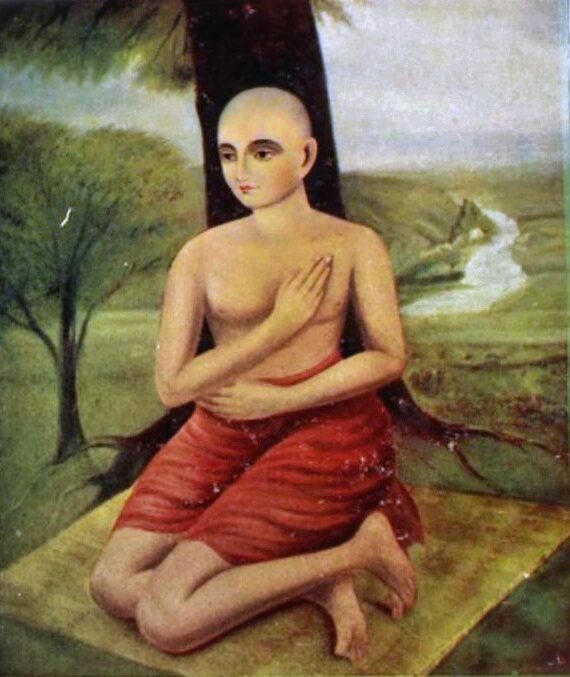
According to tradition, a son owes his departed father the shraddha ceremony. The place in all India where it brings the greatest religious merit is Gaya. There the offering is made at the temple of Vishnupada, the imprint of Vishnu's foot. Some years after Jagannatha Mishra's death, Nimai set out from Nabadwip for Gaya to fulfil that duty, taking with Him a party of His own students. When He went, He was a young married pandit, the most celebrated logician in Nadia, travelling to carry out a family obligation. He returned as someone His own town could hardly recognise.
| Detail | Description |
|---|---|
| Destination | Gaya, and the temple of Vishnupada |
| Purpose | The shraddha ceremony for His father, Jagannatha Mishra |
| Spiritual master | Ishvara Puri, a disciple of Madhavendra Puri |
| Initiation received | The ten-syllable Krishna mantra |
| Result | He returned to Nabadwip absorbed in the holy names and closed His school |
Meeting Ishvara Puri at Vishnupada #
At Gaya He performed the ceremony for His father. And at the Vishnupada temple He met a wandering Vaishnava sannyasi named Ishvara Puri. Ishvara Puri was a disciple of Madhavendra Puri, and so he belonged to a line in which the mood of intense, personal, deeply felt devotion to Krishna had been carefully preserved. Gaudiya Vaishnavas see Madhavendra Puri as the one in whom that mood first fully blossomed, and Ishvara Puri had received it from him directly. From Ishvara Puri, Nimai received initiation and the ten-syllable Krishna mantra.
The Transformation on the Road Home #
All the biographies agree that the change was immediate and complete. The young man who had walked to Gaya arguing points of grammar with His students walked back from it weeping, trembling and losing consciousness. He was unable to hold a conversation without breaking into the names of Krishna. On the road home He is described as hardly able to travel, overcome again and again. His students were confused and more and more alarmed by what had happened to their teacher. His brilliant love of argument was simply gone. In its place He was now so completely absorbed that the ordinary business of life could no longer get His attention.
Nabadwip's Reaction and the Closed School #
Understandably, Nabadwip's reaction was confusion. The town's leading pandits had spent years being defeated by this man in argument. Now they found Him unwilling to argue at all. It is said that when His students assembled for their grammar lessons, He told them that every rule of grammar reminded Him of Krishna. He is said to have wept instead of teaching, until at last He closed His school altogether. Those who had resented His pride decided that He had gone mad, or that grief had disturbed His mind. Only a small number of people understood what they were looking at. One was Advaita Acharya at Shantipura, who had been praying for exactly this. Another was Srivasa Pandit, in whose courtyard the movement would soon begin. There were also a handful of others who were already inclined to devotion.
Why the Lord Accepted a Guru #
Gaudiya theology explains this episode carefully, because at first sight it seems to raise a difficulty. If Chaitanya Mahaprabhu is Krishna Himself, He cannot have needed initiation from anyone. He also cannot have gained at Gaya a devotion that He did not have before. The tradition's answer is that the Lord accepted a spiritual master in order to establish the principle for everyone else. The principle is that no one, however exalted, approaches Krishna without taking shelter of a guru in an authentic disciplic line. The Lord obeyed this rule Himself, so that no one after Him could claim to be free from it. In the same way, the tradition understands that the ecstasy which appeared on the road home was not newly created. It was only newly shown. It was the inner life He had come to demonstrate, which He now allowed to be seen.
The Turning Point of His Life #
However one explains it, the practical result is not in dispute. Everything that Sri Chaitanya Mahaprabhu is remembered for begins after this journey. Before Gaya He is a scholar of exceptional gifts, known only in His own region. History would have kept His name, if at all, only as a small note in the story of Navya-nyaya logic. After Gaya He is the founder of a movement. Within a very short time of His return, the nightly gatherings at Srivasa Pandit's house had begun. From them the sankirtana movement went out into the streets of Nabadwip, and in the centuries that followed it went much further.
From Ritual Observance to Love of God #
The change was not from irreligion to religion. Nimai Pandita had been a perfectly orthodox brahmana. He performed the prescribed duties, observed Ekadashi, and travelled to Gaya to make an offering for His father. At Gaya His religious observance did not change. What changed was the thing His attention was fixed on. The tradition points to this as the very difference it wants us to understand. Religion correctly performed is not the goal. It is the ground from which love of God may or may not grow. At Gaya, in the case of this particular pilgrim, it grew.
