Most of what the old books tell us about Srila Raghava Pandita Goswami comes from the Bhakti-ratnakara, which shows him at Govardhana and on his tour of Vraja with Shrinivasa Acharya and Narottama Dasa Thakura. Two more things are remembered about him, and both are found in a single verse of a book that Kavi Karnapura completed in 1576. That verse says that Raghava is Campakalata, a dear friend of Srimati Radharani in the pastimes of Sri Krishna, and that he wrote a book called the Bhakti-ratna-prakasha.
The book was not lost. It survives in Sanskrit as the Krishna-bhakti-ratna-prakasha, "the light of the jewel of devotion to Krishna". In its pages we can still hear Raghava's own voice: the voice of a learned devotee who begs his readers, again and again, to give up every other shelter and worship the lotus feet of Krishna alone.
Campakalata, a Dear Friend of Srimati Radharani #
In Vraja, Srimati Radharani is surrounded by her sakhis, her friends among the gopis, the cowherd girls who love Krishna. Eight of them are the closest of all, and they are called the ashta-sakhis, "the eight friends". Srila Prabhupada once wrote out a list of the principal gopis for a disciple and explained that "the first eight are called Astasakhi". The fourth name on his list is "Campaklata", that is, Campakalata (letter to Tamala Krishna, 27 May 1970).
What is the service of these eight friends? In the Chaitanya-charitamrita, Krishnadasa Kaviraja Goswami says that the gopis "help increase the joy of Kṛṣṇa’s pastimes with Rādhārāṇī". Srila Prabhupada explains in his purport: "The parama-preṣṭha-sakhīs are eight in number". These are the dearest friends of all, and in the loving dealings of the Divine Couple "they side sometimes with Kṛṣṇa and at other times with Rādhārāṇī", so that the exchange of love becomes even sweeter (Sri Chaitanya-charitamrita Adi 4.217, purport). Campakalata is one of these eight.
What the Gaura-ganoddesha-dipika Says #
Kavi Karnapura completed his Gaura-ganoddesha-dipika in 1576. In it he names many followers of Sri Chaitanya Mahaprabhu and tells who each of them is in Krishna's eternal pastimes. In one verse he speaks of Raghava of Govardhana:
śrī-rādhā-prāṇa-rūpā yā śrī-campakalatā vraje
sādya rāghava-gosvāmī govardhana-kṛta-sthitiḥ
bhaktiratna-prakāśākhya-grantho yena vinirmitaḥ
"Srimati Campakalata-gopi, who considered Srimati Radharani as dear as her own life-breath, appeared as Raghava Gosvami, who lived at Govardhana Hill and wrote the book entitled Bhakti-ratna-prakasa." (Gaura-ganoddesha-dipika 162, translation as published at bvmlu.org)
The verse tells us three things: in Krishna's pastimes Raghava is Campakalata, who holds Srimati Radharani as dear as her own life; in this world he lives at Govardhana; and he is the author of the Bhakti-ratna-prakasha. It also gives the one firm date in Raghava's story. As the verse stands, by 1576 he was already living at Govardhana, and his book had already been written.
Narahari Chakravarti Thakura quotes the same verse in the Bhakti-ratnakara, right after his own portrait of Raghava (Fifth Wave, p. 150). There the last word of the verse reads prakashitah, "made known", instead of vinirmitah, "composed". Only four verses later, the Gaura-ganoddesha-dipika names a different devotee, Raghava Pandit of Panihati, as the gopi Dhanishtha (Sri Chaitanya-charitamrita Adi 10.24, purport). So Kavi Karnapura himself kept the two Raghavas apart.
How to Understand Such an Identity #
The eight sakhis are not ordinary devotees. Srila Prabhupada once corrected a disciple on this very point: "the actual fact is that the eight Gopis are as good as Krishna and Radharani. Therefore, no Vaisnava will claim to be one of the eight Gopis" (letter to Gargamuni, 5 February 1969). In the same letter he gives the example of Sri Chaitanya Mahaprabhu, who "claimed Himself as servant of the servant of the servant of Krishna".
This tells us how to read Kavi Karnapura's verse. When the verse calls Raghava Campakalata, that is Kavi Karnapura's statement about him. It is not a claim that Raghava made for himself. In his own book Raghava never mentions Campakalata at all. Where he names himself in his verses, he is simply a poet called Raghava, asking his readers to hear and to worship Krishna. The words about Campakalata come from another great Vaishnava who saw Raghava's greatness, and for us they are a reason to honour him all the more.
Kavi Karnapura's verse is also the oldest statement about Raghava's identity. A much later list says something else. It names sixty-four mahantas, or great devotees, and it comes from a late compilation, the Brihad-bhakti-tattva-sara, as printed in the Gaudiya Vaishnava Abhidhana, a twentieth-century Gaudiya reference work. Among the followers of Svarupa Damodara Goswami it names a "Raghava Gosvami" as the sakhi Sumukhi (vol. 3, p. 1232). That list is late, it does not agree with Kavi Karnapura, and it may not even mean the same Raghava. The Abhidhana's own entry on Raghava of Govardhana follows the Gaura-ganoddesha-dipika and calls him Campakalata (vol. 3, p. 1332).
His Book, the Krishna-bhakti-ratna-prakasha #
Raghava's book is known by three names. Kavi Karnapura, the Bhakti-ratnakara and the Sadhana-dipika call it the Bhakti-ratna-prakasha; the 1955 printed edition and the Abhidhana call it the Krishna-bhakti-ratna-prakasha; and one English translation calls it the Hari-bhakti-ratna-prakasha. The Bhakti-ratnakara says that he wrote "books such as the Bhakti-ratna-prakasha", but no other title of his has come down to us. This one is written in Sanskrit and divided into six chapters. Each chapter is called a prakasha, a "shining", and at the end of each one Raghava offers the chapter to his reader as a jewel.
The book opens with eight verses from an older work, the Krama-dipika. In the second of them Raghava bows down to the lotus feet of his guru, without telling us the guru's name (Krishna-bhakti-ratna-prakasha 1.2; see A Brahmana of the South at Govardhana). Then he explains why he wrote. The scriptures already exist, he says, but those who truly understand them are few. Some people are dry logicians, some have doubting minds, some follow the path of karma (work done for its results), some worship many gods, and some teach that all the gods are equal; and so they do not know Krishna, the Supreme Lord and the soul of all. For this reason he gathers the verses of many scriptures into one book, which he calls a sangraha, a "collection". Again and again a doubter raises a question, and the devotees of Krishna answer with verses from the shastras.
The six chapters and their subjects are these:
- Sri Krishna-bhajanoddesha: why Krishna alone should be worshipped
- Nanopasana-varjana: giving up the worship of many gods
- Krishna-purnatamatva: Krishna is the most complete form of God
- Vrindavana-nitya-prakasha: Krishna is always present in Vrindavana
- Sri Nandakishora-svarupa: Krishna's own form as the young son of Nanda
- Bhakti-viracana: devotion itself, the service of Krishna's lotus feet
He quotes the Srimad-Bhagavatam far more often than any other book, and with it the Bhagavad-gita, the Brahma-samhita and several Puranas. He also makes wide use of some lesser-known Pancaratra works, old Vaishnava texts on worship: the Govinda-vrindavana (a part of the Brihad-gautamiya-tantra), the Sammohana-tantra, the Krishna-yamala, the Narada-pancaratra and the Varaha-samhita (Gaudiya Grantha Mandira; Abhidhana, vol. 3, p. 1514).
He also draws on the writings of Rupa Goswami. In the fifth chapter (5.2-3), without naming the book, he gives two verses from Rupa Goswami's Bhakti-rasamrita-sindhu (2.1.221-222), which teach that the Lord is called complete, more complete or most complete, according to how fully He shows His qualities. Krishnadasa Kaviraja Goswami quotes the same two verses in the Chaitanya-charitamrita, and Srila Prabhupada translates the second of them: "When He manifests all His qualities in fullness, He is called most complete" (Sri Chaitanya-charitamrita Madhya 20.400). From these verses Raghava draws his own conclusion: in Vrindavana Krishna is most complete, and in other places He shows less of Himself. So the book shows that Raghava knew Rupa Goswami's work and built on it.
Six Jewels for the Reader #
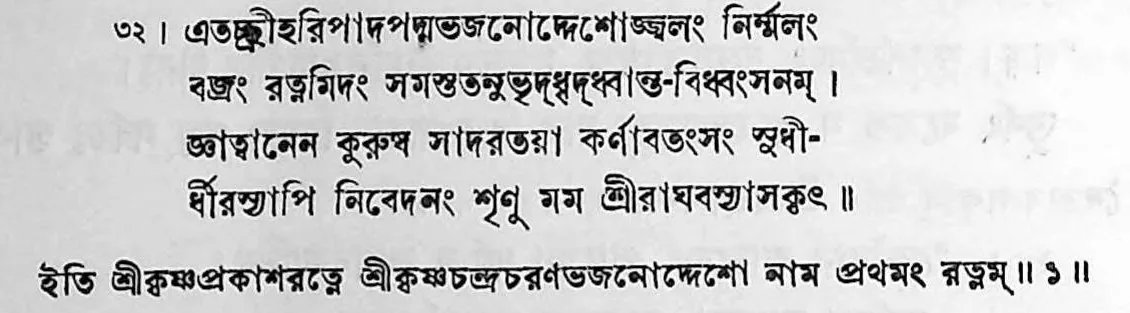
Every chapter ends with a verse in which Raghava names himself and offers the chapter as a jewel to wear. The first chapter is a diamond for the ear, the second a pearl for the neck, the third a sapphire for the forehead, the fourth a ruby to wear on the heart, and the fifth an emerald for a crown. At the very end the whole book is called a cintamani, a wish-fulfilling gem, for the worship of Krishna. The Abhidhana says that the six jewels point to steps that rise higher and higher (vol. 3, p. 1468). This is the first of these verses:
etat śrī-hari-pāda-padma-bhajanoddeśojjvalaṁ nirmalaṁ
vajraṁ ratnam idaṁ samasta-tanu-bhṛd-dhṛd-dhvānta-vidhvaṁsanam
jñātvānena kuruṣva sādaratayā karṇāvataṁsaṁ sudhīr
dhīrasyāpi nivedanaṁ śṛṇu mama śrī-rāghavasyāsakṛt
"This book, describing devotional service to Lord Hari's lotus feet, is a splendid, pure diamond that illuminates the darkness in the hearts of all living entities. O intelligent reader, please accept this diamond as your earring. O thoughtful reader, please continually hear the instructions that I, Raghava Gosvami, present in this book." (Krishna-bhakti-ratna-prakasha 1.32, 1955 Sanskrit edition, p. 4; English from Kushakratha Dasa's translation, The Splendor of the Jewel of Hari Bhakti, 2009)
At the end of the second chapter he calls himself Sri Kaviraja Raghava, kaviraja being a title for a learned poet (2.72). In two verses near the end of the book (6.73-74) he speaks of himself once more, as a poet absorbed in the love of Radha and Krishna, and he also names the place where he wrote the book. He does not name Govardhana there, and no source identifies the place, so we do not know where the book was written.
How the Book Lived On #
Later Gaudiya Vaishnavas valued Raghava's book. The Sadhana-dipika of Radha-krishna Goswami, another Sanskrit work, counts "Sri Bhakti-ratna-prakasha and other works" of "Sri Raghava-pandita Gosvami-pada" among the books through which devotees can still relish the pastimes of the Lord (Sadhana-dipika, Ninth Kaksha, p. 257). One handwritten copy, made in Shaka 1606, that is 1684-85 CE, was kept at Haribol Kutir in Navadvipa, in the collection of Haridasa Dasa, who compiled the Abhidhana (vol. 3, p. 1467).
In Shaka 1661 (1739-40 CE), in the reign of King Gopala Simha of Vana-Vishnupura in Bengal, a poet of that town named Uttama Dasa put the first four jewels of the book into Bengali verse. A manuscript of his translation is no. 3572 in the collection of the Asiatic Society (Abhidhana, vol. 3, p. 1468). Vishnupura was the town where King Vira Hambira, a disciple of Shrinivasa Acharya, had once ruled, and Shrinivasa had been Raghava's companion on the Vraja tour. No source tells us how Raghava's book came to Vishnupura. Another devotee, named Ghanashyama, later wrote a Sanskrit book called the Bhakti-siddhanta-ratna on the model of Raghava's book, and he names Raghava in its first chapter (Abhidhana, vol. 3, p. 1703).
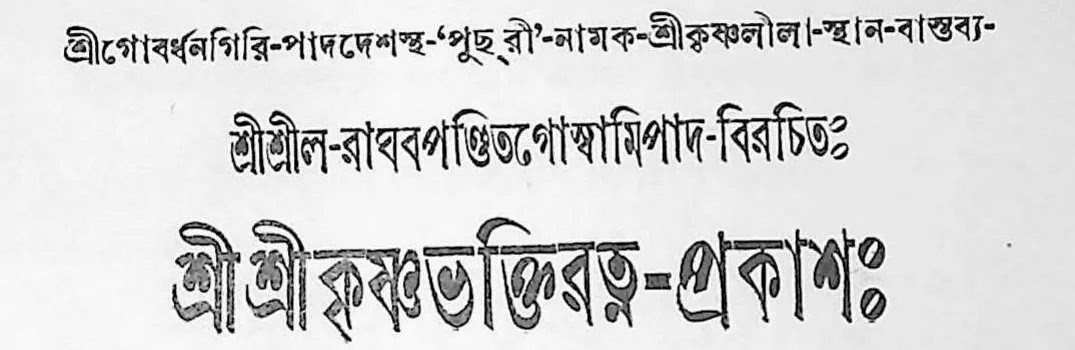
The Sanskrit text was printed in Bengali script in Calcutta in 1955, on Gaura-jayanti, the appearance day of Sri Chaitanya Mahaprabhu. It was edited by Puridasa Mahashaya and published by Haridasa Sharma of Vrindavana, and its title page calls the author "Srila Raghava Pandita Goswami, resident of the Krishna-lila place called 'Puchri' at the foot of Sri Govardhana Hill" (1955 edition). Puchri is the place now usually called Punchari, where pilgrims still visit his cave (see Around Govardhana Hill and His Own Cave). Later, Haridasa Shastri of Vrindavana published the book in Devanagari script, and the free Sanskrit e-text of the Gaudiya Grantha Mandira is based on his edition.
In English there are at least three translations: Kushakratha Dasa's The Splendor of the Jewel of Hari Bhakti (2009), an edition from Golden Age Media (2018), and a translation by Bhanu Swami (2023). Some modern introductions to the book, however, mix up its author with Raghava Pandit of Panihati, the companion of Sri Chaitanya Mahaprabhu in Bengal and Puri, and they tell the Panihati Raghava's stories, such as the bags of food that he sent to Mahaprabhu at Puri every year, as if they were about the author. The Gaura-ganoddesha-dipika itself shows that these are two different devotees (see Srila Raghava Pandita Goswami).
Krishna Alone: The Plea of His Book #
Whatever the subject of a chapter, Raghava comes back again and again to one conclusion, and near the end of the book he gathers it into a single appeal:
nānā-deva-niṣevaṇaṁ parihara prāṇādi-saṁrodhanaṁ
dharmaṁ karma ca dāna-tīrtha-niyama-brahmādikopāsanam
sarveṣāṁ parameśvarasya paramānanda-pradasyātmanaḥ
śrī-kṛṣṇasya sadāvyayasya caraṇa-dvandvāravindaṁ bhaja
"Give up the worship of many gods, the holding of the breath and the like, religious duty and fruitive work, charity, pilgrimage, vows, and the worship of Brahman and the rest. Worship the two lotus feet of Sri Krishna, the eternal and unchanging Supreme Lord of all, the soul of all, who gives the highest bliss." (Krishna-bhakti-ratna-prakasha 6.72, English rendering ours)
This is the same instruction that Lord Krishna gives at the end of the Bhagavad-gita, and Raghava quotes that verse himself a little earlier in the same chapter (6.62):
sarva-dharmān parityajya
mām ekaṁ śaraṇaṁ vraja
ahaṁ tvāṁ sarva-pāpebhyo
mokṣayiṣyāmi mā śucaḥ
"Abandon all varieties of religion and just surrender unto Me. I shall deliver you from all sinful reactions. Do not fear." (Bhagavad-gita 18.66)
This does not mean that Raghava cared nothing for holy places or good works, for he himself lived in the holy land of Vraja. He asks that nothing be followed as a goal apart from Krishna. Srila Prabhupada explains the same point in his purport to this verse: "One may perform a particular occupational duty according to his position in the social order, but if by executing his duty one does not come to the point of Kṛṣṇa consciousness, all his activities are in vain" (Bhagavad-gita 18.66, purport).
Raghava also asks that his book be given only to the right reader: not to the proud, the faithless or those who are against devotion, but to a person of pure mind who serves Krishna's lotus feet, who is devoted to the guru, peaceful and always truthful (6.77-80). Then he closes with four verses of the Bhagavad-gita. The last of them speaks of the Lord who lives in every heart: "surrender unto Him utterly. By His grace you will attain transcendental peace and the supreme and eternal abode" (Bhagavad-gita 18.62). His own last sentence draws the conclusion: knowing all this, one should take shelter of Sri Krishna's lotus feet alone (1955 edition, p. 43).
Raghava lived what he wrote. The Bhakti-ratnakara shows him grey with the dust of Vraja, with no wish to eat, always singing of Radha and Krishna and of Sri Chaitanya (Fifth Wave, p. 150). He made Govardhana his everything, and in his book he asks every reader to make the lotus feet of Krishna their everything. Kavi Karnapura saw in him a dear friend of Srimati Radharani, but Raghava himself asked only to be heard. What he asks us to hear is simple: give up every other shelter, and take shelter of Krishna alone.
