Srila Raghava Pandita Goswami
Govardhana's Guide Through Vraja
The complete life, on one page: The main biography and every pastime page, in order, in one place
Introduction
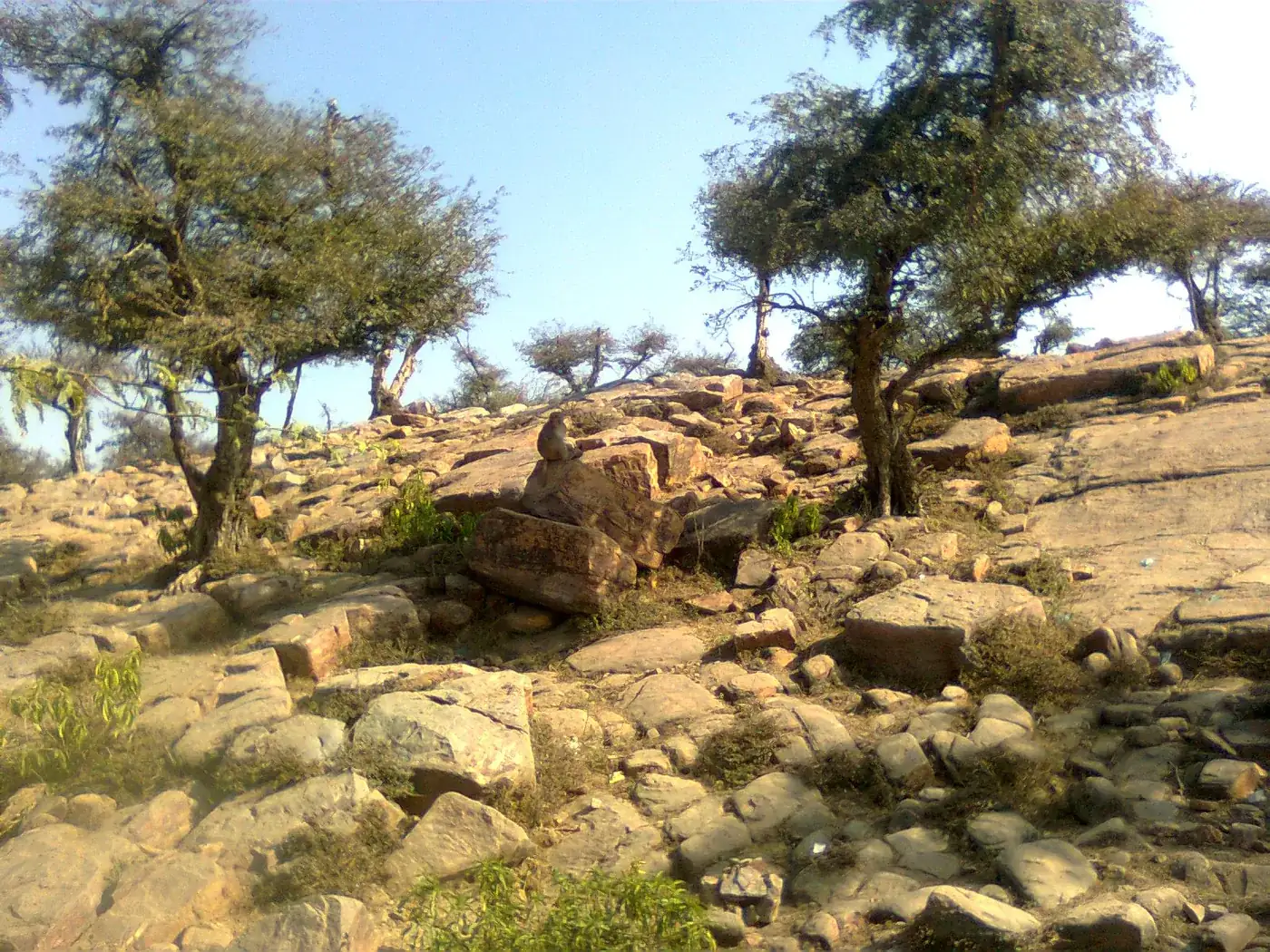
Srila Raghava Pandita Goswami was a Vaishnava saint from South India who made Govardhana Hill his home. He lived in the time of the later Vrindavana Goswamis, and the old books call him by three names: Raghava Gosai, Raghava Pandita and Raghava Goswami. He lived in a cave at the southern end of Govardhana, wandered through the forests of Vraja, and often stayed with his dear friend Raghunatha Dasa Goswami at Radha-kunda. He is remembered above all as the guide whom Srila Jiva Goswami sent with Shrinivasa Acharya and Narottama Dasa Thakura to show them all the holy places of Vraja-mandala. Narahari Chakravarti Thakura describes that great parikrama, page after page, in the Fifth Wave of his Bhakti-ratnakara. Kavi Karnapura names him in the Gaura-ganoddesha-dipika as Campakalata, one of the eight dearest friends of Srimati Radharani, and as the author of the Bhakti-ratna-prakasha, a Sanskrit book on pure devotion to Krishna that still survives. He is a different person from Raghava Pandit of Panihati, the associate of Sri Chaitanya Mahaprabhu, although many modern books mix the two up.
| Detail | Description |
|---|---|
| Also known as | Raghava Gosai, Raghava Pandita and Sri Raghava (Bhakti-ratnakara); Raghava Goswami (Gaura-ganoddesha-dipika 162) |
| Identity | Campakalata, one of the eight principal sakhis of Srimati Radharani (Gaura-ganoddesha-dipika 162) |
| Origin | A brahmana from South India, of a highly respected family (Bhakti-ratnakara, Fifth Wave, p. 150); a twentieth-century reference work names his birthplace as Ramanagara |
| Home | A cave at the southern end of Govardhana Hill, near Apsara-kunda and Punchari (Bhakti-ratnakara, Fifth Wave, p. 203) |
| Time | Already living at Govardhana, with his book written, when the Gaura-ganoddesha-dipika was completed in 1576 |
| Closest companion | Raghunatha Dasa Goswami of Radha-kunda |
| Best known for | Guiding Shrinivasa Acharya and Narottama Dasa Thakura around Vraja-mandala at Jiva Goswami's request |
| Book | Krishna-bhakti-ratna-prakasha (Bhakti-ratna-prakasha), a Sanskrit work in six chapters called "jewels" |
| Guru | Not named in any old source |
| Main source | Bhakti-ratnakara of Narahari Chakravarti Thakura, especially the Fifth Wave |
Scriptural evidence for the introduction (11)
प्रेमानन्दे सदा मत्त राघव-गोसाञि । राघवेर चरित्र कहिते अन्त नाञि
दाक्षिणात्य विप्र महा-कुलीन प्रचार । परम-वैष्णव क्रिया के वर्णिबे ताँर
दीन-हीने अनुग्रह-सीमा देखाइला । भक्ति-रत्न-प्रकाशादि ग्रन्थ ये वर्णिला
याहार सर्वस्व श्री-पर्वत-गोवर्धन । गोवर्धने वास सर्व-शास्त्रे विचक्षण
premānande sadā matta rāghava-gosāñi / rāghavera caritra kahite anta nāñi
dākṣiṇātya vipra mahā-kulīna pracāra / parama-vaiṣṇava kriyā ke varṇibe tāṅra
dīna-hīne anugraha-sīmā dekhāilā / bhakti-ratna-prakāśādi grantha ye varṇilā
yāhāra sarvasva śrī-parvata-govardhana / govardhane vāsa sarva-śāstre vicakṣaṇa
Raghava Gosai is always intoxicated with the joy of prema; there is no end to telling of Raghava's character. He is known as a brahmana from the South, of a very high-born family. Who can describe the ways of that great Vaishnava? He showed the utmost mercy to the lowly and the poor, and he wrote books such as the Bhakti-ratna-prakasha. Sri Govardhana Hill is his everything; he lives at Govardhana and is expert in all the scriptures.
1912 Bengali edition; English rendering ours.
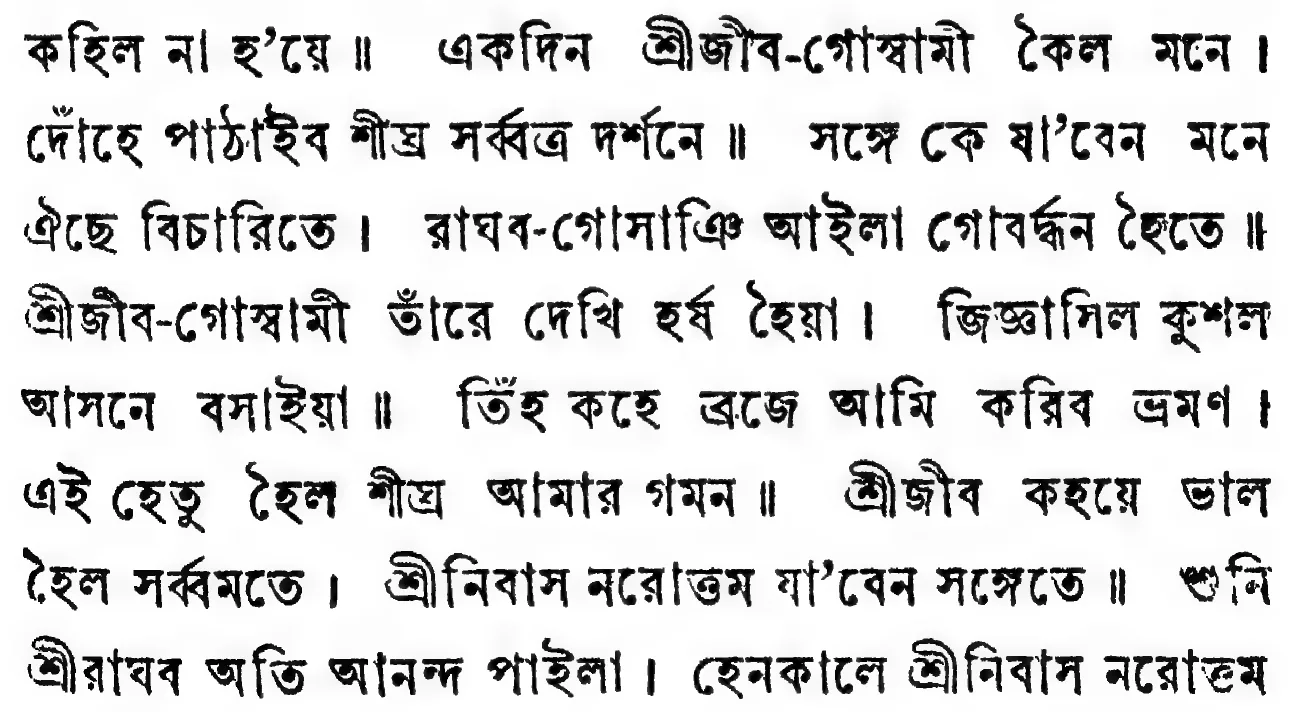
एक-दिन श्री-जीव-गोस्वामी कैल मने । दोँहे पाठाइब शीघ्र सर्वत्र दर्शने
सङ्गे के या'बेन मने ऐछे विचारिते । राघव-गोसाञि आइला गोवर्धन हैते
श्री-जीव-गोस्वामी ताँरे देखि हर्ष हैया । जिज्ञासिल कुशल आसने वसाइया
तिँह कहे व्रजे आमि करिब भ्रमण । एइ हेतु हैल शीघ्र आमार गमन
श्री-जीव कहये भाल हैल सर्व-मते । श्रीनिवास नरोत्तम या'बेन सङ्गेते
eka-dina śrī-jīva-gosvāmī kaila mane / doṅhe pāṭhāiba śīghra sarvatra darśane
saṅge ke yā'bena mane aiche vicārite / rāghava-gosāñi āilā govardhana haite
śrī-jīva-gosvāmī tāṅre dekhi harṣa haiyā / jijñāsila kuśala āsane vasāiyā
tiṅha kahe vraje āmi kariba bhramaṇa / ei hetu haila śīghra āmāra gamana
śrī-jīva kahaye bhāla haila sarva-mate / śrīnivāsa narottama yā'bena saṅgete
One day Sri Jiva Goswami thought, 'I will soon send these two to see all the holy places.' While he was thinking about who should go with them, Raghava Gosai came from Govardhana. Sri Jiva Goswami was delighted to see him; he gave him a seat and asked how he was. Raghava said, 'I am going to wander through Vraja; that is why I have come in haste.' Sri Jiva said, 'This is good in every way. Shrinivasa and Narottama will go with you.'
1912 Bengali edition; English rendering ours.
अहे श्रीनिवास ए निश्चय जान चिते । राधा-कुण्ड वास रघुनाथ कृपा हैते
श्री-कुण्ड श्री-गोवर्धन शिला गुञ्जा-हार । श्री-रघुनाथेर एइ सेवा सुप्रचार
ahe śrīnivāsa e niścaya jāna cite / rādhā-kuṇḍa vāsa raghunātha kṛpā haite
śrī-kuṇḍa śrī-govardhana śilā guñjā-hāra / śrī-raghunāthera ei sevā supracāra
O Shrinivasa, know this for certain in your heart: one gets to live at Radha-kunda by the mercy of Raghunatha. Sri Radha-kunda, the Govardhana-shila and the gunja-mala: this service of Sri Raghunatha is well known.
1912 Bengali edition; English rendering ours.
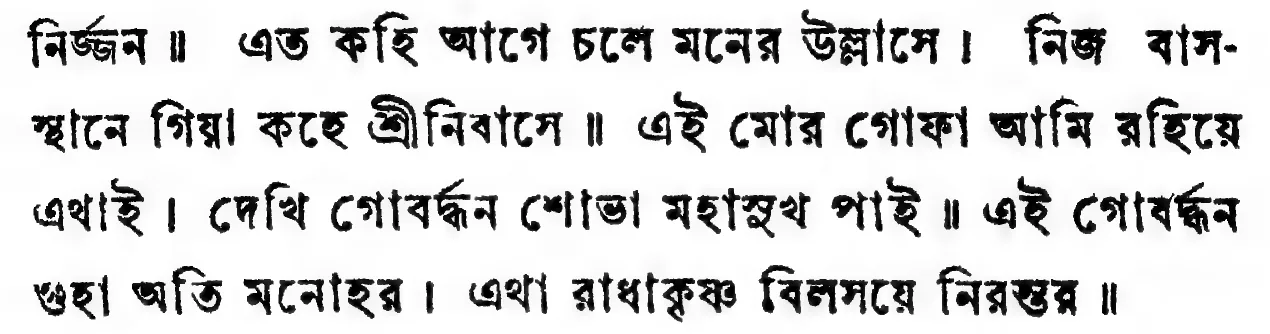
एत कहि आगे चले मनेर उल्लासे । निज वास-स्थाने गिया कहे श्रीनिवासे
एइ मोर गोफा आमि रहिये एथाइ । देखि गोवर्धन शोभा महा-सुख पाइ
एइ गोवर्धन गुहा अति मनोहर । एथा राधा-कृष्ण विलसये निरन्तर
eta kahi āge cale manera ullāse / nija vāsa-sthāne giyā kahe śrīnivāse
ei mora gophā āmi rahiye ethāi / dekhi govardhana śobhā mahā-sukha pāi
ei govardhana guhā ati manohara / ethā rādhā-kṛṣṇa vilasaye nirantara
Saying this, he went on with joy in his heart. Reaching his own dwelling place, he said to Shrinivasa, 'This is my cave; I live right here. Seeing the beauty of Govardhana, I feel great happiness. This cave of Govardhana is most charming; here Radha and Krishna enjoy Their pastimes without end.'
1912 Bengali edition; English rendering ours.
ऐछे कत कहि धैर्य धरिते ना पारे । राघव-पण्डित नेत्र जलेइ साँतारे
श्रीनिवास नरोत्तम धूलाय लोटाय । छाडे दीर्घ-श्वास भासे नेत्रेर धाराय
कत क्षणे श्री-पण्डित सुस्थिर हैया । दोँहे स्थिर करि आगे चले दोँहे लैया
aiche kata kahi dhairya dharite nā pāre / rāghava-paṇḍita netra jalei sāṅtāre
śrīnivāsa narottama dhūlāya loṭāya / chāḍe dīrgha-śvāsa bhāse netrera dhārāya
kata kṣaṇe śrī-paṇḍita susthira haiyā / doṅhe sthira kari āge cale doṅhe laiyā
Saying many such things, Raghava Pandita could not keep his composure: he swam in his own tears. Shrinivasa and Narottama rolled in the dust, heaving long sighs and floating in streams of tears. After some time Sri Pandita became calm, calmed the two, and went on, taking them with him.
1912 Bengali edition; English rendering ours.
ओहे श्रीनिवास वृन्दावनेर माधुरी । मने अभिलाष सदा राखि नेत्रे भरि'
तोमा दोँहा लैया महा आनन्दे भ्रमिनु । पुन ना ह-इबे हेन मने विचारिनु
जन्मे जन्मे तुमि दुइ प्रभुर किङ्कर । एत कहि' पण्डितेर अधैर्य अन्तर
ohe śrīnivāsa vṛndāvanera mādhurī / mane abhilāṣa sadā rākhi netre bhari'
tomā doṅhā laiyā mahā ānande bhraminu / puna nā ha-ibe hena mane vicārinu
janme janme tumi dui prabhura kiṅkara / eta kahi' paṇḍitera adhairya antara
'O Shrinivasa, the one wish of my heart is always to keep the sweetness of Vrindavana filling my eyes. Taking you two with me, I have wandered in great joy, and I feel in my heart that this will not happen again. Birth after birth, you two are servants of the Lord.' Saying this, the Pandita's heart lost all composure.
1912 Bengali edition; English rendering ours.
श्रीराधाप्राणरूपा या श्रीचम्पकलता व्रजे ।
साद्य राघवगोस्वामी गोवर्धनकृतस्थितिः ।
भक्तिरत्नप्रकाशाख्यग्रन्थो येन विनिर्मितः ॥
śrī-rādhā-prāṇa-rūpā yā śrī-campakalatā vraje
sādya rāghava-gosvāmī govardhana-kṛta-sthitiḥ
bhaktiratna-prakāśākhya-grantho yena vinirmitaḥ
Srimati Campakalata-gopi, who considered Srimati Radharani as dear as her own life-breath, appeared as Raghava Gosvami, who lived at Govardhana Hill and wrote the book entitled Bhakti-ratna-prakasa.
Translation as published at bvmlu.org.
धनिष्ठा भक्ष्यसामग्रीं कृष्णायादाद्व्रजेऽमिताम् ।
सैव सम्प्रति गौराङ्गप्रियो राघवपण्डितः ॥
dhaniṣṭhā bhakṣya-sāmagrīṁ kṛṣṇāyādād vraje ’mitām
saiva sāmprataṁ gaurāṅga-priyo rāghava-paṇḍitaḥ
Rāghava Paṇḍita was formerly a confidential gopī in Vraja during the time of Lord Kṛṣṇa’s pastimes, and his former name was Dhaniṣṭhā. This gopī, Dhaniṣṭhā, always engaged in preparing foods for Kṛṣṇa.
भवद्विधा भागवतास्तीर्थभूताः स्वयं विभो ।
तीर्थीकुर्वन्ति तीर्थानि स्वान्तःस्थेन गदाभृता ॥
bhavad-vidhā bhāgavatās
tīrtha-bhūtāḥ svayaṁ vibho
tīrthī-kurvanti tīrthāni
svāntaḥ-sthena gadābhṛtā
My lord, devotees like your good self are verily holy places personified. Because you carry the Personality of Godhead within your heart, you turn all places into places of pilgrimage.
श्री-राघव पण्डित गोसाञि गोवर्धने । पाइला परमानन्द देखि नरोत्तमे
śrī-rāghava paṇḍita gosāñi govardhane / pāilā paramānanda dekhi narottame
Sri Raghava Pandita, who had been living at Govardhana, was extremely happy to see Narottama.
Narahari Chakravarti's other biography, the Narottama-vilasa, remembers Raghava's joy on meeting Narottama, when Narottama was first brought to Radha-kunda and Govardhana.
जय रघुनाथ-दास श्री-कुण्ड-निवासी । जय जय श्री-राघव गोवर्धन-वासी
jaya raghunātha-dāsa śrī-kuṇḍa-nivāsī / jaya jaya śrī-rāghava govardhana-vāsī
Glory to Raghunatha Dasa, who lives at Sri Radha-kunda! Glory, glory to Sri Raghava, who lives at Govardhana!
In the opening prayers of the Third Wave, Narahari remembers Raghava together with Raghunatha Dasa Goswami in a single couplet.
Chapter 1
A Brahmana of the South at Govardhana
What the old books tell of his origin, his life of prema and renunciation at Govardhana, and his place among the Vrindavana Goswamis.
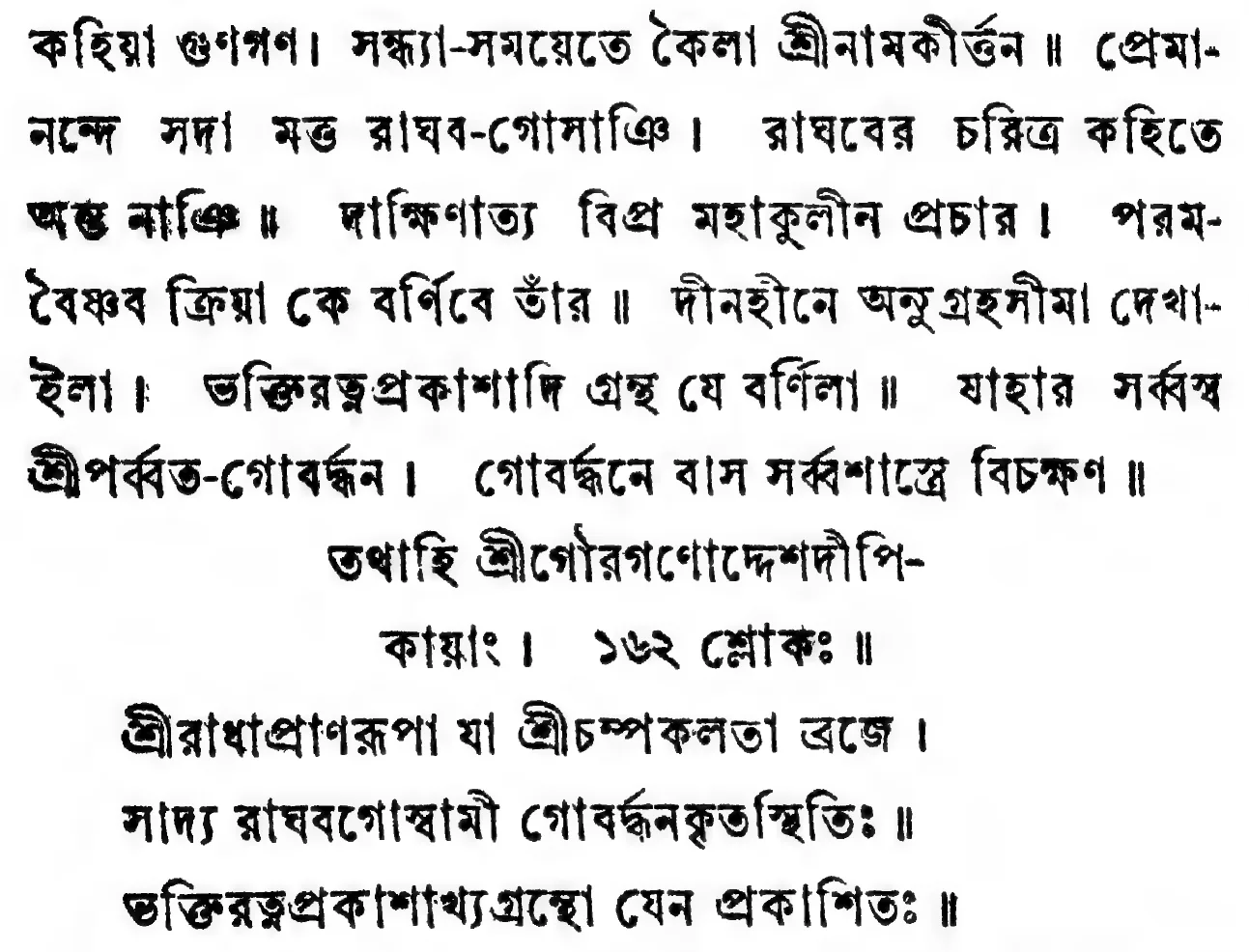
Srila Raghava Pandita Goswami made his home at Govardhana Hill in the days of Srila Jiva Goswami and Raghunatha Dasa Goswami. Devotees remember him above all as the guide with whom Jiva Goswami sent Shrinivasa Acharya and Narottama Dasa Thakura to see the holy places of Vraja. When Narahari Chakravarti Thakura comes to that journey in the Fifth Wave, or chapter, of his Bhakti-ratnakara, he stops his story for a moment to tell us who this guide was. His few lines are the fullest picture of Raghava that any old book gives:
premānande sadā matta rāghava-gosāñi / rāghavera caritra kahite anta nāñi
dākṣiṇātya vipra mahā-kulīna pracāra / parama-vaiṣṇava kriyā ke varṇibe tāṅra
dīna-hīne anugraha-sīmā dekhāilā / bhakti-ratna-prakāśādi grantha ye varṇilā
yāhāra sarvasva śrī-parvata-govardhana / govardhane vāsa sarva-śāstre vicakṣaṇa
"Raghava Gosai is always intoxicated with the joy of prema; there is no end to telling of Raghava's character. He is known as a brahmana from the South, of a very high-born family. Who can describe the ways of that great Vaishnava? He showed the utmost mercy to the lowly and the poor, and he wrote books such as the Bhakti-ratna-prakasha. Sri Govardhana Hill is his everything; he lives at Govardhana and is expert in all the scriptures." (Bhakti-ratnakara, Fifth Wave, p. 150, 1912 Bengali edition; English rendering ours)
Narahari then quotes a verse of Kavi Karnapura that names Raghava as Campakalata, one of the eight principal sakhis, the closest companions, of Srimati Radharani (see Campakalata and the Krishna-bhakti-ratna-prakasha), and he adds four couplets on how Raghava lived. Apart from the story of the Vraja tour and a few short notices elsewhere, this is almost all that the old books tell us about his life.
A Brahmana From the South #
Narahari gives Raghava's origin in half a line. He calls him a dakshinatya vipra, a brahmana from the South of India, and maha-kulina, a man of a very high-born family. He gives this as what was generally known ("he is known as"), and he says nothing more. He does not name Raghava's village or parents, or tell us how or when he came to Vraja (Bhakti-ratnakara, Fifth Wave, p. 150).
A twentieth-century Gaudiya reference work, the Gaudiya Vaishnava Abhidhana of Haridasa Dasa, adds that he was "a brahmana, a resident of Ramanagara in the South" (vol. 3, p. 1332). It gives no source for this, and it does not say which Ramanagara is meant, though South India has several places of that name. The same book says clearly that he is a different person from Raghava Pandita of Panihati (vol. 4, p. 1939). The Panihati Raghava was a companion of Sri Chaitanya Mahaprabhu, and the Bhakti-ratnakara says that he was born at Panihati in Bengal (Eighth Wave, p. 538).
Raghava was not the only devotee from the South in the Vraja of the Goswamis: Gopala Bhatta Goswami had also come from there. Narahari salutes the two just one couplet apart in the opening prayers of his book (First Wave, p. 3), but the books show no other link between them.
Narahari mentions Raghava's high birth only in passing, and at once he asks, "Who can describe the ways of that great Vaishnava?" In bhakti, a good family does not make anyone a devotee, and a humble family does not stop anyone from becoming one. Sri Chaitanya Mahaprabhu told Sanatana Goswami:
nīca-jāti nahe kṛṣṇa-bhajane ayogya
sat-kula-vipra nahe bhajanera yogya
"“A person born in a low family is not unfit for discharging devotional service to Lord Kṛṣṇa, nor is one fit for devotional service simply because he is born in an aristocratic family of brāhmaṇas." (Sri Chaitanya-charitamrita Antya 4.66)
That is why Narahari spends half a line on Raghava's birth and the rest of his portrait on his devotion.
Govardhana Was His Everything #
Narahari's strongest words about Raghava are about a place: "Sri Govardhana Hill is his everything; he lives at Govardhana" (Bhakti-ratnakara, Fifth Wave, p. 150). The Bengali word he uses, sarvasva, means "one's all", everything that a person has. For Raghava, that was Govardhana.
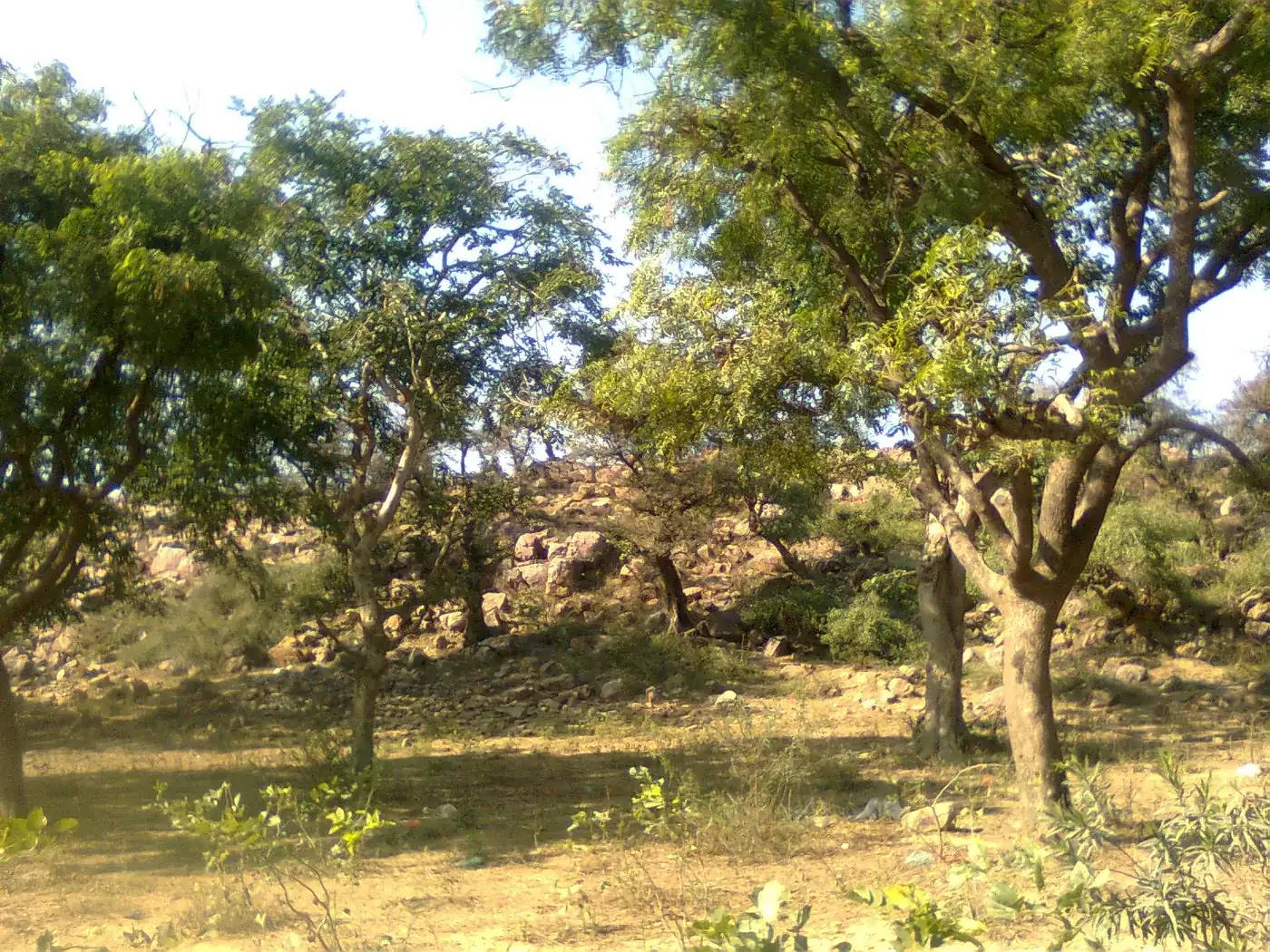
In the very first prayers of his book, Narahari names Raghava simply by the place where he lived:
jaya raghunātha-bhaṭṭa raghunātha-dāsa / jaya śrī-rāghava govardhanāraṇye vāsa
"Glory to Raghunatha Bhatta and Raghunatha Dasa! Glory to Sri Raghava, who lives in the forest of Govardhana!" (Bhakti-ratnakara, First Wave, p. 3, 1912 Bengali edition; English rendering ours)
His home there was a cave near Apsara-kunda, which the Bhakti-ratnakara places "at the end of Govardhana". On the Vraja tour he brought Shrinivasa to it and said, "This is my cave; I live right here" (Fifth Wave, p. 203). The visit is told in Around Govardhana Hill and His Own Cave.
To a Gaudiya Vaishnava, Govardhana is no ordinary hill. When Sri Chaitanya Mahaprabhu first saw it, "He immediately offered obeisances, falling down on the ground like a rod. He embraced one piece of rock from Govardhana Hill and became mad" (Sri Chaitanya-charitamrita Madhya 18.16). He would not even climb it (Madhya 18.23). Srila Prabhupada explains that Rupa Goswami and Sanatana Goswami followed His example and did not climb the hill either, "because they considered it nondifferent from Kṛṣṇa, the Supreme Personality of Godhead" (Madhya 18.47, purport). Dancing at the sight of the hill, Mahaprabhu recited the praise that the gopis, the cowherd girls of Vraja, sing of it in the Srimad-Bhagavatam:
hantāyam adrir abalā hari-dāsa-varyo
yad rāma-kṛṣṇa-caraṇa-sparaśa-pramodaḥ
mānaṁ tanoti saha-go-gaṇayos tayor yat
pānīya-sūyavasa-kandara-kanda-mūlaiḥ
"“ ‘Of all the devotees, this Govardhana Hill is the best! O my friends, this hill supplies Kṛṣṇa and Balarāma, as well as Their calves, cows and cowherd friends, with all kinds of necessities — water for drinking, very soft grass, caves, fruits, flowers and vegetables. In this way the hill offers respect to the Lord. Being touched by the lotus feet of Kṛṣṇa and Balarāma, Govardhana Hill appears very jubilant.’ ”" (Sri Chaitanya-charitamrita Madhya 18.34)
Govardhana gives Sri Krishna and His friends everything they need. A devotee who makes Govardhana his everything chooses to live beside the best of Krishna's servants.
A Life of Prema and Renunciation #
Right after Kavi Karnapura's verse, Narahari describes Raghava's way of life. It is a life full of prema, pure love for Krishna, and of strict renunciation.
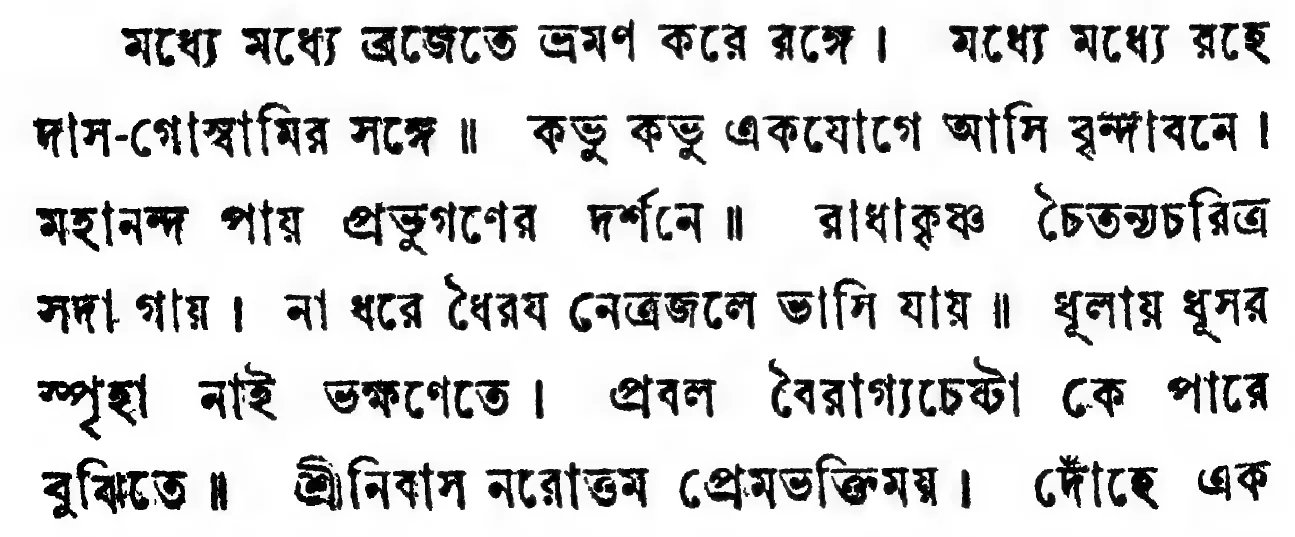
These are his words:
madhye madhye vrajete bhramaṇa kare raṅge / madhye madhye rahe dāsa-gosvāmira saṅge
rādhā-kṛṣṇa caitanya-caritra sadā gāya / nā dhare dhairaya netra-jale bhāsi yāya
dhūlāya dhūsara spṛhā nāi bhakṣaṇete / prabala vairāgya-ceṣṭā ke pāre bujhite
"Now and then he wanders joyfully through Vraja, and now and then he stays with Dasa Goswami. He always sings of Radha and Krishna and of the life of Sri Chaitanya; he cannot stay composed and is carried away by his tears. Grey with the dust of Vraja, he has no wish to eat. Who can understand his intense renunciation?" (Bhakti-ratnakara, Fifth Wave, p. 150, 1912 Bengali edition; English rendering ours)
"Dasa Goswami" is Raghunatha Dasa Goswami, who lived in strict bhajana at Radha-kunda. Their friendship is told in At Radha-kunda With Raghunatha Dasa Goswami. In one more couplet, left out above, Narahari adds that sometimes Raghava came to Vrindavana and was overjoyed to see the Goswamis there. With all his renunciation he was full of kindness: the first lines of the portrait say that he "showed the utmost mercy to the lowly and the poor".
The tears that Narahari speaks of come again and again on the Vraja tour. Once in Mathura, thinking of Sri Chaitanya's life, Raghava lost all composure, and Shrinivasa and Narottama fell weeping at his feet (Fifth Wave, p. 184; see Jiva Goswami Entrusts Shrinivasa and Narottama to Him).
Such a life brings to mind the five practices of bhakti that Sri Chaitanya Mahaprabhu called the best of all. Living in the land of Krishna is one of them:
sādhu-saṅga, nāma-kīrtana, bhāgavata-śravaṇa
mathurā-vāsa, śrī-mūrtira śraddhāya sevana
"“One should associate with devotees, chant the holy name of the Lord, hear Śrīmad-Bhāgavatam, reside at Mathurā and worship the Deity with faith and veneration." (Sri Chaitanya-charitamrita Madhya 22.128)
Mahaprabhu goes on to say that "Even a slight performance of these five awakens love for Kṛṣṇa" (Madhya 22.129). Several of them filled Raghava's days: he lived in Vraja, he kept the company of Raghunatha Dasa Goswami and the other Goswamis, and he was always singing about Radha and Krishna and about Sri Chaitanya.
Remembered Among the Goswamis #
In the prayers that open several waves of his book, Narahari salutes Raghava among the great Vaishnavas of Vraja. At the start of the Third Wave he names him right after the Goswamis of Vrindavana, and he joins him with Raghunatha Dasa Goswami in a single couplet:
jaya raghunātha-dāsa śrī-kuṇḍa-nivāsī / jaya jaya śrī-rāghava govardhana-vāsī
"Glory to Raghunatha Dasa, who lives at Sri Radha-kunda! Glory, glory to Sri Raghava, who lives at Govardhana!" (Bhakti-ratnakara, Third Wave, opening, 1912 Bengali edition; English rendering ours)
The next names in that prayer are Shrinivasa, Narottama and Ramacandra. This is fitting, because in the Fifth Wave it is Raghava who leads Shrinivasa and Narottama through Vraja. A "Sri Raghava", very probably the same devotee, is saluted again with Bhugarbha and Lokanatha at the opening of the Seventh Wave, and once more at the opening of the Twelfth.
When Shrinivasa first came to Radha-kunda, before the tour, Narahari names Raghava even before Krishnadasa Kaviraja among those who blessed him: "Sri Raghava, Krishnadasa Kaviraja and the others all showed Shrinivasa the greatest mercy" (Fourth Wave, p. 145). Narahari's other book, the Narottama-vilasa, remembers him in the same circle, when Narottama was brought to Radha-kunda to meet Raghunatha Dasa Goswami:
śrī-rāghava paṇḍita gosāñi govardhane / pāilā paramānanda dekhi narottame
"Sri Raghava Pandita, who had been living at Govardhana, was extremely happy to see Narottama." (Narottama-vilasa, Second Vilasa, verse 310, translated by Dravida Dasa)
Later, when the Vaishnavas of Vraja gathered to send the Goswamis' books to Bengal, Narahari names among them "Raghava Pandita, who possessed prema-bhakti" (Sixth Wave, p. 486).
Outside Narahari's books, an early Sanskrit work, the Sadhana-dipika of Radha-krishna Goswami, honours Raghava through his writing. It lists "Sri Bhakti-ratna-prakasha and other works" of "Sri Raghava-pandita Gosvami-pada" among the books through which devotees, even now, can relish the pastimes of the Lord (Sadhana-dipika, Ninth Kaksha, p. 257). The list runs from Vishnu Puri, who lived before Mahaprabhu, to Nayanananda, who lived after Him, so it does not tell us when Raghava lived. It shows that his book was counted among the trusted works of the Gaudiya Vaishnavas.
Gosai, Pandita and Goswami #
The Bhakti-ratnakara calls him both Raghava Gosai and Raghava Pandita, within the same wave. Kavi Karnapura calls him Raghava-gosvami, and the Sadhana-dipika joins the titles: "Sri Raghava-pandita Gosvami-pada". No source says who first gave him these titles, or when.
Pandita means a learned man. Narahari calls Raghava "expert in all the scriptures", and the Vraja tour shows it: on its first evening he recited the glories of Mathura to Shrinivasa and Narottama from the Puranas (Fifth Wave, pp. 151-165).
Gosai is the Bengali form of gosvami, or Goswami. Srila Prabhupada explains the word: "Svāmī means master, and gosvāmī means master of the go, or senses" (Nectar of Instruction, verse 1, purport). He adds that a gosvami is one who can control the urges of speech, mind, anger, tongue, belly and genitals. Narahari's picture of Raghava, grey with the dust of Vraja and with no wish to eat, shows that the name fitted him.
What the Sources Do Not Tell Us #
Much of Raghava's outer life is not recorded. No source we have names his guru. In his own book he bows down to the lotus feet of his spiritual master, in a verse taken from an older work, the Krama-dipika, but he does not give his guru's name (Krishna-bhakti-ratna-prakasha 1.2). No disciples of his are named either. Shrinivasa and Narottama, whom he led through Vraja, were not his disciples: Shrinivasa had been initiated by Gopala Bhatta Goswami, and Narottama was the disciple of Lokanatha Goswami.
No year is recorded for his birth or for his passing. No source we have gives the day of his disappearance, and no pranama-mantra, the short prayer with which devotees offer obeisances, has come down to us for him. The one firm date comes from Kavi Karnapura's Gaura-ganoddesha-dipika, which was completed in 1576. As its verse stands, Raghava was by then already living at Govardhana and had already written his book. The Bhakti-ratnakara shows him still active years after the Vraja tour, when Jahnava Devi came to Vrindavana (Eleventh Wave, p. 667). The Gaudiya Vaishnava Abhidhana says that "his samadhi is in Sri Vrindavana" (vol. 3, p. 1332), but it does not say where, and no other source gives the place.
One more thing is missing from the old books: any meeting between Raghava and Sri Chaitanya Mahaprabhu. On the Vraja tour he tells the Lord's pastimes at almost every place, but always in the third person, and never with the words "I saw". Once he names his source plainly: "I heard this from the mouths of the elders; it is a well-known account" (Fifth Wave, p. 165). Some modern guidebooks call him a close associate of Mahaprabhu, but they have mixed him up with Raghava Pandita of Panihati (see Srila Raghava Pandita Goswami).
A Holy Man in a Holy Place #
Narahari's portrait ends where Raghava's best-known service begins: he took two young devotees with him and showed them Vraja. Years later, in Navadvipa, Shrinivasa still remembered that journey as touring Vraja "with Sri Raghava" (Twelfth Wave, p. 716). For Shrinivasa and Narottama, the way into the holy land was a holy person. This is how the Srimad-Bhagavatam speaks of such devotees:
bhavad-vidhā bhāgavatās
tīrtha-bhūtāḥ svayaṁ vibho
tīrthī-kurvanti tīrthāni
svāntaḥ-sthena gadābhṛtā
"My lord, devotees like your good self are verily holy places personified. Because you carry the Personality of Godhead within your heart, you turn all places into places of pilgrimage." (Srimad-Bhagavatam 1.13.10)
Srila Prabhupada draws out what this means for every pilgrim: "If anyone visits a holy place, he must search out the pure devotees residing in such holy places, take lessons from them, try to apply such instructions in practical life and thus gradually prepare oneself for the ultimate salvation, going back to Godhead" (Srimad-Bhagavatam 1.13.10, purport). Raghava made Govardhana his everything, and for Shrinivasa and Narottama he became the guide through whom they saw all of Vraja. A pilgrim to Govardhana today can follow his example: bow down to the hill he loved, hear about Krishna from the devotees who live there, and sing, as he always did, about Radha and Krishna and about Sri Chaitanya.
Scriptural evidence for this chapter (9)
Quoted in the text above:
- Bhakti-ratnakara, Fifth Wave, p. 150 (1912 ed.)
- Sri Chaitanya-charitamrita Antya 4.66 quoted above ↑
- Bhakti-ratnakara, First Wave, p. 3 (1912 ed.)
- Sri Chaitanya-charitamrita Madhya 18.34 quoted above ↑
- Bhakti-ratnakara, Fifth Wave, p. 150 (1912 ed.)
- Sri Chaitanya-charitamrita Madhya 22.128 quoted above ↑
- Bhakti-ratnakara, Third Wave, opening (1912 ed.)
- Narottama-vilasa, Second Vilasa, verse 310
- Srimad-Bhagavatam 1.13.10 quoted above ↑
Chapter 2
Jiva Goswami Entrusts Shrinivasa and Narottama to Him
How the Vraja tour began: the first meeting at Radha-kunda, Jiva Goswami's choice of Raghava as guide, and the first days in Mathura with the two young devotees.
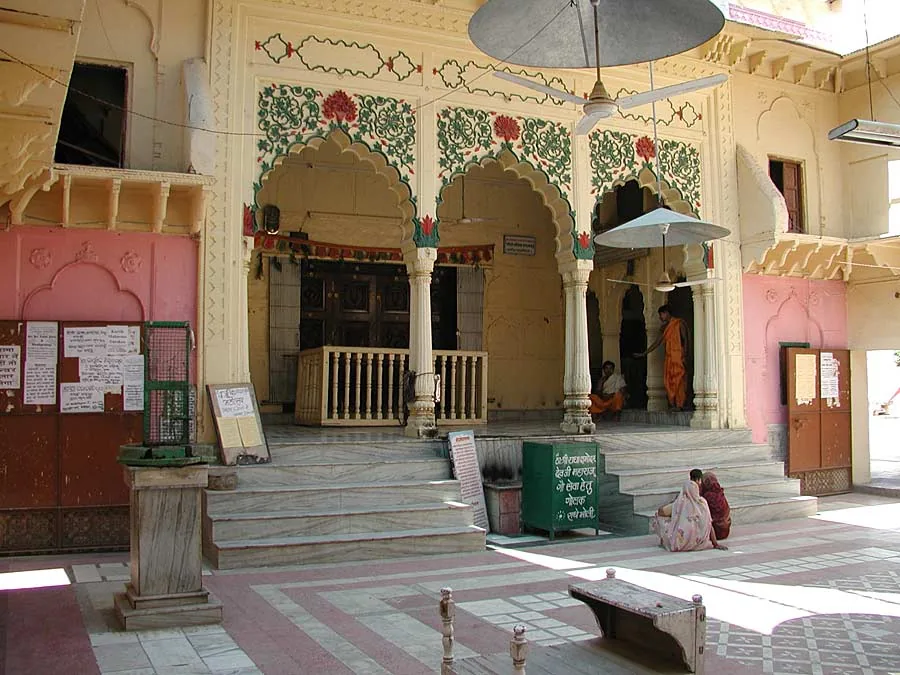
Srila Raghava Pandita Goswami of Govardhana is remembered above all as the saint who guided Shrinivasa Acharya and Narottama Dasa Thakura through the holy land of Vraja. (He is a different person from Raghava Pandita of Panihati, who had the same name.) Their journey fills the Fifth Wave of the Bhakti-ratnakara, the great Bengali history written by Narahari Chakravarti Thakura. At almost every holy place Narahari lets Raghava speak, and most of his words begin with a loving call: "O Shrinivasa."
The book gives no date for the journey and does not say how long it lasted, but it tells how it began: with a meeting at Radha-kunda, a choice made by Srila Jiva Goswami, and a few days in Mathura.
The First Meeting at Radha-kunda #
Raghava first appears in the Bhakti-ratnakara a little before the tour. Shrinivasa had just received initiation from Gopala Bhatta Goswami and had been placed in Jiva Goswami's care (see Training Under Jiva and Gopala Bhatta Goswami). The next day Jiva sent him to Raghunatha Dasa Goswami at Radha-kunda, who showed him endless kindness (Bhakti-ratnakara, Fourth Wave, p. 145). Raghava was there too, with Krishnadasa Kaviraja Goswami:
śrī-rāghava kṛṣṇadāsa-kavirāja ādi / śrīnivāse kaila sabe kṛpāra avadhi
tina dina rahi rādhā-kuṇḍa govardhane / sabā' anumati laiyā āilā vṛndāvane
"Sri Raghava, Krishnadasa Kaviraja and the others all showed Shrinivasa the greatest mercy. After staying three days at Radha-kunda and Govardhana, he took everyone's leave and came back to Vrindavana." (Bhakti-ratnakara, Fourth Wave, p. 145, 1912 Bengali edition; English rendering ours)
So Raghava first met Shrinivasa in the circle of Raghunatha Dasa Goswami, a circle very close to his heart (see At Radha-kunda With Raghunatha Dasa Goswami). Narottama, the other young devotee, was the disciple of Lokanatha Goswami (see Discipleship Under Lokanatha Gosvami); when Raghava first met him, the book does not say. Years later these two young men would carry the Goswamis' books to Bengal (Carrying the Scriptures to Bengal).
Jiva Goswami Chooses a Guide #
Narahari says that Jiva Goswami's love for Shrinivasa and Narottama cannot be told in words (Bhakti-ratnakara, Fifth Wave, p. 149). Jiva was then leading the Vaishnavas of Vrindavana. Then came the day the journey began:
eka-dina śrī-jīva-gosvāmī kaila mane / doṅhe pāṭhāiba śīghra sarvatra darśane
saṅge ke yā'bena mane aiche vicārite / rāghava-gosāñi āilā govardhana haite
śrī-jīva-gosvāmī tāṅre dekhi harṣa haiyā / jijñāsila kuśala āsane vasāiyā
tiṅha kahe vraje āmi kariba bhramaṇa / ei hetu haila śīghra āmāra gamana
śrī-jīva kahaye bhāla haila sarva-mate / śrīnivāsa narottama yā'bena saṅgete
"One day Sri Jiva Goswami thought, 'I will soon send these two to see all the holy places.' While he was thinking about who should go with them, Raghava Gosai came from Govardhana. Sri Jiva Goswami was delighted to see him; he gave him a seat and asked how he was. Raghava said, 'I am going to wander through Vraja; that is why I have come in haste.' Sri Jiva said, 'This is good in every way. Shrinivasa and Narottama will go with you.'" (Bhakti-ratnakara, Fifth Wave, p. 149, 1912 Bengali edition; English rendering ours)
Raghava was very happy. Just then the two young men came in and bowed down, he embraced them both, and Jiva joyfully told them about the tour of the forests (p. 149). The tour was Raghava's own plan. Jiva joined the two young men to it, and his words, "This is good in every way", show how fully he trusted this sadhu from Govardhana.
The First Night in Mathura #
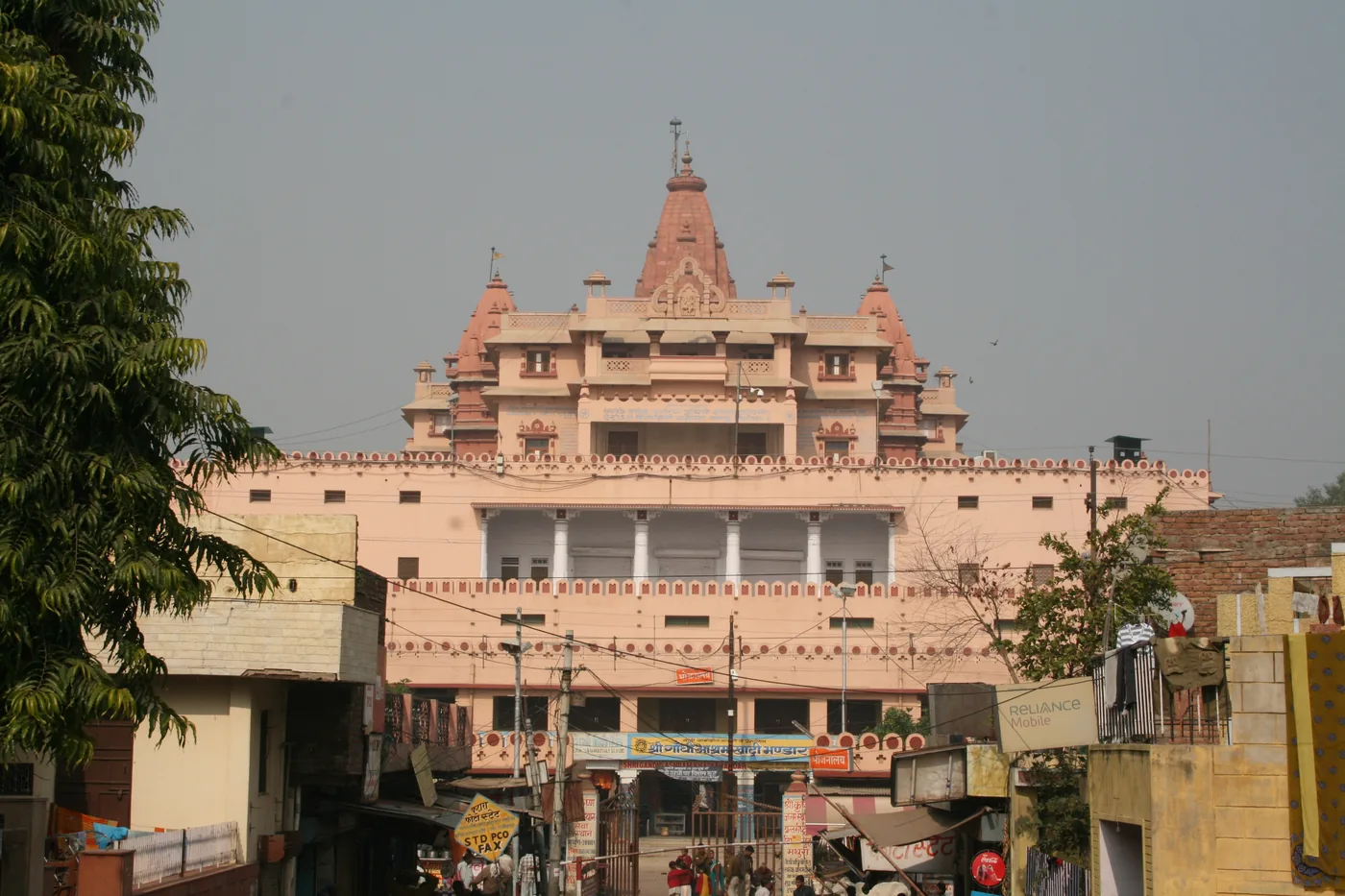
The two took leave of everyone at once, and Jiva bade them farewell with deep satisfaction (Bhakti-ratnakara, Fifth Wave, pp. 149-150). Raghava did not lead them first into the forests. He took them to Mathura, the city where Lord Krishna was born.
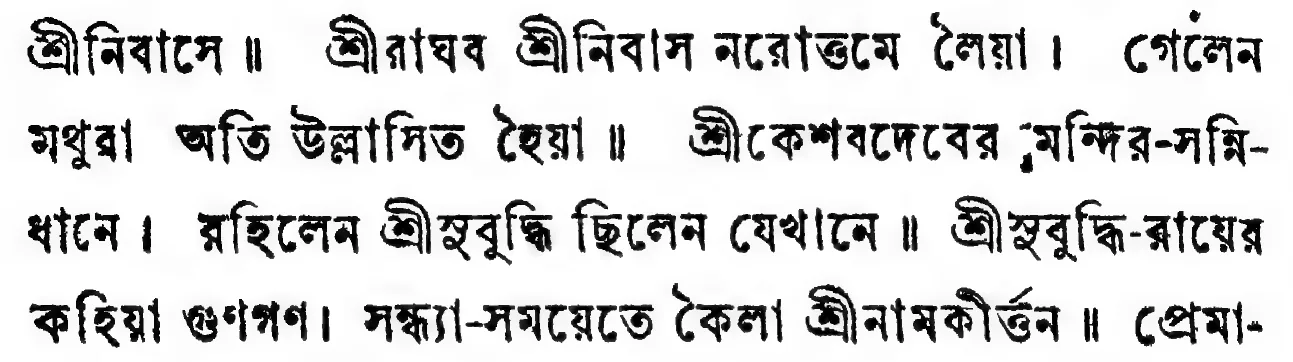
śrī-rāghava śrīnivāsa narottame laiyā / gelena mathurā ati ullāsita haiyā
śrī-keśava-devera mandira-sannidhāne / rahilena śrī-subuddhi chilena yekhāne
śrī-subuddhi-rāyera kahiyā guṇa-gaṇa / sandhyā-samayete kailā śrī-nāma-kīrtana
"Sri Raghava took Shrinivasa and Narottama and went to Mathura in great joy. They stayed near the temple of Sri Keshavadeva, at the place where Sri Subuddhi had lived. After telling of Sri Subuddhi Raya's many good qualities, at dusk he held kirtana of the holy name." (Bhakti-ratnakara, Fifth Wave, p. 150, 1912 Bengali edition; English rendering ours)
The book says that Subuddhi Raya "had lived" at that spot (see Life of Service in Mathura and Vrindavana), and it does not say which of his qualities Raghava praised. Even so, the first lesson of the tour was about a Vaishnava, and the first evening ended in kirtana, the singing of the holy names together. Narahari now pauses to describe Raghava himself (see A Brahmana of the South at Govardhana), and then says:
śrīnivāsa narottama prema-bhakti-maya / doṅhe eka jāni sneha kare atiśaya
"Shrinivasa and Narottama were full of loving devotion. Seeing the two as one, he loved them very much." (Bhakti-ratnakara, Fifth Wave, p. 150, 1912 Bengali edition; English rendering ours)
One had received initiation from Gopala Bhatta Goswami and the other from Lokanatha Goswami, but Raghava saw the devotion they shared and loved them as one.
How the Lost Holy Places Were Found #
Later that evening, in private, Raghava told the two the history of Mathura-mandala, the holy land around Mathura (Bhakti-ratnakara, Fifth Wave, pp. 150-151). King Vajranabha, he said, had once marked the places of Krishna's pastimes with villages, Deities and kundas. In time they became almost hidden. Then Sri Chaitanya Mahaprabhu, whom Raghava calls "the son of the king of Vraja", came to Mathura and revealed everything through Rupa Goswami and Sanatana Goswami.
yadyapi se saba sthāna vedya se doṅhāra / tathāpi karilā śāstra-rīta aṅgīkāra
nānā śāstra pramāṇa kariyā saṅkalana / karilena vrajete bhramaṇa dui jana
gupta-tīrtha uddhāra karila yatna kari / vyakta kaila rādhā-kṛṣṇa-rasera mādhurī
"Although all those places were known to the two of them, they still followed the way of the scriptures. Gathering evidence from many shastras, the two travelled all over Vraja. With great care they recovered the hidden holy places, and they revealed the sweetness of the rasa of Radha and Krishna." (Bhakti-ratnakara, Fifth Wave, p. 151, 1912 Bengali edition; English rendering ours)
Rupa and Sanatana knew the places already, yet they proved each one from the shastras. Sacred knowledge is kept in the same way, as Lord Krishna tells Arjuna:
evaṁ paramparā-prāptam
imaṁ rājarṣayo viduḥ
sa kāleneha mahatā
yogo naṣṭaḥ paran-tapa
"This supreme science was thus received through the chain of disciplic succession, and the saintly kings understood it in that way. But in course of time the succession was broken, and therefore the science as it is appears to be lost." (Bhagavad-gita 4.2)
The Gita's teaching and Vraja's holy places were both lost in time, both were restored by the Lord and His pure devotees, and both live on by being handed down. That evening Raghava was handing the story of Vraja on to two young devotees.
Then he recited Mathura's glories from the Varaha, Padma, Skanda, Brahmanda and other Puranas (pp. 151-164). Srila Prabhupada's translation of Srila Rupa Goswami's Nectar of Instruction gives the root of that glory: "The holy place known as Mathurā is spiritually superior to Vaikuṇṭha, the transcendental world, because the Lord appeared there." (Nectar of Instruction, verse 9) Telling these glories, Raghava could not stay steady for joy (p. 165).
Here Gauracandra Danced #
Next morning Raghava took them first to the house of the Sanodiya brahmana, the disciple of Madhavendra Puri in whose home Mahaprabhu had taken His meal (Bhakti-ratnakara, Fifth Wave, p. 165; see also Chaitanya-charitamrita Madhya 17.167). There he spoke of Gauracandra, "the golden moon", as Mahaprabhu is lovingly called:
śrī-rāghava-paṇḍita kahaye śrīnivāse / ethā gauracandra nṛtya kailā premāveśe
āila asaṅkhya loka prabhura darśane / sabe mahā-matta hailā śrī-nāma-kīrtane
…
ethāte adbhuta gauracandrera vilāsa / eta kahi śrī-rāghava chāḍe dīrgha-śvāsa
"Sri Raghava Pandita said to Shrinivasa, 'Here Gauracandra danced in ecstatic love. Countless people came to see the Lord, and all of them became wild in the kirtana of the holy name. ... Here took place Gauracandra's wonderful pastime.' Saying this, Sri Raghava heaved a long sigh." (Bhakti-ratnakara, Fifth Wave, p. 165, 1912 Bengali edition; English rendering ours)
Hearing this, Shrinivasa and Narottama wept and lamented until they were grey with dust in the brahmana's courtyard (p. 165). Raghava told the Lord's dance as a pastime of that place, never as something he had seen himself.
I Heard This From the Elders #
Then Raghava told a story of Advaita Acharya, set at a place called Ardhacandra, and first he named his source:
śrīnivāsa prati kahe rāghava-paṇḍita / śuninu prācīna-mukhe e kathā vidita
"Raghava Pandita said to Shrinivasa, 'I heard this from the mouths of the elders; it is a well-known account.'" (Bhakti-ratnakara, Fifth Wave, p. 165, 1912 Bengali edition; English rendering ours)
A brahmana from another region, proud of his learning, used to insult the Vaishnavas of Mathura, he said, and one day he did so before Advaita, who was staying at this very spot on pilgrimage. Advaita blazed up in anger and showed a four-armed form holding the cakra; the man shook and begged for mercy. Then Advaita's anger melted into compassion. He told him: always think of yourself as an offender; give up everything and do nama-sankirtana, the chanting of the holy names together; satisfy the Vaishnavas even at the cost of your life; wait at their door; practise bhakti; and keep secret the form you have seen. The man went weeping from house to house of the Mathura Vaishnavas (pp. 165-167).
This is how an offence against a Vaishnava (Vaishnava-aparadha) is healed: by humility, by the holy name and by service to the Vaishnavas, exactly as Advaita taught. Then, Narahari says:
eta kahi śrīnivāsācārya kare dhari / manera ānande punaḥ kahe dhīri dhīri
"Having said this, he took Shrinivasa Acharya by the hand and, with joy in his heart, spoke again, slowly and gently." (Bhakti-ratnakara, Fifth Wave, p. 167, 1912 Bengali edition; English rendering ours)
Before the Deity of Keshava #
After showing them the house of Vasudeva and Devaki, where Krishna was born, Raghava brought them before the Deity of Keshava (Bhakti-ratnakara, Fifth Wave, p. 168). "O Shrinivasa, take darshan of Keshava," he said. "Here Sri Chaitanya danced wonderfully." All the people, he added, were swept away in the flood of prema and said that He was Keshava Himself.
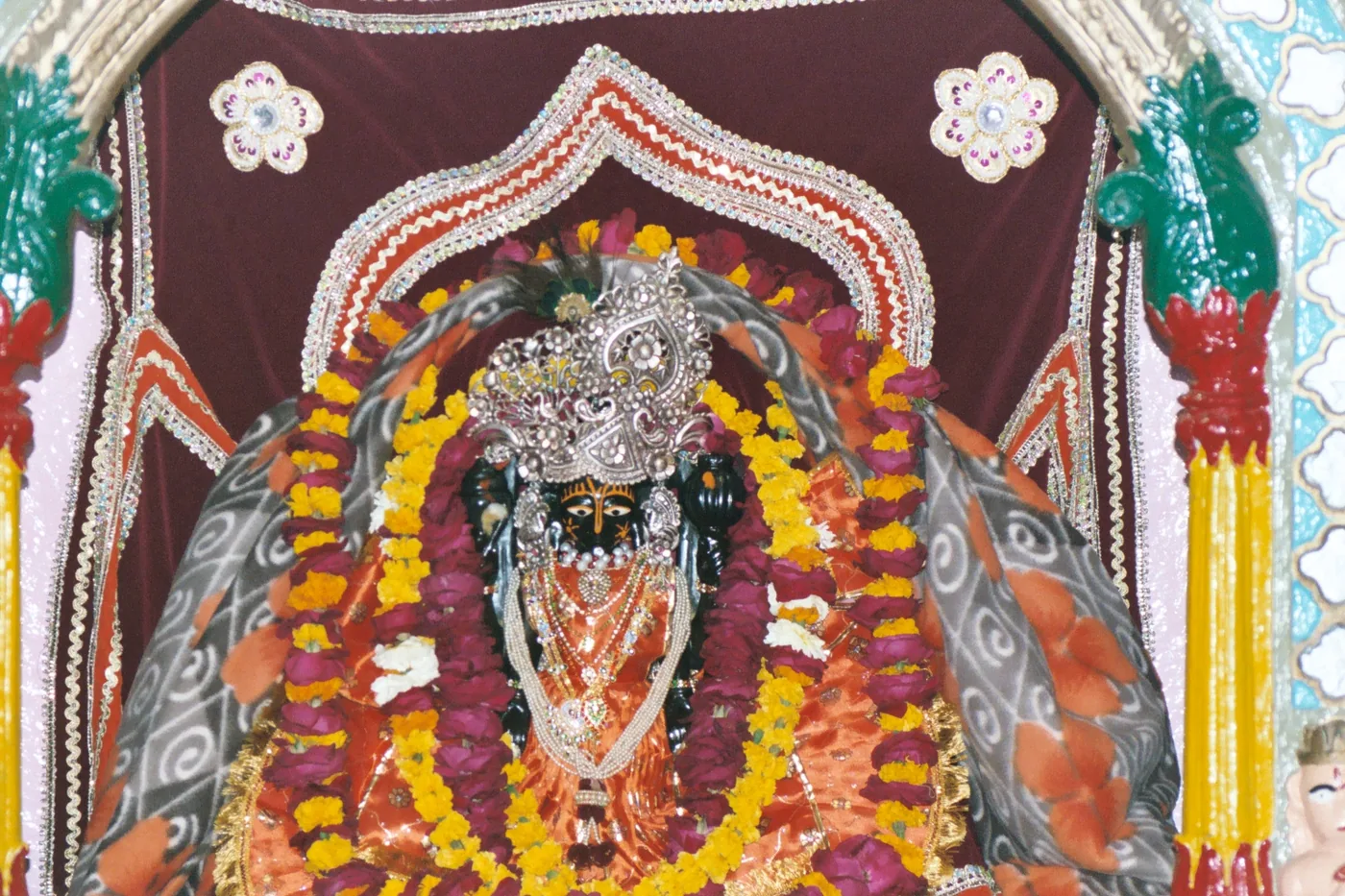
At every place of Krishna's pastimes Raghava also told what Mahaprabhu had done there, so the two came to know Vraja in the light of Mahaprabhu's visit.
Vishranti, the Ghatas and His Tears #
At Vishranti-tirtha, where Krishna rested after killing Kamsa, Raghava described the crowds who ran wild with joy when "the crest-jewel of sannyasis" came to Mathura, unable to take their eyes off Gauracandra (Bhakti-ratnakara, Fifth Wave, p. 170). At the twenty-four ghatas, the bathing steps along the Yamuna, he said that Mahaprabhu had bathed at every one (pp. 178-179).
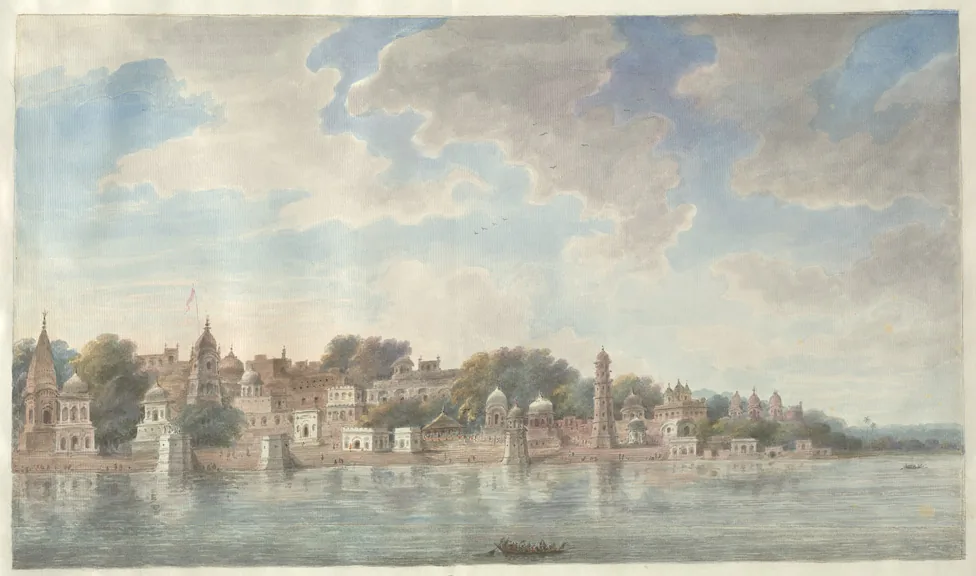
At another place he told how the brahmanas of Mathura said to one another that this sannyasi was surely Krishna, hiding Himself in a golden form (pp. 183-184). Then his own heart gave way:
aiche kata kahite śrī-rāghava-paṇḍita / hailā adhairya cinti caitanya-carita
śrīnivāsa narottama dhairya nāhi bāndhe / hā hā prabhu baliyā bhūmite paḍi kānde
śrī-rāghava-paṇḍitera caraṇe dhariyā / doṅhe kata kahe śuni vidaraye hiyā
śrī-paṇḍita sthira haiyā doṅhe sthira kaila / mathurāra āra ye tīrtha dekhāila
"While saying such things, Sri Raghava Pandita lost all composure as he thought of Sri Chaitanya's life. Shrinivasa and Narottama could not hold themselves; crying 'Ha ha Prabhu!', they fell to the ground and wept. Clasping Sri Raghava Pandita's feet, the two said things that break the heart to hear. Sri Pandita became steady, steadied the two, and showed them the other holy places of Mathura." (Bhakti-ratnakara, Fifth Wave, p. 184, 1912 Bengali edition; English rendering ours)
His tears were part of the lesson. Srila Prabhupada writes: "The purpose of pilgrimages is to remember the Lord constantly, and therefore the Lord is known as tīrtha-kīrti." (Srimad-Bhagavatam 3.1.45, purport)
Into the Twelve Forests #
Before leaving Mathura, Raghava spoke "in very sweet words" of the month Gopala spent there, when Rupa Goswami came with his companions and was overwhelmed to see Him (Bhakti-ratnakara, Fifth Wave, p. 184; the Chaitanya-charitamrita also tells of that month in Madhya 18.47). Beside an old tree he told how Nityananda Prabhu had stayed there on pilgrimage and wandered about unrecognised, overjoyed to see His former birthplace (p. 184). Then he turned to the forests:
rāghava-paṇḍita ati manera ullāse / śrīnivāsa prati kichu kahe mṛdu bhāṣe
"Raghava Pandita, full of joy, spoke a few words to Shrinivasa in a soft voice." (Bhakti-ratnakara, Fifth Wave, p. 184, 1912 Bengali edition; English rendering ours)
Mathura with its twelve forests, he said, is "sacred, removes sin, is auspicious, of unique sweetness", and he explained the forests from the Padma and Skanda Puranas (pp. 184-186). On the parikrama path, the route pilgrims walk around the holy places, it came to his mind to show them Shashthikaratavi. He left the usual road and told Shrinivasa: "Formerly this was called Shashthikaratavi; now people call it Shashthighara" (pp. 187-188). All through the tour he gave both names, the old and the new.
At Bahulavana he told, full of joy, how hundreds of thousands of cows ran to Mahaprabhu with their tails raised and gathered round Him, and how He touched them with His hand as He had once herded them (p. 189). The Chaitanya-charitamrita says the same: "When Śrī Caitanya Mahāprabhu passed through Vṛndāvana, herds of grazing cows saw Him pass and, immediately surrounding Him, began to moo very loudly." (Sri Chaitanya-charitamrita Madhya 17.194) From there the road led on to Radha-kunda and Govardhana, and later to the forests described in Through the Forests of Vraja.
The Holy Place and the Holy Man #
Jiva Goswami did not send the two young men alone. He gave them a great Vaishnava who lived in the holy land, and the Srimad-Bhagavatam explains why that matters:
bhavad-vidhā bhāgavatās
tīrtha-bhūtāḥ svayaṁ vibho
tīrthī-kurvanti tīrthāni
svāntaḥ-sthena gadābhṛtā
"My lord, devotees like your good self are verily holy places personified. Because you carry the Personality of Godhead within your heart, you turn all places into places of pilgrimage." (Srimad-Bhagavatam 1.13.10)
Srila Prabhupada writes in the purport: "If anyone visits a holy place, he must search out the pure devotees residing in such holy places, take lessons from them, try to apply such instructions in practical life and thus gradually prepare oneself for the ultimate salvation, going back to Godhead." (Srimad-Bhagavatam 1.13.10, purport) Shrinivasa and Narottama had such a devotee beside them, holding Shrinivasa's hand, proving every place from the scriptures and weeping for Sri Chaitanya. Years later Shrinivasa still spoke of touring Vraja "with Sri Raghava" (see Last Teachings in Vrindavana and the Farewell). As Srila Prabhupada said: "The real purpose of going to holy places is to find out there the holy man and take knowledge from him. That is real going to the holy places of pilgrimage." (room conversation, Geneva, 4 June 1974)
Scriptural evidence for this chapter (12)
Quoted in the text above:
- Bhakti-ratnakara, Fourth Wave, p. 145 (1912 ed.)
- Bhakti-ratnakara, Fifth Wave, p. 149 (1912 ed.)
- Bhakti-ratnakara, Fifth Wave, p. 150 (1912 ed.)
- Bhakti-ratnakara, Fifth Wave, p. 150 (1912 ed.)
- Bhakti-ratnakara, Fifth Wave, p. 151 (1912 ed.)
- Bhagavad-gita 4.2 quoted above ↑
- Bhakti-ratnakara, Fifth Wave, p. 165 (1912 ed.)
- Bhakti-ratnakara, Fifth Wave, p. 165 (1912 ed.)
- Bhakti-ratnakara, Fifth Wave, p. 167 (1912 ed.)
- Bhakti-ratnakara, Fifth Wave, p. 184 (1912 ed.)
- Bhakti-ratnakara, Fifth Wave, p. 184 (1912 ed.)
- Srimad-Bhagavatam 1.13.10 quoted above ↑
Chapter 3
At Radha-kunda With Raghunatha Dasa Goswami
Raghava's closeness to Raghunatha Dasa Goswami: the stories he told at Radha-kunda, the meeting he arranged, and the message he carried years later to Jahnava Mata.
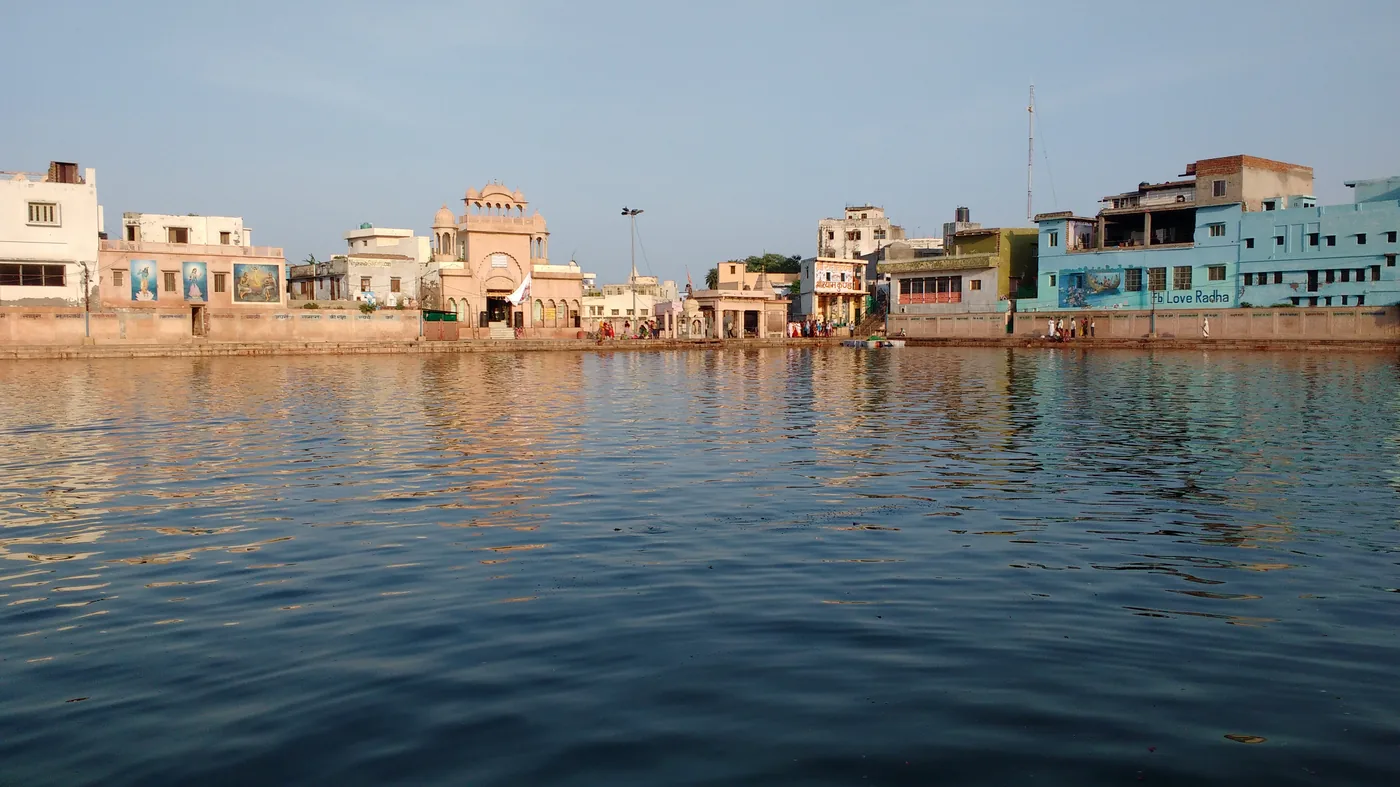
Srila Raghava Pandita Goswami lived in a cave at Govardhana, but now and then he stayed at Radha-kunda, the holy lake at the foot of the same hill, with Raghunatha Dasa Goswami. Narahari Chakravarti Thakura says so in his Bhakti-ratnakara: "now and then he stays with Dasa Goswami" (Bhakti-ratnakara, Fifth Wave, p. 150). He even praises the two saints in one couplet: "Glory to Raghunatha Dasa, who lives at Sri Radha-kunda! Glory, glory to Sri Raghava, who lives at Govardhana!" (Third Wave, opening). (This Raghava is a different person from Raghava Pandit of Panihati.)
To this lake Raghava brought Shrinivasa Acharya and Narottama Dasa Thakura, whom Srila Jiva Goswami had sent with him to see the holy places of Vraja. Here he told them story after story about Raghunatha and brought them before him, and years later he carried Raghunatha's message to Jahnava Mata. The sources show a close and loving bond between the two saints, but they never call Raghava Raghunatha's disciple.
The Lake Most Dear to Krishna #
For Gaudiya Vaishnavas, Radha-kunda is the highest of all holy places, because it is Srimati Radharani's own lake, and Lord Krishna loves it as He loves Her. Srila Rupa Goswami teaches this in his Nectar of Instruction, here in the translation of Srila Prabhupada:
"Of the many objects of favored delight and of all the lovable damsels of Vraja-bhūmi, Śrīmatī Rādhārāṇī is certainly the most treasured object of Kṛṣṇa’s love. And, in every respect, Her divine kuṇḍa is described by great sages as similarly dear to Him. Undoubtedly Rādhā-kuṇḍa is very rarely attained even by the great devotees; therefore it is even more difficult for ordinary devotees to attain. If one simply bathes once within those holy waters, one’s pure love of Kṛṣṇa is fully aroused." (Nectar of Instruction, verse 11)
How, then, does anyone come to live on its banks? Raghava gave Shrinivasa his answer at the lake itself.
How the Two Kundas Appeared and Were Found #
The road came to Radha-kunda from Arit, where, Raghava said, Krishna killed Arishta, a demon in the form of a bull (Bhakti-ratnakara, Fifth Wave, p. 190). Smiling, Srimati Radharani teased Him that this had made Him impure, and only a bath in all the holy places would purify Him. So Krishna struck the ground with His foot, and a kunda filled with the waters of all the holy places. Radha and Her friends quickly dug a kunda of their own; the holy places entered it from Shyama-kunda, praising Her, and both kundas were filled with holy water (pp. 190-191).
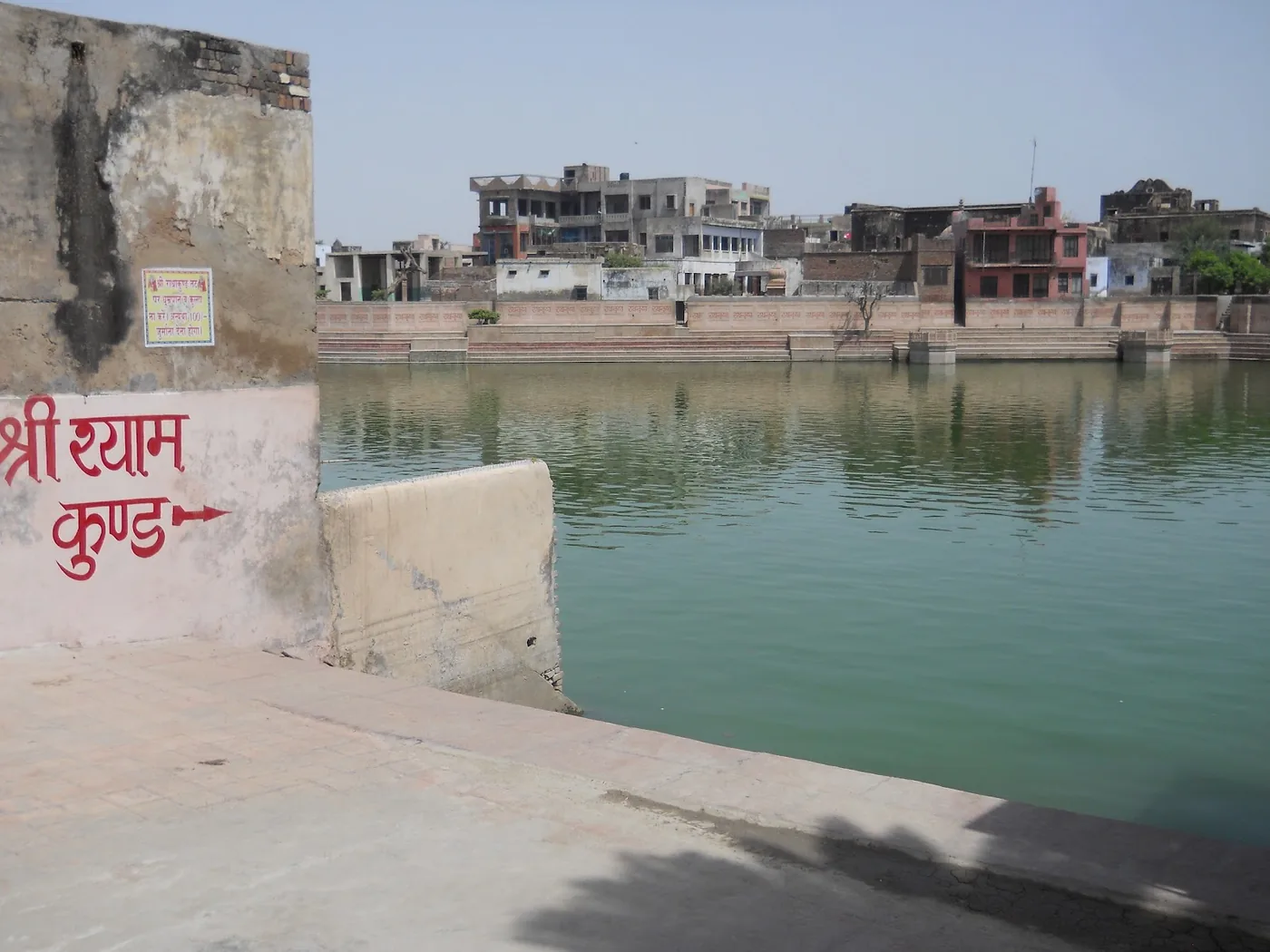
At the lake Raghava said, "See, Shrinivasa, the two kundas, Radha-kunda and Shyama-kunda" (p. 194), and he told how Sri Chaitanya Mahaprabhu had found them. The Lord sat under "this tamala tree" and asked the villagers about the two kundas, but no one could tell Him. Then He, who knows everything, saw the hidden kundas in two paddy fields. He bathed joyfully in their little water, praised the kunda, and marked His body with tilaka made from its clay, while the villagers looked on in wonder (pp. 194-195). Raghava told this, as always, as a pastime of that place, not as something he had seen. The Chaitanya-charitamrita agrees: "However, being the omniscient Supreme Personality of Godhead, He discovered Rādhā-kuṇḍa and Śyāma-kuṇḍa in two paddy fields. There was only a little water, but He took His bath there." (Sri Chaitanya-charitamrita Madhya 18.5)
Then Raghava told "briefly" how the paddy fields became lakes again (p. 195). One day Raghunatha Dasa Goswami thought how good it would be if the two kundas were full of water, and at once he blamed himself, because such a wish showed some desire for wealth. But, Raghava said, "Krishna fulfils what is in a devotee's heart." In a dream Narayana told a wealthy man who had offered many coins at Badarikashrama to take them to Raghunatha at Arit, and to remind him of his wish if he refused them. Raghunatha, stunned by the Lord's message, had the mud cleared from the two kundas, and when he saw them full of clear water he was overjoyed (pp. 195-196). Srila Prabhupada writes: "Later the pond was excavated by Lord Caitanya’s devotees, headed first by the Six Gosvāmīs, such as Rūpa and Raghunātha dāsa." (Nectar of Instruction, verse 9, purport)
Raghava's Stories of Raghunatha #
Then Raghava spoke of Raghunatha's own life of bhajana at Radha-kunda. Raghunatha used to stay under a tree day and night. One day Sanatana Goswami, who had come to the lodging of Gopala Bhatta Goswami at the kunda, saw a tiger drink at the ghata and pass close to Raghunatha as he sat in meditation. Sanatana embraced Raghunatha and told him gently, "From now on, instead of under the tree you will stay in a hut." From then on, for the good of others, Raghunatha lived in a hut (Bhakti-ratnakara, Fifth Wave, pp. 196-197). "O Shrinivasa," Raghava said, "how much of all Raghunatha's ways can I tell with one mouth?"
Raghunatha had given up grains, and his rule was to drink just one leaf-cup of buttermilk. A Vrajavasi named Dasa, whom he loved very much, once made a bigger cup from a large palasha leaf he had found at Sakhisthali, so that Raghunatha would take a little more. Hearing where the leaf came from, Raghunatha threw the cup away and said, "That is Candravali's village; do not go there" (p. 197). In Vraja, as Srila Prabhupada once wrote, "there is Radharani's party and there is Candravali's party" (letter of 6 December 1974). "The bodies of all these devotees are eternally perfect (nitya-siddha)," Raghava said, "and only a wretch doubts it."
Another time Raghunatha ate milk-rice offered to the Lord, in his mind, and his body grew heavy with indigestion. Vitthalanatha, the son of Vallabha Bhatta, brought two physicians, who felt his pulse and said that he had eaten milk-rice. Vitthalanatha was amazed, because milk-rice was impossible for Raghunatha. Then Raghunatha said, "This is the very truth: in my mind I ate milk-rice," and everyone was struck with wonder (pp. 197-198). From these stories Raghava drew his own conviction, and he spoke it to Shrinivasa as a certainty:
ahe śrīnivāsa e niścaya jāna cite / rādhā-kuṇḍa vāsa raghunātha kṛpā haite
śrī-kuṇḍa śrī-govardhana śilā guñjā-hāra / śrī-raghunāthera ei sevā supracāra
"O Shrinivasa, know this for certain in your heart: one gets to live at Radha-kunda by the mercy of Raghunatha. Sri Radha-kunda, the Govardhana-shila and the gunja-mala: this service of Sri Raghunatha is well known." (Bhakti-ratnakara, Fifth Wave, p. 198, 1912 Bengali edition; English rendering ours)
The Govardhana-shila, a stone from Govardhana Hill, and the gunja-mala came to Raghunatha from Sri Chaitanya Mahaprabhu Himself. When Raghunatha lived near Him at Jagannatha Puri, the Lord gave him both and told him, "This stone is the transcendental form of Lord Kṛṣṇa. Worship the stone with great eagerness." (Sri Chaitanya-charitamrita Antya 6.294) Krishnadasa Kaviraja Goswami records how Raghunatha understood the gift:
“śilā diyā gosāñi samarpilā ‘govardhane’
guñjā-mālā diyā dilā ‘rādhikā-caraṇe’ ”
"“By offering me the govardhana-śilā, Śrī Caitanya Mahāprabhu has offered me a place near Govardhana Hill, and by offering me the garland of conchshells, He has offered me shelter at the lotus feet of Śrīmatī Rādhārāṇī.”" (Sri Chaitanya-charitamrita Antya 6.307)
Mahaprabhu gave Raghunatha shelter at Srimati Radharani's feet; and it is by Raghunatha's mercy, Raghava says, that anyone else comes to live at Her lake.
Bringing the Two to Raghunatha Dasa Goswami #
First Raghava showed the two young devotees other kundas nearby: Malyahari-kunda, where a pastime with a pearl necklace took place, as Raghunatha describes in his Mukta-carita, and the kundas called Shiva-khora and Bhanu-khora. "Saying this, Raghava's heart was full of joy" (Bhakti-ratnakara, Fifth Wave, p. 198). Then he took them to Raghunatha:
śrī-rāghava-paṇḍita sakala nivedila / śuni dāsa-gosvāmira citte harṣa haila
śrīnivāsa narottama ati sāvadhāne / bhūme paḍi praṇamilā gosvāmi-caraṇe
gosvāmira śuṣka deha durbalātiśaya / tathāpi uṭhiyā dui bāhu pasāraya
"Sri Raghava Pandita told him everything, and Dasa Goswami's heart was delighted to hear it. Very respectfully, Shrinivasa and Narottama fell to the ground and bowed at the Goswami's feet. The Goswami's body was dried up and extremely weak, yet he rose and opened both his arms to them." (Bhakti-ratnakara, Fifth Wave, p. 198, 1912 Bengali edition; English rendering ours)
Narahari's word for Raghava's report is nivedila, "he submitted", a word of respect for what one humbly places before an elder. Raghunatha embraced the two and spoke softly to Shrinivasa. Krishnadasa Kaviraja, who loved Shrinivasa as his own life, came to them, and so did Dasa and the other Vaishnavas living on the bank, who quickly had food prepared (p. 198). They honoured mahaprasada, food offered to the Lord, "where Sri Gopala Bhatta Goswami's hut is" (p. 199), the hut of Shrinivasa's own guru.
Shrinivasa had been here once before, soon after his initiation, when "Sri Raghava, Krishnadasa Kaviraja and the others all showed Shrinivasa the greatest mercy" (Bhakti-ratnakara, Fourth Wave, p. 145). This time Raghava himself brought him. After a day of great joy, "the Pandita set out at dawn, taking the two with him" (p. 199), to go round Govardhana Hill.
Govinda-ghata and a Night of Krishna-katha #
After the circuit of Govardhana, the Pandita brought Shrinivasa joyfully back to Radha-kunda. At Govinda-ghata, "very dear to Govinda", he bathed and said, "O Shrinivasa, I will tell you the pastime that happened under this tree" (Bhakti-ratnakara, Fifth Wave, p. 210). Once, he said, Sanatana came from Govardhana and questioned a verse of Rupa's that compares a braid of hair to a serpent. Then, at the kunda, Sanatana saw some young girls playing under the tree. He took one girl's braid for a serpent climbing to her head and called out in alarm. The girls smiled a little and vanished, and Sanatana went to Rupa and said, "What you wrote is true."
Rupa had come for Raghunatha's sake. His play Lalita-madhava, in which the pain of separation reaches its limit, had made Raghunatha weep day and night like a madman. As a medicine for him Rupa wrote the Dana-keli-kaumudi. "Reading the Dana-keli," Raghava said, "Raghunatha, best of the wise, was immersed for ever in an ocean of joy. O Shrinivasa, how much can I tell of all the ways of Sanatana, Rupa and Raghunatha?" (pp. 210-211).
Then Raghava showed them the places around the lake: Nimagrama, where the gopis, coming out from Govardhana, gazed at Krishna's face and waved offerings (nirmanchana) to Him; Kunjera, at the edge of Radha-kunda's groves; and Surya-kunda, where Radha worships the sun with Her friends while Krishna Himself plays the priest (Bhakti-ratnakara, Fifth Wave, pp. 211-212). Then they came back to Radha-kunda full of joy:
se divasa rādhā-kuṇḍa-taṭei rahilā / kṛṣṇa-kathāya sei niśā prabhāta karilā
"That day they stayed on the very bank of Radha-kunda, and they passed the whole night until dawn in talk about Krishna." (Bhakti-ratnakara, Fifth Wave, p. 212, 1912 Bengali edition; English rendering ours)
Gathuli and the Service of Gopala #
From Radha-kunda they went to Gathuli, and Raghava told how it got its name: after playing Holi, Radha and Krishna sat on a throne, and a sakhi secretly tied Their garments together in a knot, a ganthi (Bhakti-ratnakara, Fifth Wave, pp. 212-213). There they had darshan of Gopala, the Deity whom Madhavendra Puri had served, and His beauty took away their composure. Vitthalanatha, the son of Vallabha Bhatta, showed them more love than words can tell (p. 213).
Then came Gopala's history. In the mood of a devotee, Sri Chaitanya Mahaprabhu would not set foot on Govardhana Hill, yet He wished to see Gopala, and Gopala came to Gathuli "on a pretext". Seeing Him, the Lord was lost in dancing and singing. In those days two Bengali brahmanas, disciples of Madhavendra Puri, served Gopala. After they passed away, a new servant had to be chosen, and Srila Prabhupada quotes Narahari's lines about that choice in his purport:
śrī-dāsa-gosvāmī ādi parāmarśa kari’
śrī-viṭhṭhaleśvare kailā sevā-adhikārī
"After consulting together, Sri Dasa Goswami and the others made Sri Vitthaleshvara the one in charge of the service." (Sri Chaitanya-charitamrita Madhya 18.47, purport, quoting the Bhakti-ratnakara; English rendering ours, since the purport gives these lines without a translation)
Vitthaleshvara is Vitthalanatha, the younger son of Vallabha Bhatta, who was now always attentive in Gopala's service (pp. 213-214). The book does not mark exactly where Narahari's narration ends and Raghava's words begin, but it closes: "Having told Gopala's qualities, Raghava Pandita left Gathuli full of joy" (p. 214). So Raghava told this history, and the choice in it had been made by Raghunatha and the devotees around him. From Gathuli he led the two on to the forests of Vraja.
A Message for Jahnava Mata #
Years after the tour, the book shows Raghava once more in Raghunatha's service. After the great festival at Kheturi, Jahnava Mata, the wife of Nityananda Prabhu, came to Vrindavana. Raghunatha was delighted to hear of her coming, but he had no strength to travel: his heart was always restless in separation from Sri Rupa, and without food his body had become extremely thin. So he sent his humble message through Krishnadasa Kaviraja and many others (Bhakti-ratnakara, Eleventh Wave, p. 667):
gopāla rāghava paṇḍitādi eka sāthe / cale nandīśvara govardhanādi haite
sabe vṛndāvane kari' īśvarī darśana / jānāilā dāsa-gosvāmira nivedana
"Gopala, Raghava Pandita and others set out together from Nandishvara, Govardhana and other places. In Vrindavana they all had darshan of Ishvari [Jahnava Devi] and conveyed Dasa Goswami's request." (Bhakti-ratnakara, Eleventh Wave, p. 667, 1912 Bengali edition; English rendering ours)
Jahnava Mata told Gopala Bhatta Goswami and the other Goswamis that she would go to Sri-kunda in the morning, and when she saw its beauty her heart overflowed with love (p. 667). Raghava is not named again during her visit, but these lines show him, long after the tour, still living near Govardhana and still close to Raghunatha.
The Mercy of the Vaishnavas #
Rupa Goswami calls Radha-kunda "very rarely attained even by the great devotees". It is not won by learning or effort alone; it is given by the mercy of the pure devotees who live there. Raghava was "expert in all the scriptures" (p. 150), yet this is just what he told Shrinivasa: "one gets to live at Radha-kunda by the mercy of Raghunatha." Raghunatha himself had received that mercy from Mahaprabhu, who, as he said, "has offered me shelter at the lotus feet of Śrīmatī Rādhārāṇī".
Raghava's own life shows how such mercy is received. He stayed with Raghunatha, told the stories of Raghunatha's life with love, brought two young devotees to bow at his feet, and years later carried his humble message to Jahnava Mata. For anyone who longs for Radha-kunda, Raghava shows the way: serve the devotees who belong to it, and pray for their mercy.
Scriptural evidence for this chapter (7)
Quoted in the text above:
- Nectar of Instruction, verse 11 quoted above ↑
- Bhakti-ratnakara, Fifth Wave, p. 198 (1912 ed.)
- Sri Chaitanya-charitamrita Antya 6.307 quoted above ↑
- Bhakti-ratnakara, Fifth Wave, p. 198 (1912 ed.)
- Bhakti-ratnakara, Fifth Wave, p. 212 (1912 ed.)
- Sri Chaitanya-charitamrita Madhya 18.47, purport quoted above ↑
- Bhakti-ratnakara, Eleventh Wave, p. 667 (1912 ed.)
Chapter 4
Around Govardhana Hill and His Own Cave
On the Govardhana circuit Raghava showed Shrinivasa the places of Krishna, Mahaprabhu and the Goswamis, and then his own cave, where Radha and Krishna play without end.
Srila Raghava Pandita Goswami had spent a day of great joy at Radha-kunda with his two young companions, Shrinivasa Acharya and Narottama Dasa Thakura, whom Srila Jiva Goswami had sent with him to see the holy places of Vraja (see Jiva Goswami Entrusts Shrinivasa and Narottama to Him). They had honoured mahaprasada, food offered to the Lord, at the hut of Gopala Bhatta Goswami, and then "the Pandita set out at dawn, taking the two with him" (Bhakti-ratnakara, Fifth Wave, p. 199), to go round the hill that was his home.
Narahari Chakravarti Thakura, who tells this story in his Bhakti-ratnakara, says of Raghava: "Sri Govardhana Hill is his everything; he lives at Govardhana" (Bhakti-ratnakara, Fifth Wave, p. 150). On this circuit Raghava showed the two the places of Krishna's pastimes. At many of them he told what Sri Chaitanya Mahaprabhu, Nityananda Prabhu and the Goswamis had done there. And on the way he brought them to the one place he called his own: a cave near Apsara-kunda, "at the end of Govardhana."
Govardhana in the Eyes of a Gaudiya Vaishnava #
For a Gaudiya Vaishnava, Govardhana is no ordinary hill. In the Nectar of Instruction, Srila Rupa Goswami places it above even the forest of Vrindavana, "for it was raised by the divine hand of Śrī Kṛṣṇa and was the site of His various loving pastimes" (Nectar of Instruction, verse 9). Only Radha-kunda, at its foot, stands higher. Srila Prabhupada explains in his purport: "It is also at Govardhana Hill that Kṛṣṇa tends the cows with His cowherd friends, and there also He had His rendezvous with His most beloved Śrī Rādhā and engaged in loving pastimes with Her."
Sri Chaitanya Mahaprabhu showed by His own example how a devotee looks at this hill:
govardhana dekhi’ prabhu ha-ilā daṇḍavat
‘eka śilā’ āliṅgiyā ha-ilā unmatta
"When the Lord saw Govardhana Hill, He immediately offered obeisances, falling down on the ground like a rod. He embraced one piece of rock from Govardhana Hill and became mad." (Sri Chaitanya-charitamrita Madhya 18.16)
This was the hill that Raghava called his everything, and now, place by place, he began to show it to Shrinivasa and Narottama.
From Kusuma-sarovara to Govinda-kunda #
South of Radha-kunda lies the village of Mukharai. There the Pandita told Shrinivasa that there are many places of pastimes all around Govardhana (Bhakti-ratnakara, Fifth Wave, p. 199). He showed him Kusuma-sarovara "in this forest," where Radha and Krishna had wonderful play while gathering flowers, and Narada-kunda, where the sage Narada performed austerities and, through Vrinda's instruction, the desire of his heart was fulfilled.
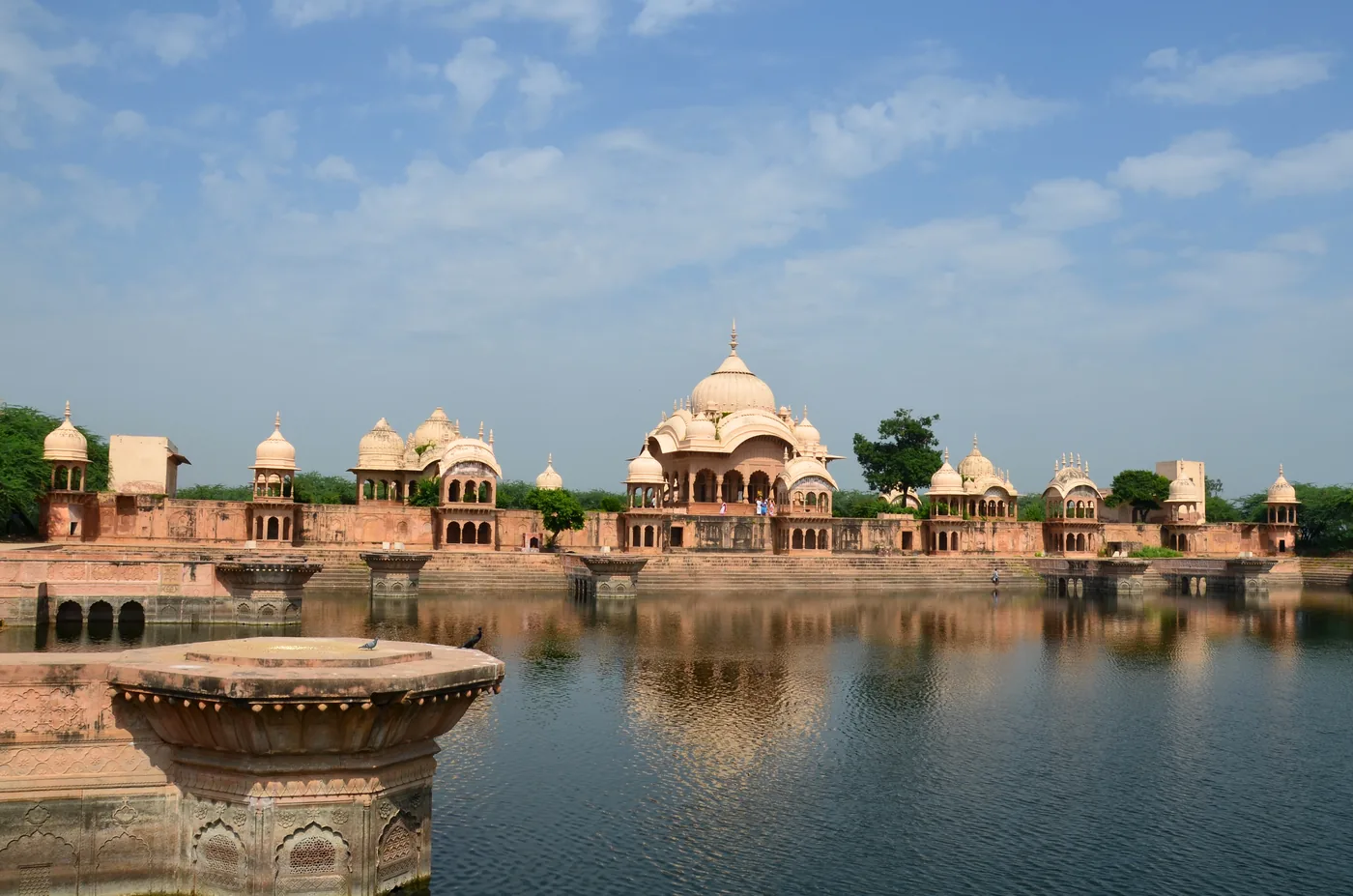
Then came Ratna-simhasana, Parasauli of the spring rasa dance, Paitha and many more. At each place the book adds verses from Raghunatha Dasa Goswami's Vraja-vilasa-stava, Rupa Goswami's Ujjvala-nilamani and the Puranas (pp. 199-202). On these pages Narahari notes only one thing about the guide himself, his joy: "the Pandita joyfully said, 'See, Shrinivasa'" (p. 201). At Aniyora he spoke to Shrinivasa in words that Srila Prabhupada quotes in the Chaitanya-charitamrita:
gopa-gopī bhuñjāyena kautuka apāra
ei hetu ‘āniyora’ nāma se ihāra
annakūṭa-sthāna ei dekha śrīnivāsa
e-sthāna darśane haya pūrṇa abhilāṣa
"“Here all the gopīs and the gopas enjoyed wonderful pastimes with Śrī Kṛṣṇa. Therefore this place is also called Āniyora. The Annakūṭa ceremony was celebrated here. O Śrīnivāsa, whoever sees this place has all his desires fulfilled.”" (Sri Chaitanya-charitamrita Madhya 18.26, purport)
Srila Prabhupada does not name the speaker, but in the Bhakti-ratnakara these are Raghava's words. So a few sentences from this walk still reach devotees today through Srila Prabhupada's books. Close by is Govinda-kunda, where "Indra, defeated by Lord Govinda, offered prayers to Him and bathed Him" (Sri Chaitanya-charitamrita Madhya 18.37, purport). Near the kunda Raghava pointed to a thick wood: "Look at the dense forest near the kuṇḍa. It was there that Gopāla was concealed" (Sri Chaitanya-charitamrita Madhya 18.26, purport). He showed them the place under a tree where Madhavendra Puri had stayed (p. 202), and Gopala's place on the hill, adding that from time to time Gopala stays at Gathuli (p. 203).
This Is My Cave #
Going on, they came to the place where Govardhana ends. The few lines in which the Bhakti-ratnakara records what Raghava said there are among the most precious in his whole story (Bhakti-ratnakara, Fifth Wave, p. 203).
First he showed them a sacred pond and an ancient tree:
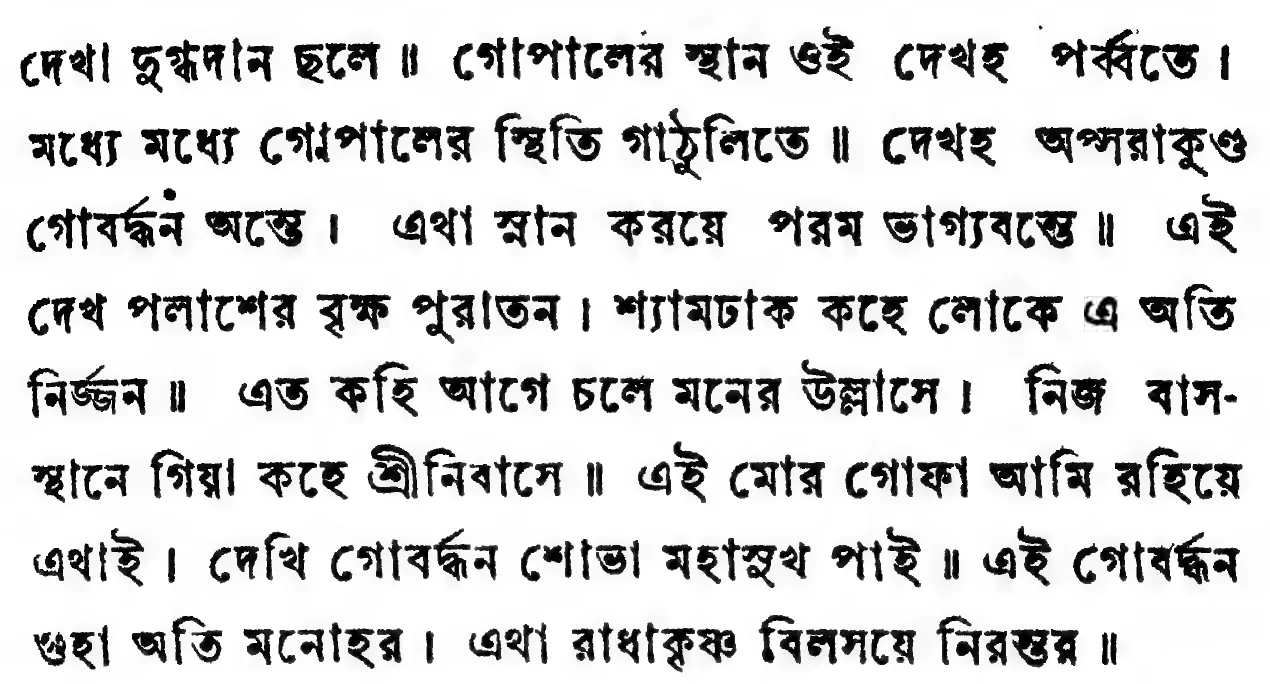
dekhaha apsarā-kuṇḍa govardhana ante / ethā snāna karaye parama bhāgyavante
ei dekha palāśera vṛkṣa purātana / śyāma-ḍhāka kahe loke e ati nirjana
"'See Apsara-kunda at the end of Govardhana; the most fortunate bathe here. And see this ancient palasha tree. People call this place Shyama-dhaka; it is very secluded.'" (Bhakti-ratnakara, Fifth Wave, p. 203, 1912 Bengali edition; English rendering ours)
Then he brought them to his home:
eta kahi āge cale manera ullāse / nija vāsa-sthāne giyā kahe śrīnivāse
ei mora gophā āmi rahiye ethāi / dekhi govardhana śobhā mahā-sukha pāi
ei govardhana guhā ati manohara / ethā rādhā-kṛṣṇa vilasaye nirantara
"Saying this, he went on with joy in his heart. Reaching his own dwelling place, he said to Shrinivasa, 'This is my cave; I live right here. Seeing the beauty of Govardhana, I feel great happiness. This cave of Govardhana is most charming; here Radha and Krishna enjoy Their pastimes without end.'" (Bhakti-ratnakara, Fifth Wave, p. 203, 1912 Bengali edition; English rendering ours)
These lines are the only place in the old books where we hear Raghava speak of his own home. He calls it a gopha, a cave. He says that he lives right there, that the beauty of Govardhana fills him with happiness, and that Radha and Krishna enjoy Their pastimes there without end. He says nothing about his comfort or hardship, and the book does not describe the cave itself. Narahari at once adds a verse of Raghunatha Dasa Goswami, with whom Raghava stayed from time to time at Radha-kunda:
yeṣāṁ kvāpi ca mādhavo viharate snigdhair vayasyotkarais
tad-dhātu-drava-puñja-citritataraiś taiś taiḥ svayaṁ citritaḥ
khelābhiḥ kila pālanair api gavāṁ kutrāpi narmotsavaiḥ
śrī-rādhā-sahito guhāsu ramate tān śaila-varyān bhaje
"I worship those best of hills where Madhava sometimes plays with crowds of loving friends, who, brightly painted with the liquid minerals of those hills, paint Him too; where He plays games and herds the cows; and where, in the caves, He enjoys joking pastimes with Sri Radha." (Vraja-vilasa-stava 65, as quoted in the Bhakti-ratnakara, p. 203; English rendering ours)
The verse speaks of all the caves of Govardhana, and the Bhakti-ratnakara applies it to Raghava's cave. For him, a cave on this hill was a place of nearness to Radha and Krishna. This helps us understand Narahari's earlier picture of him: "Grey with the dust of Vraja, he has no wish to eat. Who can understand his intense renunciation?" (p. 150; see A Brahmana of the South at Govardhana).
Where Mahaprabhu Danced Before Harideva #
From the cave they went on, past the footprint of Airavata, Indra's elephant, where "Indra spoke of Krishna's wonderful mercy," to Dana-ghati (p. 203). Here, Raghava said, Krishna, the king of rasikas (those who relish loving exchanges), demands the toll of milk products. Then he told what Sri Chaitanya Mahaprabhu had done at this spot. The Lord gently asked the brahmana travelling with Him about the toll pastime and smiled softly with joy as He heard it. Then, in ecstasy, He took darshan of the Deity of Harideva and danced so wonderfully that the people wept and said, "This is an incarnation of Harideva." Raghava ended: "O Shrinivasa, who knows how to describe how the Lord revealed Himself at Govardhana?" (Bhakti-ratnakara, Fifth Wave, p. 203).
Krishnadasa Kaviraja Goswami records the same dance: "Mad with ecstatic love, Śrī Caitanya Mahāprabhu began to dance before the Harideva Deity. Hearing of the Lord’s wonderful activities, all the people came to see Him" (Sri Chaitanya-charitamrita Madhya 18.19). Like all his stories of Mahaprabhu, Raghava tells this one in the third person and never says that he saw it. Of one such story in Mathura he said plainly, "I heard this from the mouths of the elders" (Bhakti-ratnakara, Fifth Wave, p. 165). He added that Sri Rupa had described Krishna's toll pastime in his Dana-keli-kaumudi (p. 204), and after Brahma-kunda, Manasi-ganga and darshan of Harideva, he "spoke joyfully of the glory of Govardhana" (pp. 204-205).
Two Stones of Govardhana #
Further on, Raghava told a secret pastime of Nityananda Prabhu. Near Govardhana, he said, lived a wealthy brahmana who was always overwhelmed with love for Balarama and was sure that Balarama would appear to him. Then Nityananda, who is Balarama Himself, came to Govardhana on His pilgrimage and stayed "right here" for the sake of His devotee. He accepted the brahmana's milk, butter and curd and appeared to him in a dream as Baladeva. When the brahmana wished to offer Him ornaments, Nityananda asked instead for a stone of Govardhana set in gold, and He wore it at His neck. This pastime, Raghava said, is "rare even for Brahma and the gods," and Nityananda forbade the brahmana to reveal it. Raghava added, "By seeing this place one obtains rare love" (Bhakti-ratnakara, Fifth Wave, pp. 206-208).
Next he showed Cakra-tirtha, "very famous at Govardhana" (p. 208), where Sanatana Goswami had lived with great joy. "See his hut inside the forest," Raghava said. Every day Sanatana went round Govardhana, a walk of twelve kroshas (a krosha is an old Indian measure of distance): "who else has such strength?" When Sanatana grew old, Gopinatha, Krishna Himself, came to him as a cowherd boy and gave him a stone of Govardhana marked with His own footprint, so that Sanatana could go round the stone instead. Then the boy vanished. Seeing Sanatana anxious, Krishna, unseen and full of affection, told him who He was, and Sanatana wept until he took heart (pp. 208-209).
Of the stone from Govardhana that Mahaprabhu kept with Him, Krishnadasa Kaviraja writes that "Śrī Caitanya Mahāprabhu would say, “This stone is directly the body of Lord Kṛṣṇa.”" (Sri Chaitanya-charitamrita Antya 6.292). In Raghava's two stories it is the Lord who asks for such a stone as His ornament, and the Lord who gives one to an aged devotee. Then the Pandita took Shrinivasa back to Radha-kunda (p. 210), where the stories of Rupa, Sanatana and Raghunatha and a whole night of talk about Krishna followed, as told in At Radha-kunda With Raghunatha Dasa Goswami.
Gathuli, Where Gopala Came Down #
After that night, "having gone round in this way by way of Govardhana," they went joyfully to Gathuli (Bhakti-ratnakara, Fifth Wave, p. 212). The beauty of the Gopala Deity took away their composure, and Vitthalanatha, the son of Vallabha Bhatta, showed them more love than words can tell. Raghava then told Gopala's history. In the mood of a devotee Mahaprabhu would not set foot on Govardhana, so Gopala came to Gathuli "on a pretext" to meet Him. In those days two Bengali disciples of Madhavendra Puri served Gopala; after them, "Sri Dasa Goswami and others" put Vitthaleshvara in charge of His service (pp. 213-214). Srila Prabhupada quotes these lines in his purport to Sri Chaitanya-charitamrita Madhya 18.47, and the full account is in At Radha-kunda With Raghunatha Dasa Goswami. The Chaitanya-charitamrita shows the same humility from Mahaprabhu's side:
‘govardhana-upare āmi kabhu nā caḍiba
gopāla-rāyera daraśana kemane pāiba?’
"Śrī Caitanya Mahāprabhu thought, “Since I shall not at any time climb Govardhana Hill, how shall I be able to see Gopāla Rāya?”" (Sri Chaitanya-charitamrita Madhya 18.23)
Gopala Himself answered that humble wish, as Raghava told at Gathuli. From Gathuli Raghava led the two toward the western forests, as told in Through the Forests of Vraja.
Raghava's Cave Today #
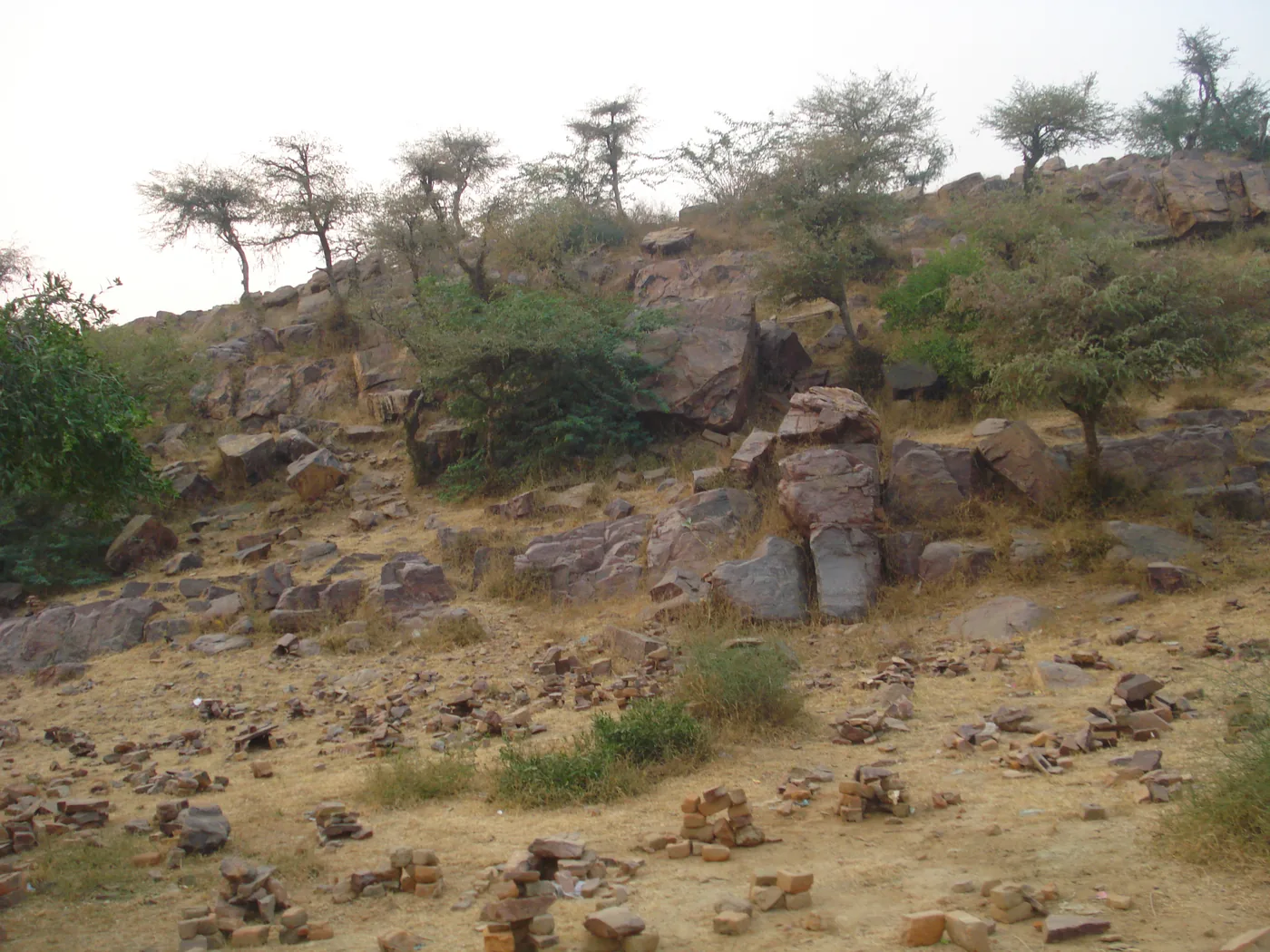
The Bhakti-ratnakara says only that Raghava's cave lay beyond Apsara-kunda, "at the end of Govardhana," and the old palasha tree of Shyama-dhaka (p. 203). A twentieth-century Gaudiya reference work, the Gaudiya Vaishnava Abhidhana of Haridasa Dasa, describes Puchari, that is Punchari, as a place at the edge of Govardhana, a mile and a half south of Govinda-kunda. North of the village, it says, are Apsara-kunda and Navala-kunda; north of the kunda is Sri Raghava Pandita's cave, and in front of the cave is the mark of Sri Krishna's crown (Gaudiya Vaishnava Abhidhana, vol. 4, p. 1908). The 1955 edition of his book calls him a "resident of the Krishna-lila place called 'Puchri' at the foot of Sri Govardhana Hill" (see Campakalata and the Krishna-bhakti-ratna-prakasha).
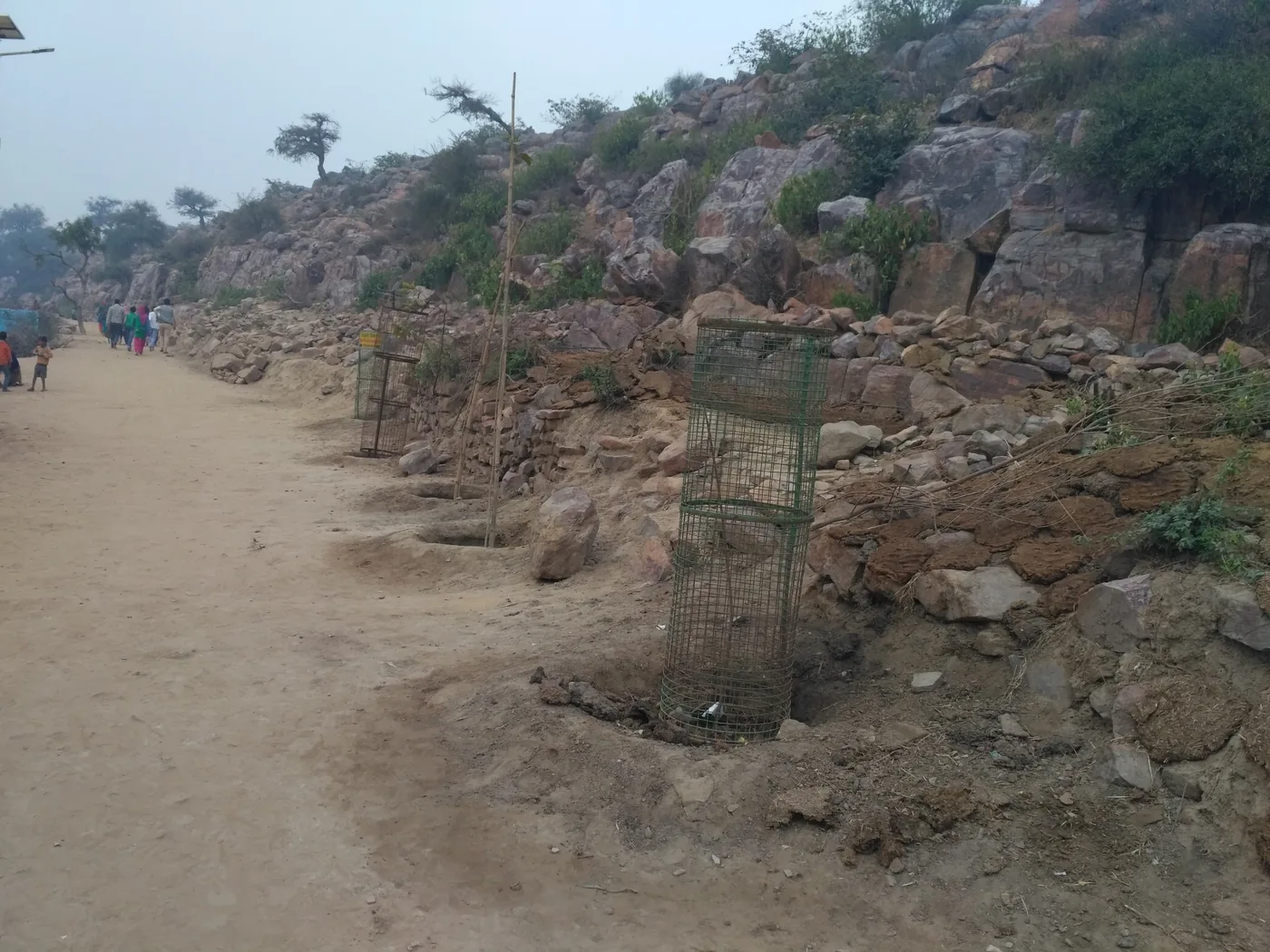
Modern guidebooks place the cave close to Apsara-kunda, near Sutala-kunda and a Sri Nathji temple at Punchari that is less than a hundred years old, and say that its mouth is now sealed. Some call it the "Mani-kandali cave," a name found in no old source, and say that a later devotee, Ramakrishna Dasa, known as Pandita Baba, did bhajana there. These are traditions of the place. Several of the same guides describe Raghava as a close associate of Mahaprabhu; that is a confusion with Raghava Pandita of Panihati, a different devotee. Pilgrims on the Govardhana parikrama pass Punchari, and the guides direct them from Apsara-kunda along a short path toward the hill. There one can offer obeisances and remember what Raghava told Shrinivasa at this spot.
Why a Devotee Lives Where Krishna Plays #
Why would a brahmana "expert in all the scriptures" (p. 150) make his home in a cave at the edge of Govardhana? One answer is in the gopis' words from the Srimad-Bhagavatam, which Mahaprabhu Himself recited as He danced on seeing the hill (Sri Chaitanya-charitamrita Madhya 18.33):
hantāyam adrir abalā hari-dāsa-varyo
yad rāma-kṛṣṇa-caraṇa-sparaśa-pramodaḥ
mānaṁ tanoti saha-go-gaṇayos tayor yat
pānīya-sūyavasa-kandara-kanda-mūlaiḥ
"“ ‘Of all the devotees, this Govardhana Hill is the best! O my friends, this hill supplies Kṛṣṇa and Balarāma, as well as Their calves, cows and cowherd friends, with all kinds of necessities — water for drinking, very soft grass, caves, fruits, flowers and vegetables. In this way the hill offers respect to the Lord. Being touched by the lotus feet of Kṛṣṇa and Balarāma, Govardhana Hill appears very jubilant.’ ”" (Sri Chaitanya-charitamrita Madhya 18.34)
The hill serves Krishna and His friends with everything they need, even caves, and one who lives in such a cave lives in the middle of Krishna's play. Raghava's life there had nothing to do with comfort or gain. Srila Prabhupada warns: "However, if one goes to Mathurā-maṇḍala-bhūmi for sense gratification or to make a livelihood, he commits an offense and is condemned" (Sri Chaitanya-charitamrita Madhya 22.132, purport). Raghava's own words tell us what kept him there: "Seeing the beauty of Govardhana, I feel great happiness." And what he saw, he gladly shared, as he shared it with Shrinivasa and Narottama. We may not be able to live at Govardhana, but we can learn from him how to see it: not as rocks and ponds, but as the place where Radha and Krishna enjoy Their pastimes without end.
Scriptural evidence for this chapter (7)
Quoted in the text above:
- Sri Chaitanya-charitamrita Madhya 18.16 quoted above ↑
- Sri Chaitanya-charitamrita Madhya 18.26, purport quoted above ↑
- Bhakti-ratnakara, Fifth Wave, p. 203 (1912 ed.)
- Bhakti-ratnakara, Fifth Wave, p. 203 (1912 ed.)
- Vraja-vilasa-stava 65 (in Bhakti-ratnakara, p. 203)
- Sri Chaitanya-charitamrita Madhya 18.23 quoted above ↑
- Sri Chaitanya-charitamrita Madhya 18.34 quoted above ↑
Chapter 5
Through the Forests of Vraja
From Kamyavana and Nandishvara to Mahavana and Raval: the stories Raghava told at each place, the nights of Krishna-katha, and the tears he could not hold back.
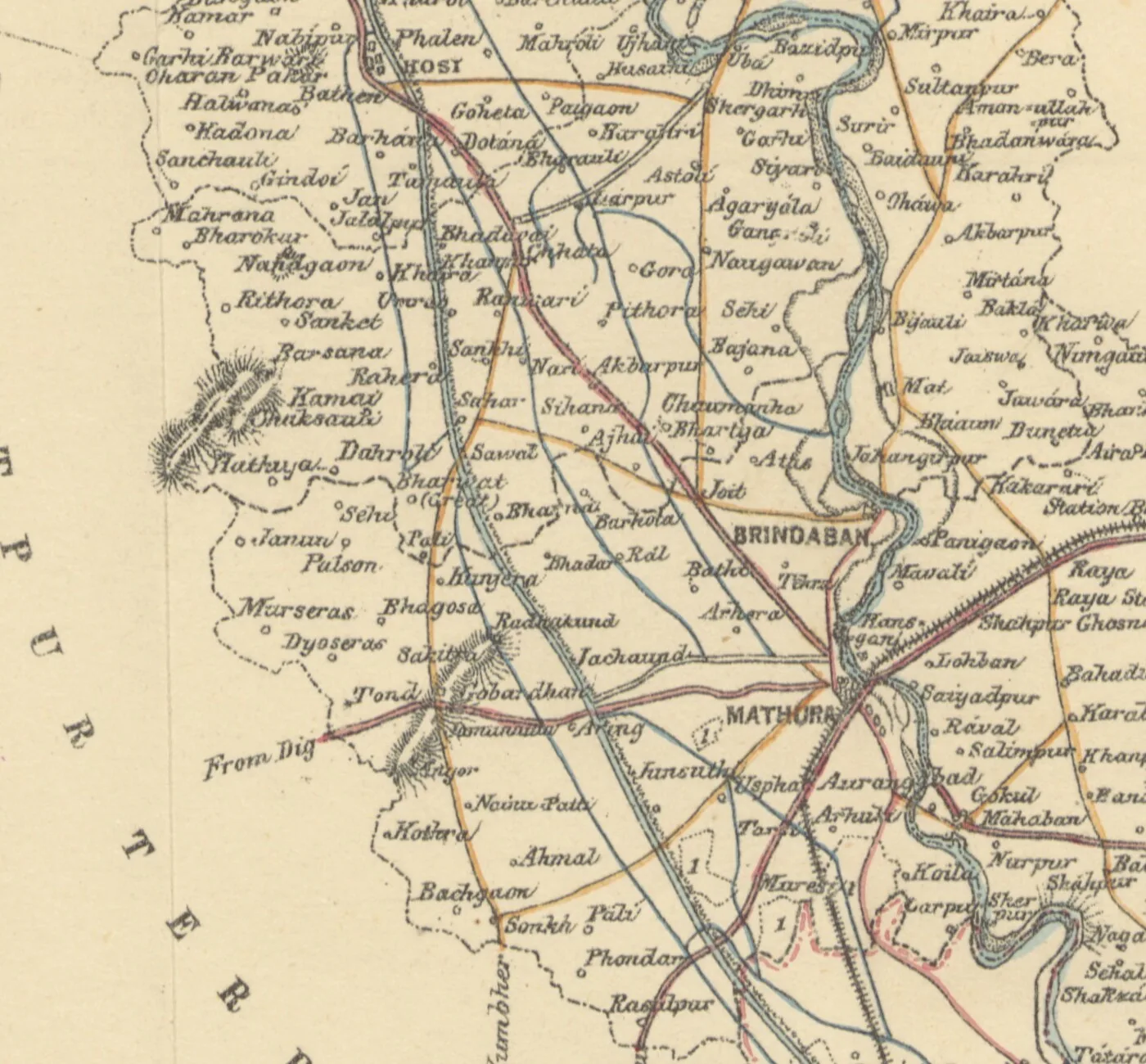
From Gathuli, Srila Raghava Pandita Goswami led Shrinivasa Acharya and Narottama Dasa Thakura away from Govardhana into the wider forests of Vraja. Srila Jiva Goswami had sent the two young devotees with him to see all the holy places (see Jiva Goswami Entrusts Shrinivasa and Narottama to Him), and they had already seen Mathura, Radha-kunda and the circuit of Govardhana. The Fifth Wave of Narahari Chakravarti Thakura's Bhakti-ratnakara now follows them to Kamyavana, through Varshana and Nandishvara, along the Yamuna, across the river to Mahavana and Gokula, and back to Mathura. At almost every place Raghava turns to Shrinivasa, says "O Shrinivasa, see," and tells what happened there: the pastimes of Krishna, the visits of Sri Chaitanya Mahaprabhu and Nityananda Prabhu, and the lives of the Goswamis who had lived in these forests.
The book does not say how many days the journey took. On this part of the road it mentions nights at Sanatana Goswami's hut at Nandishvara, at the village of Surukhuru and at Raval. But it lets us see the guide clearly. He weeps at the places where the Goswamis lived, he walks slowly because the beauty of the forest overwhelms him, he climbs a mound to look over the countryside, and he spends whole nights talking about Krishna.
From Kamyavana to Nandishvara #
Leaving Gathuli, Raghava showed one village after another, often giving both the old name and the name people used in his day, such as Pramodana, "now Paramadana" (Bhakti-ratnakara, Fifth Wave, p. 214). Then they reached Kamyavana, a forest so full of holy ponds that the book gives up trying to list them. Srila Prabhupada quotes its words:
ei kāmyavane kṛṣṇa-līlā manohara
karibe darśana sthāna kuṇḍa bahutara
kāmyavane yata tīrtha lekhā nāhi tāra
"“In this Kāmyavana, Kṛṣṇa performed enchanting pastimes. Here you will be able to take darśana of many ponds and other transcendental spots. I cannot even describe in writing all the sacred tīrthas found at Kāmyavana.”" (Sri Chaitanya-charitamrita Madhya 18.55, purport)
From Kamyavana they went on to Varshana, the town of King Vrishabhanu, the father of Srimati Radharani, and from there to Nandishvara (pp. 215-221). At Nandishvara Raghava pointed to the top of the hill: "See, on top of the hill Sri Nanda and Yashoda shine with their son in a wonderful cave." Then he told what Sri Chaitanya Mahaprabhu had done there (p. 222). The Lord entered the cave and saw Nanda and Yashoda on either side and Krishna in the middle, and His eyes blossomed with joy. He bowed at the feet of Nanda and Yashoda, touched Krishna's whole form, and began to dance and sing in the ecstasy of prema, and the people who watched said that Nanda's son seemed to have appeared again. Raghava ended humbly: "I do not know how to tell the prema that Sri Krishna-Chaitanya, crest-jewel of sannyasis, revealed here."
Krishnadasa Kaviraja Goswami tells the same scene in the Chaitanya-charitamrita: "Śrī Caitanya Mahāprabhu offered His respects to Nanda Mahārāja and mother Yaśodā, and with great ecstatic love He touched the body of Lord Kṛṣṇa" (Sri Chaitanya-charitamrita Madhya 18.62). As always, Raghava tells the story in the third person and never says that he saw it.
Lokanatha Goswami at Umrao #
From Nandishvara they went through Yavata, Kokilavana and many other villages of Radha and Krishna's pastimes (pp. 223-247). At Umrao, beside Kishori-kunda, "very dear to Vrishabhanu's daughter," Raghava told how Lokanatha Goswami had lived there (p. 247). There is no end, he said, to telling of Lokanatha's renunciation. Whatever came to him, fruits, roots, greens or grain, he offered with care to his Deity, Sri Radha-vinoda. In the rains and the cold he lived under a tree with only a worn quilt and a very worn cloth. When the rain poured down he let himself be soaked, but he kept the Deity dry in the hollow of the tree. At other times he carried Him in a worn bag on his chest, his heart full of joy. And remembering the pastimes of Sri Gauracandra, he would weep there. As Raghava spoke, his own heart overflowed:
aiche kata kahi dhairya dharite nā pāre / rāghava-paṇḍita netra jalei sāṅtāre
śrīnivāsa narottama dhūlāya loṭāya / chāḍe dīrgha-śvāsa bhāse netrera dhārāya
kata kṣaṇe śrī-paṇḍita susthira haiyā / doṅhe sthira kari āge cale doṅhe laiyā
"Saying many such things, Raghava Pandita could not keep his composure: he swam in his own tears. Shrinivasa and Narottama rolled in the dust, heaving long sighs and floating in streams of tears. After some time Sri Pandita became calm, calmed the two, and went on, taking them with him." (Bhakti-ratnakara, Fifth Wave, p. 248, 1912 Bengali edition; English rendering ours)
Narottama, rolling in the dust that day, was Lokanatha Goswami's own disciple (see Discipleship under Lokanatha Gosvami). He was hearing of his guru's renunciation at the very place where it had happened, from a devotee who wept as he told it. A little further on, in Khadiravana, Raghava spoke words that Srila Prabhupada also quotes:
dekhaha khadira-vana vidita jagate
viṣṇu-loka-prāpti ethā gamana-mātrete
"“Behold the forest named Khadiravana, renowned throughout the universe. If one comes to Khadiravana, he can immediately be elevated to Viṣṇuloka.”" (Sri Chaitanya-charitamrita Madhya 18.63, purport)
There he showed Sangama-kunda, a very secluded place where Lokanatha stayed from time to time with Bhugarbha Goswami (p. 249).
Tears at Sanatana Goswami's Hut #
After showing many more places, they came back to Nandishvara full of joy. Raghava told Shrinivasa a little about the lives of Nanda and his family and then stopped beside Pavana-sarovara, where Sanatana Goswami had lived:
sanātana gosvāmira kuṭīra darśane / hailā adhairya aśru jharaye nayane
rāghava paṇḍita kahe śrīnivāsa prati / kahi kichu yaiche gosvāmira ethā sthiti
"On seeing Sanatana Goswami's hut, he lost all composure and tears streamed from his eyes. Raghava Pandita said to Shrinivasa, 'Let me tell you a little of how the Goswami lived here.'" (Bhakti-ratnakara, Fifth Wave, p. 250, 1912 Bengali edition; English rendering ours)
The book does not name the one who wept, but the next line has Raghava speaking, so the tears were most likely his own. Sanatana, he said, had come from Vrindavana to this lonely forest and stayed hidden, so absorbed in Krishna that he made no effort to get food. Then Krishna came to him as a cowherd boy, a turban on His head and a pot of milk in His hands. "You stay in a lonely place and nobody knows you," the boy said. "Drink this milk; I will take the pot later. If you stay like this, the Vrajavasis will be pained." Sanatana drank the milk and was overcome with prema, and the Lord had the people of Vraja build him a hut (pp. 250-251). Raghava also told how Srimati Radharani, dressed as a cowherd girl, once brought Rupa Goswami the ingredients for milk-rice to feed Sanatana, and how Rupa's heart burned with the fire of separation while nothing showed outside, so that his breath raised blisters on another devotee's body (pp. 251-252).
Then Raghava went to Sanatana's hut. There they found Gopala Mishra, a brahmana of good character, the son of Sanatana Goswami's family priest and Sanatana's own disciple, and with him Uddhava Dasa, Madhava, Gopala Dasa and others. They all met with great joy, the Vrajavasis at once brought food, and "there was a great festival there that day" (p. 252). One line, printed in brackets in the 1912 edition, adds that they all spent the night in nama-sankirtana, singing the holy names together. Narahari writes: "Whoever hears such a wonderful account soon attains the treasure of love for Krishna." At dawn Raghava said goodbye and set off again on the parikrama path with the two.
Baithan and Sheshashayi #
The first village was Baithan. Here, Raghava said, Sanatana had stayed, "bound by the love of the Vrajavasis" (pp. 252-253). Then he told one of the warmest stories in the book. Sanatana loved the people of Vraja more than his own life. When he moved on from a village, young and old ran after him weeping, until he sent them home with comforting words and tears of his own, and the next village would see him coming from afar and cry out, "Look, Rupa-Sanatana!" They sat him under a tree and fed him curd, milk and butter, and he asked every family about their children, their cows, their crops and their health, and grieved at their troubles (pp. 253-255).
Further on they came to Sheshashayi, the shrine of the Lord who lies on the serpent Shesha (p. 257). Here, Raghava said, Sri Krishna-Chaitanya came to see the Deity and lost His composure in prema. The fortunate people who saw His effulgence wept for joy, and some said, "This sannyasi is this very Sheshashayi Bhagavan." Then Raghava added a word of his own:
ahe śrīnivāsa prabhu caritra apāra / prabhu jānāile se pāraye jānibāra
"O Shrinivasa, the Lord's life has no end. Only one whom the Lord Himself lets know can know it." (Bhakti-ratnakara, Fifth Wave, p. 257, 1912 Bengali edition; English rendering ours)
These words are a teaching, and also a window into Raghava's humility. Mahaprabhu's life is known by His mercy, through those to whom He reveals it. Raghava never claims to have seen what he describes; in Mathura he had said plainly that he heard such an account "from the mouths of the elders" (Bhakti-ratnakara, Fifth Wave, p. 165).
Along the Yamuna to Nanda-ghata #
At Rama-ghata on the Yamuna, Raghava told of Balarama's rasa dance there, and of how Nityananda, who is Balarama, stayed there on His pilgrimage (pp. 266-267). Nityananda was always lost in play with the cowherd boys and lived on curd, milk, roots and fruits. In the mood of Baladeva He could not hide Himself, and people said, "This is that son of Rohini, wandering in Vraja in the dress of an avadhuta." Raghava showed them a shakata tree that came, he said, from Nityananda's tooth-stick. Lying under that tree on a little altar of dust, Nityananda used to ask again and again, "When will the Lord of Navadvipa become manifest?" Then, the book says, "the Pandita walked on slowly; seeing the beauty of the forest he could not keep his composure" (p. 267). On the road to Bhandira, which people "now call Akshaya-vata," he spoke to Shrinivasa "with great affection, in very sweet words." A little later comes a scene that shows how he guided them:
eta kahi kṛṣṇa-kuṇḍa-ṭīlāya caḍiyā / caturdike cāhe mahā praphullita haiyā
… eta kahi kautuke nāmiyā ṭīlā haite / śrīnivāsa prati kahe parama snehete
"Saying this, he climbed the mound of Krishna-kunda and looked all around, his face blooming with joy. ... Saying this, he came down from the mound playfully and spoke to Shrinivasa with the greatest affection." (Bhakti-ratnakara, Fifth Wave, p. 271, 1912 Bengali edition; English rendering ours)
Back at Nanda-ghata, Raghava said, "Here, in this solitary place, Sri Jiva lived completely unknown," and told the story (pp. 271-274). When the scholar Vallabha Bhatta offered to correct the opening verse of Rupa Goswami's Bhakti-rasamrita-sindhu, the young Jiva followed him to the Yamuna and answered all his objections. Rupa then sent Jiva away until his mind was steady, and Jiva came to this lonely forest. He lived in a hut of leaves, often fasting, longing only for the Lord's lotus feet, until Sanatana heard of him from the villagers, found him, and had Rupa call him back. "O Shrinivasa, this is his hut," Raghava said. He was showing the two young men the hut of the very teacher who had sent them on this tour. Then they crossed the Yamuna and stayed that day at the village of Surukhuru (p. 274).
Mahavana, Raval and Back to Mathura #
The last stretch of the forests took them along the far bank of the Yamuna, by Mahavana and Raval, and brought them round to Mathura, where the journey had begun.
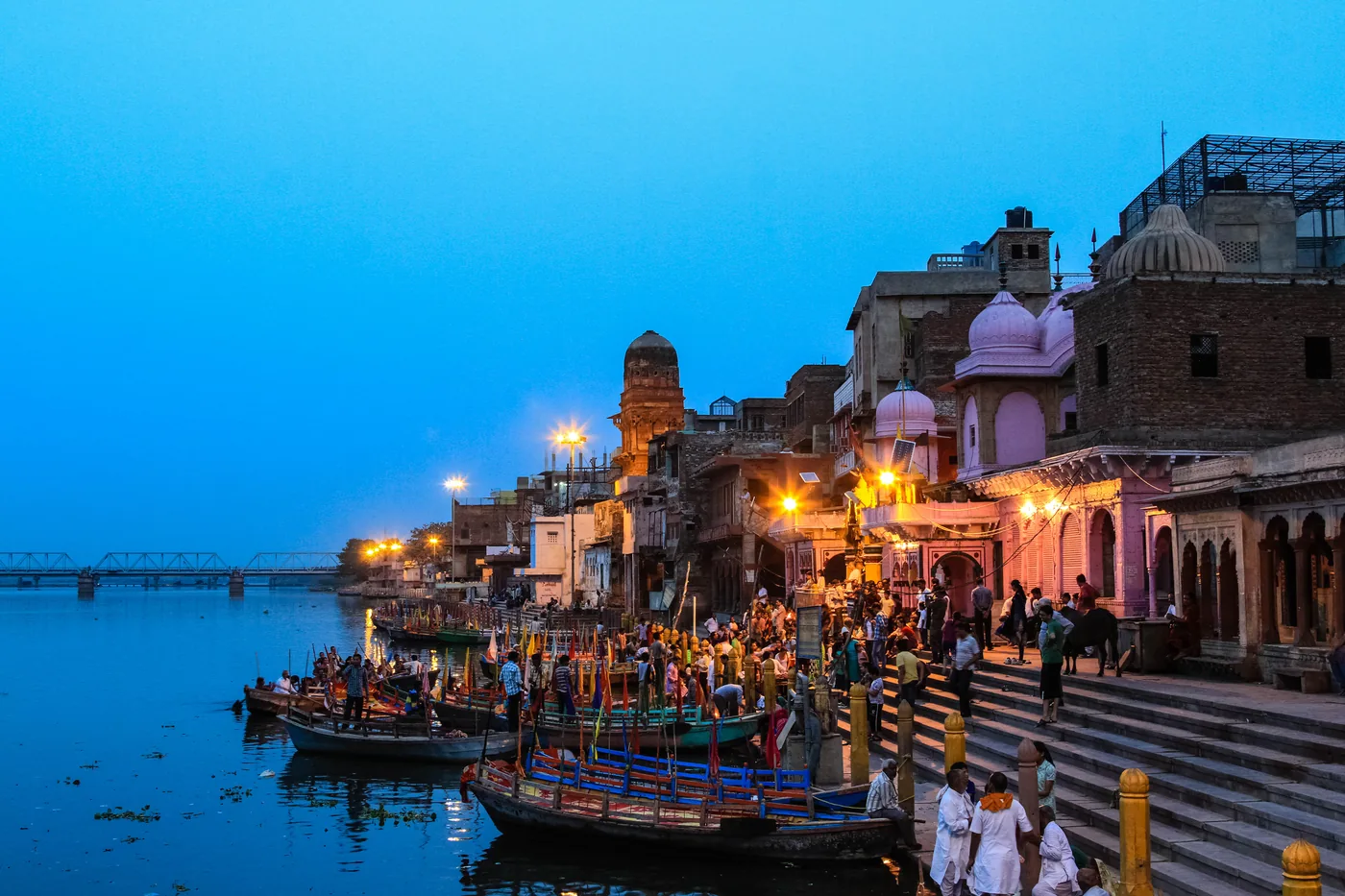
Raghava showed them Bhadravana, Bhandiravana and Bilvavana, and then Lohavana: "At Lohavana, Lord Kṛṣṇa used to tend cows. The demon named Lohajaṅgha was killed at this place" (Sri Chaitanya-charitamrita Madhya 18.67, purport). At Mahavana, the book says, "the Sri Pandita, in the ecstasy of prema," spoke softly to the two (p. 277), in words that Srila Prabhupada also quotes:
dekha nanda-yaśodā-ālaya mahāvane
ei dekha śrī-kṛṣṇa-candrera janma sthala
śrī-gokula, mahāvana — dui ‘eka’ haya
"“Behold the house of Nanda and Yaśodā in Mahāvana. See the birthplace of Lord Kṛṣṇa. Mahāvana and the birthplace of Lord Kṛṣṇa, Gokula, are one and the same.”" (Sri Chaitanya-charitamrita Madhya 18.67, purport)
Then he told how Mahaprabhu, seeing the place of Krishna's birth festival, was lost in dancing and singing while people ran from every side crying "Hari! Hari!", and how He lost His composure on seeing the Deity of Madana-gopala. He showed where Sanatana Goswami had lived at Mahavana, so loved there that the people "felt their life return just by seeing Sanatana" (p. 283). At Raval, the place of Srimati Radharani's childhood pastimes, he told how Gauracandra had come there from Gokula, and how the people, drinking in the sight of His face, said, "He is certainly Krishna" (pp. 286-287). That night they stayed at Raval:
aiche kata kahi' rātri rāvale rahila / kṛṣṇa-kathā-rase niśī prabhāta haila
śrī-rāghava śrīnivāsa narottama sane / ye preme nimagna tā varṇiba kona jane
"Speaking of many such things, they stayed the night at Raval, and in the joy of talking about Krishna the night turned to dawn. Who can describe the prema in which Sri Raghava was immersed together with Shrinivasa and Narottama?" (Bhakti-ratnakara, Fifth Wave, p. 287, 1912 Bengali edition; English rendering ours)
In the morning they crossed the Yamuna into Mathura. Raghava showed Shrinivasa the homes of Ugrasena, Vasudeva and Kamsa, the prison where Vasudeva had been kept, and the road by which Vasudeva carried the newborn Krishna to Gokula, explaining everything in great detail. They bathed at Vishrama-tirtha with joy and went on to Ambika-vana, where Raghava "said gently to the two" how Nanda Maharaja had once been seized there by a serpent (pp. 287-288). From there the road led to Akrura and Vrindavana, where Raghava gave his last teachings, as told in Last Teachings in Vrindavana and the Farewell.
Hearing at the Holy Places #
Through all these forests, the greatest gift Raghava gave Shrinivasa and Narottama was not only the sight of the holy places but the hearing: the stories and verses that let them see each place with understanding and love. Lord Krishna teaches in the Bhagavad-gita that real knowledge comes in just this way:
tad viddhi praṇipātena
paripraśnena sevayā
upadekṣyanti te jñānaṁ
jñāninas tattva-darśinaḥ
"Just try to learn the truth by approaching a spiritual master. Inquire from him submissively and render service unto him. The self-realized souls can impart knowledge unto you because they have seen the truth." (Bhagavad-gita 4.34)
Centuries later Srila Prabhupada showed the same spirit. He once remembered a parikrama party of the Gaudiya Math that he went to see before his initiation. One evening it was announced that the pilgrims would set out on parikrama and that his spiritual master, Srila Bhaktisiddhanta Sarasvati Thakura, would also speak, so anyone who wished could stay and hear him. About a dozen stayed and the rest went. Srila Prabhupada stayed: "I preferred to hear him than go to parikramā." (Morning walk, Mayapur, 10 February 1976) His spiritual master, he said, very much appreciated it.
This is what Raghava taught at Sheshashayi: the Lord's life is known only when He makes it known, and He makes it known through those who speak of Him. Shrinivasa never forgot what he heard on this journey. Years later, in Navadvipa, he said that touring Vraja "with Sri Raghava" had made him wish to tour Nadiya in the same way (Bhakti-ratnakara, Twelfth Wave, p. 716).
Scriptural evidence for this chapter (9)
Quoted in the text above:
- Sri Chaitanya-charitamrita Madhya 18.55, purport quoted above ↑
- Bhakti-ratnakara, Fifth Wave, p. 248 (1912 ed.)
- Sri Chaitanya-charitamrita Madhya 18.63, purport quoted above ↑
- Bhakti-ratnakara, Fifth Wave, p. 250 (1912 ed.)
- Bhakti-ratnakara, Fifth Wave, p. 257 (1912 ed.)
- Bhakti-ratnakara, Fifth Wave, p. 271 (1912 ed.)
- Sri Chaitanya-charitamrita Madhya 18.67, purport quoted above ↑
- Bhakti-ratnakara, Fifth Wave, p. 287 (1912 ed.)
- Bhagavad-gita 4.34 quoted above ↑
Chapter 6
Last Teachings in Vrindavana and the Farewell
At Akrura, the Bhojana-tila and Advaita-vata he taught on Vrindavana, Govinda and the disciplic line; then came his tearful farewell to Shrinivasa and Narottama.
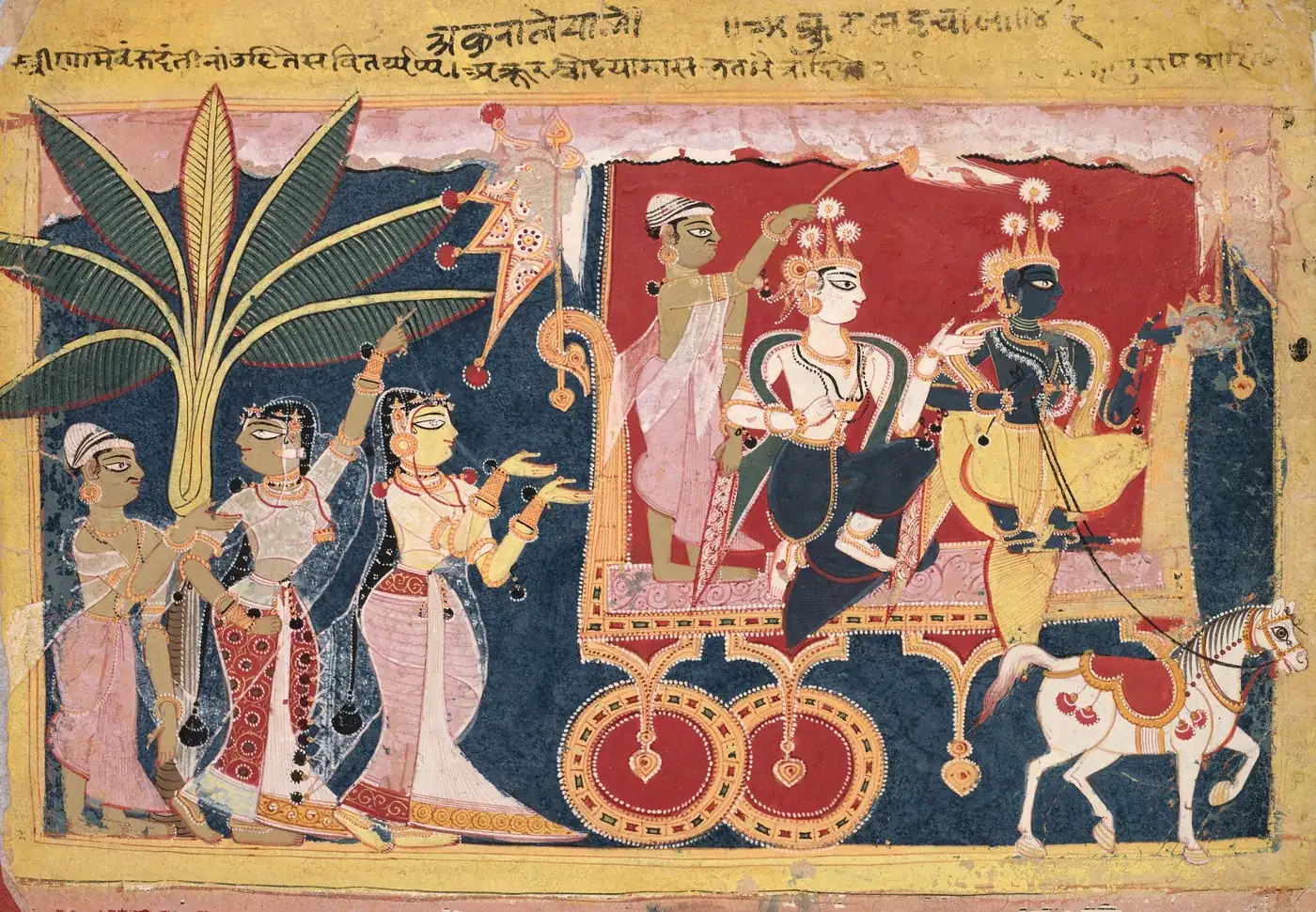
The tour of Vraja that Srila Raghava Pandita Goswami made with Shrinivasa Acharya and Narottama Dasa Thakura was coming to its end. Srila Jiva Goswami had placed the two young devotees in his care (Jiva Goswami Entrusts Shrinivasa and Narottama to Him), and together they had walked through the forests of Vraja-mandala (Through the Forests of Vraja). Now they crossed the Yamuna back to Mathura, bathed at Vishrama-tirtha and set out for Vrindavana (Bhakti-ratnakara, Fifth Wave, pp. 287-288). The book does not say how long the whole tour took.
In these last days Raghava gave some of his deepest teachings. Then came the farewell, the most tender scene the Bhakti-ratnakara gives of him.
From Akrura to the Bhojana-tila #
On the way the party reached Akrura-tirtha, the village named after Akrura, who drove Sri Krishna and Balarama from Vraja to Mathura. Here Raghava told Shrinivasa that Sri Chaitanya Mahaprabhu had once stayed in this quiet place. Srila Prabhupada quotes his words in a purport to the Chaitanya-charitamrita:
dekha, śrīnivāsa, ei akrūra grāmete
śrī-kṛṣṇa-caitanya-prabhu chilena nibhṛte
"“Śrīnivāsa, look at this village of Akrūra. Śrī Caitanya Mahāprabhu stayed there in a solitary place.”" (Sri Chaitanya-charitamrita Madhya 18.70, purport)
Srila Prabhupada does not name the speaker, but in the Bhakti-ratnakara these are Raghava's words, and in the 1912 printed edition the line begins "ahe Shrinivasa" ("O Shrinivasa") instead of "dekha, Shrinivasa" ("look, Shrinivasa") (Fifth Wave, p. 289). Because of the crowds in Vrindavana, Raghava added, the Lord used to come here to take His meals with a joyful heart. "Who can understand His mind?" he asked. Here, as everywhere on the tour, he tells the Lord's pastimes as history and never says that he saw them himself.
A little further on, at the mound called the Bhojana-tila, where the sages' wives once fed Krishna, Raghava stopped to teach Shrinivasa what Vrindavana really is. Quoting verse after verse of scripture, he said that this forest is Krishna's own body, that Krishna never leaves it, and that every creature living there, whether animal, bird, tree, insect or human, reaches Krishna's abode in the end. But this Vrindavana is hidden from ordinary eyes (pp. 290-301):
ahe śrīnivāsa sarva śāstre nirūpaṇa / kṛṣṇera parama priya dhāma vṛndāvana
… tejomaya vṛndāvana ati manohara / prema-netra vinā carma-cakṣu agocara
"O Shrinivasa, all the scriptures establish this: Vrindavana is Krishna's most dear abode. ... Vrindavana is full of spiritual light and supremely charming, but without the eyes of prema it cannot be seen by eyes of flesh." (Bhakti-ratnakara, Fifth Wave, p. 291, 1912 Bengali edition; English rendering ours)
Govinda Seen Face to Face #
From Vrindavana Raghava turned to its Lord, Sri Govindadeva. Govinda, he said, is not a statue standing in place of Krishna; He is Krishna Himself (p. 293).
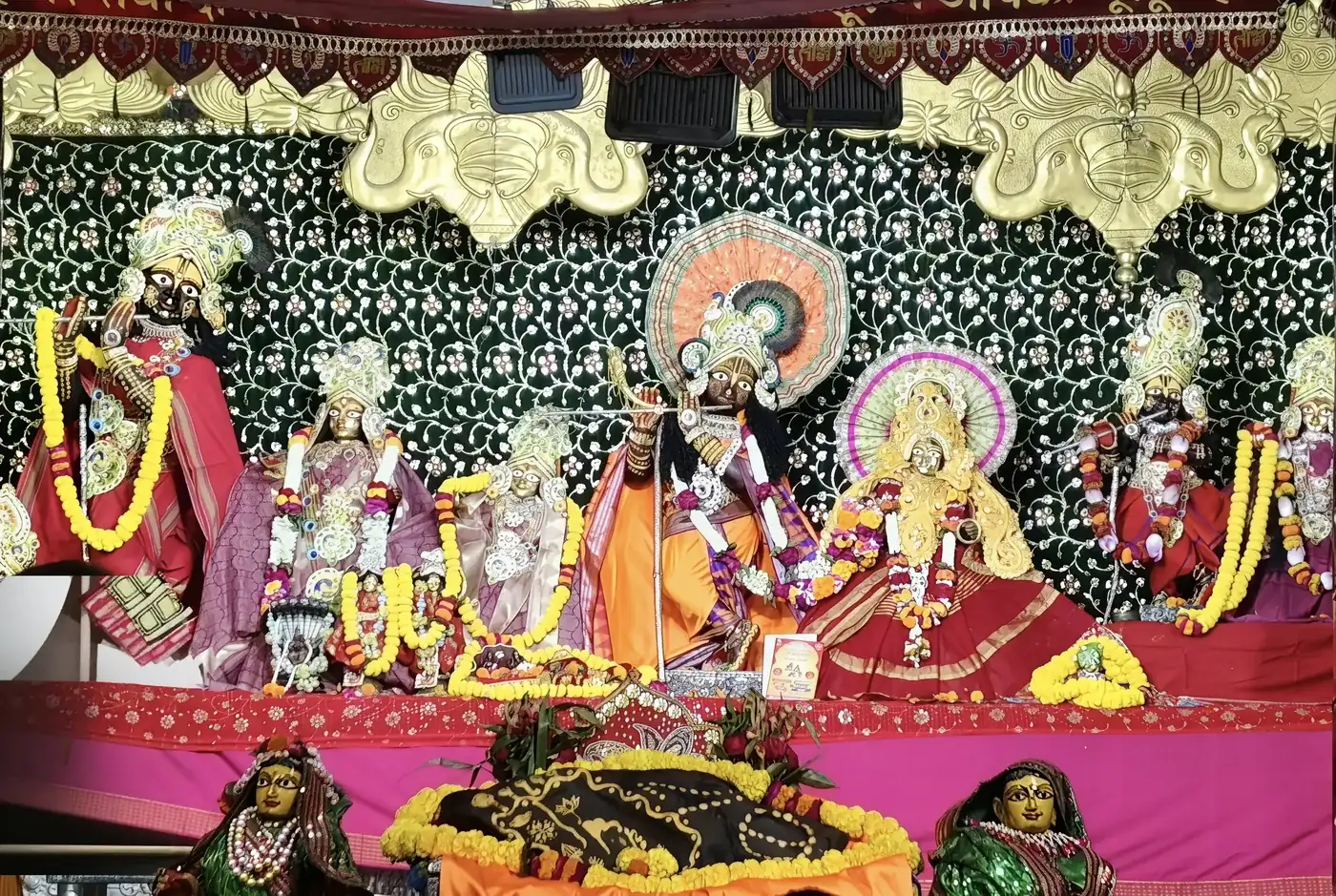
śrī-govinda-deva sākṣāt vrajendra-tanaya / vigrahera nyāya līlā kare icchāmaya
prāpañcika loka dekhe pratimā ākāra / svajana dekhaye śrī-govinda sākṣātkāra
"Sri Govindadeva is directly the son of the king of Vraja. The Lord, who does whatever He wishes, plays the part of a Deity. Worldly people see the form of a statue; His own people see Sri Govinda face to face." (Bhakti-ratnakara, Fifth Wave, p. 293, 1912 Bengali edition; English rendering ours)
Sri Chaitanya Mahaprabhu taught the same truth when He gave Raghunatha Dasa Goswami, with whom Raghava stayed from time to time, a stone from Govardhana Hill:
prabhu kahe, — “ei śilā kṛṣṇera vigraha
iṅhāra sevā kara tumi kariyā āgraha
"Śrī Caitanya Mahāprabhu instructed Raghunātha dāsa, “This stone is the transcendental form of Lord Kṛṣṇa. Worship the stone with great eagerness.”" (Sri Chaitanya-charitamrita Antya 6.294)
As Raghunatha Dasa worshipped it, the Chaitanya-charitamrita adds, "he saw the Supreme Personality of Godhead, Kṛṣṇa, the son of Nanda Mahārāja, directly in the stone" (Antya 6.300). The Lord does not change; what changes is the eye that looks at Him. When Raghava had finished this teaching, the Bhakti-ratnakara says, he walked slowly on from the Bhojana-tila, joyful at heart (p. 301).
The Disciplic Line at Advaita-vata #
The way into Vrindavana passed Kaliya-hrada and Praskandana, where Mahaprabhu Himself had gone from Akrura-tirtha to bathe (Chaitanya-charitamrita Madhya 18.71). Srila Prabhupada's purport to that verse quotes the Bhakti-ratnakara:
e kālīya-tīrtha pāpa vināśaya
kālīya-tīrtha-sthāne bahu-kārya-siddhi haya
"“When one takes a bath in Kālīya-hrada, he is freed from all sinful reactions. One can also be successful in business by bathing in Kālīya-hrada.”" (Sri Chaitanya-charitamrita Madhya 18.71, purport)
Beside Kaliya-hrada, at the Dvadashaditya-tila, Raghava told how Sanatana Goswami had lived in that lonely spot by Mahaprabhu's order, and how Mahaprabhu, seeing him anxious, appeared to him there in a dream and embraced him (p. 303).
At the banyan tree called Advaita-vata he spoke "in the ecstasy of prema" (p. 304). He told the life of Advaita Acharya, who had worshipped Krishna under that tree, and then the life of Mahaprabhu, Sri Gaurasundara, whom he called Krishna Himself, the son of the king of Vraja. Coming to the Lord's diksha, His initiation, from Ishvara Puri, he raised a question himself: if the Lord is the guru of the whole world, how can He have a guru? "For the instruction of people," he answered. The Lord practises dharma Himself in order to establish it, and so He made the Madhva sampradaya, the disciplic line of Madhvacharya, glorious. Then Raghava stated the rule:
sampradā-niviṣṭa haile kārya-siddhi haya / anyatra dīkṣite mantra niṣphala niścaya
śrī mādhva rudra sanaka sampradāya cāri / kalite vidita kahe purāṇe vistāri'
"One who belongs to a sampradaya reaches the goal; a mantra received outside one is surely fruitless. There are four sampradayas, the Shri, Madhva, Rudra and Sanaka, known in Kali-yuga, as the Puranas explain in detail." (Bhakti-ratnakara, Fifth Wave, p. 308, 1912 Bengali edition; English rendering ours)
The Bhakti-ratnakara backs this with a verse of the Padma Purana, and Srila Prabhupada explains the same verse: "In the Padma Purāṇa it is also said, sampradāya-vihīnā ye mantrās te niṣphalā matāḥ. There are four sampradāyas, or disciplic successions, namely the Brahma sampradāya, the Rudra sampradāya, the Śrī sampradāya and the Kumāra sampradāya. If one wants to advance in spiritual power, one must receive his mantras from one of these bona fide sampradāyas; otherwise he will never successfully advance in spiritual life." (Srimad-Bhagavatam 6.8.42, purport)
So a guru does not make himself a guru. His authority comes down to him through the line, and he gives only what he has received. Raghava then recited the Madhva line itself, twenty names numbered one by one, from Narayana, Lord Brahma, Narada Muni and Vyasadeva, through Madhvacharya himself, down to Lakshmipati Tirtha, Madhavendra Puri and Ishvara Puri, ending: "his disciple Prabhu Gauracandra, the Lord" (pp. 310-311). He confirmed it from Kavi Karnapura's Gaura-ganoddesha-dipika. Both listeners had received diksha within this sampradaya, Shrinivasa from Gopala Bhatta Goswami and Narottama from Lokanatha Goswami, and it is the same guru-parampara that comes down to Srila Prabhupada.
His Last Teaching on Vraja #
At Imli-tala Raghava showed the tamarind tree under which Mahaprabhu used to sit, floating in tears of His own bliss; at Shringara-vata he told the life of Nityananda Prabhu; then came Nidhuvana, Keshi-tirtha, Dhira-samira and Vamshivata (pp. 317-327). From there, at the rasa-sthali and from grove to grove, the Bhakti-ratnakara places in Raghava's mouth its long treatise on the rasa dance, on music and dance, and on the heroes and heroines of rasa, about a hundred and twenty printed pages (pp. 325-450). Its author, Narahari Chakravarti Thakura, was himself a musician, and the learning is surely his own; but the book presents it as Raghava's teaching to Shrinivasa.
At last, near Brahma-kunda and Govindasvami-tirtha, Raghava summed up how a devotee should feel about Vraja, backing each point with a verse of Raghunatha Dasa Goswami's Vraja-vilasa-stava:
ohe śrīnivāsa bhakta sadā samprārthaye / anya prasaṅgeo yena vraje vāsa haye
vraja-bhūme vaise ye se kṛṣṇa-priya hana / tā sabāre vande nitya bhāgyavanta-gaṇa
vraja-sthita tṛṇa-gulma kīṭādika yata / se sabe praṇame bhāgyavanta avirata
"O Shrinivasa, a devotee always prays that, by some means or other, he may get to live in Vraja. Whoever lives in the land of Vraja is dear to Krishna; the fortunate always bow down to them all. To the grass, the bushes, the insects and every other thing that is in Vraja, the fortunate bow down again and again." (Bhakti-ratnakara, Fifth Wave, p. 449, 1912 Bengali edition; English rendering ours)
Some devotees, he added, call out the names of Radha and Krishna with tears in their eyes and long to sprinkle Krishna's play-places with those tears (p. 450). The words fit his own life: the Bhakti-ratnakara had described him as grey with the dust of Vraja and carried away by his tears, as told in A Brahmana of the South at Govardhana.
The Farewell to Shrinivasa and Narottama #
Then Raghava turned to the two young men who had walked beside him through Vraja, and spoke from his heart:
ohe śrīnivāsa vṛndāvanera mādhurī / mane abhilāṣa sadā rākhi netre bhari'
tomā doṅhā laiyā mahā ānande bhraminu / puna nā ha-ibe hena mane vicārinu
janme janme tumi dui prabhura kiṅkara / eta kahi' paṇḍitera adhairya antara
"'O Shrinivasa, the one wish of my heart is always to keep the sweetness of Vrindavana filling my eyes. Taking you two with me, I have wandered in great joy, and I feel in my heart that this will not happen again. Birth after birth, you two are servants of the Lord.' Saying this, the Pandita's heart lost all composure." (Bhakti-ratnakara, Fifth Wave, p. 450, 1912 Bengali edition; English rendering ours)
Narottama and Shrinivasa floated in tears, and all their composure was gone.
paṇḍitera pada-tale paḍe loṭāiyā / paṇḍita nayana-jale siñce kole laiyā
"They fell rolling at the Pandita's feet, and the Pandita took them on his lap and bathed them with his tears." (Bhakti-ratnakara, Fifth Wave, p. 451, 1912 Bengali edition; English rendering ours)
The three sat together in a solitary place, singing of the lives of Radha and Krishna and of Sri Chaitanya until they lost all outward awareness. Bowing again and again to the land of Vrindavana, they made prayers that, the book says, cannot be told, and only after some time did they become steady again (p. 451).
Back to Jiva Goswami and Govardhana #
Then the three went to see Sri Govindadeva. At the temple Sri Krishna Pandita joyfully gave them Govinda's garland and prasada, and Raghava told him the whole journey in order. From there they hurried to Jiva Goswami's lodging, and Jiva was overjoyed to see them (pp. 451-452).
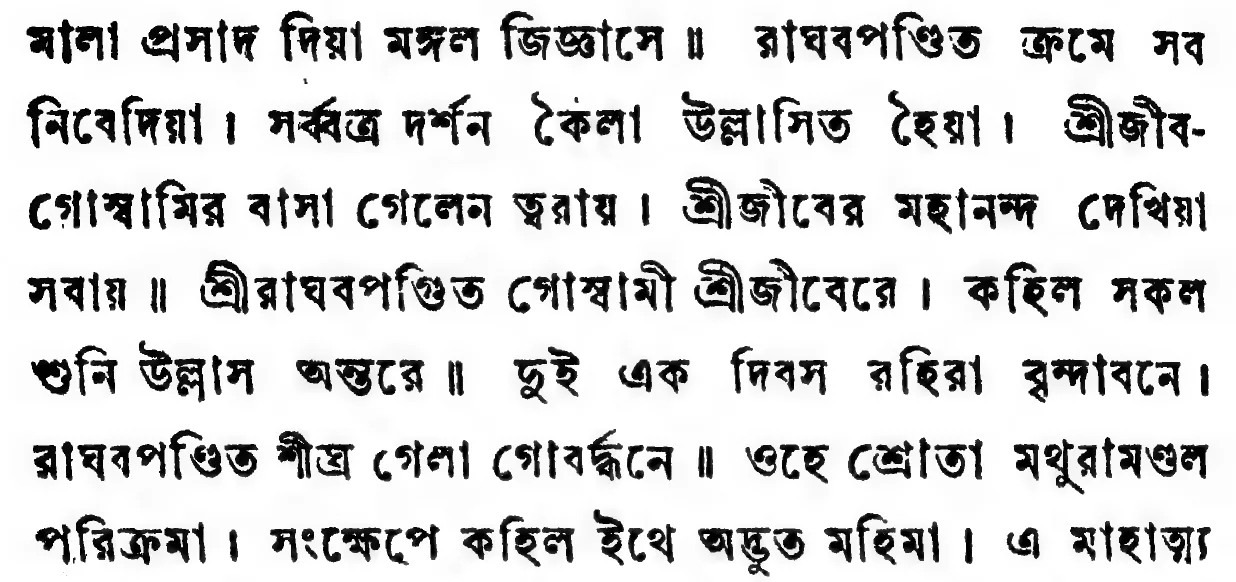
śrī-rāghava-paṇḍita gosvāmī śrī-jīvere / kahila sakala śuni' ullāsa antare
dui eka divasa rahiyā vṛndāvane / rāghava-paṇḍita śīghra gelā govardhane
"Sri Raghava Pandita Goswami told Sri Jiva everything, and Jiva's heart rejoiced to hear it. After staying one or two days in Vrindavana, Raghava Pandita quickly went back to Govardhana." (Bhakti-ratnakara, Fifth Wave, p. 452, 1912 Bengali edition; English rendering ours)
Jiva Goswami had placed the two young men in his care, so Raghava gave him a full account. Then, after only a day or two, he hurried home to Govardhana, the hill the Bhakti-ratnakara calls "his everything" (p. 150), as told in Around Govardhana Hill and His Own Cave.
How Shrinivasa Remembered Him #
The Bhakti-ratnakara shows Raghava with the two devotees one last time. When Shrinivasa was to take the books of the Goswamis to Bengal, as told in his own life, the great Vaishnavas of Vraja gathered at Govinda's temple, and the book names Raghava among them (Sixth Wave, p. 486):
premī kṛṣṇadāsa kṛṣṇadāsa brahmacārī / rāghava-paṇḍita prema-bhakti adhikārī
"... the loving Krishnadasa, Krishnadasa Brahmachari, and Raghava Pandita, who possessed prema-bhakti ..." (Bhakti-ratnakara, Sixth Wave, p. 486, 1912 Bengali edition; English rendering ours)
The books were loaded onto a cart, and Jiva Goswami and a few others went with it as far as Mathura, where they spent the day and the night in Krishna-katha, talk about Krishna. At the parting next morning, the book names Raghava, with Krishnadasa Kaviraja Goswami, among those who could not hold back their grief:
kṛṣṇadāsa kavirāja paṇḍita rāghava / śrī-gopāla mādhavādi yateka vaiṣṇava
sakale adhairya hailā vidāyera kāle / śrīnivāsa ādi sikta hailā netra-jale
"Krishnadasa Kaviraja, Pandita Raghava, Sri Gopala, Madhava and all the other Vaishnavas lost their composure at the time of parting, and Shrinivasa and the others were drenched with tears." (Bhakti-ratnakara, Sixth Wave, p. 487, 1912 Bengali edition; English rendering ours)
Shrinivasa never forgot the tour. Long afterwards, visiting Navadvipa with Narottama and Ramachandra Kaviraja, he hesitantly told Mahaprabhu's old servant Ishan Thakur of his wish (Twelfth Wave, p. 716):
śrī-rāghava saṅge vraje bhramaṇa karite / mane haila nadīyā bhramiba ei mate
"'While I was touring Vraja with Sri Raghava, it came to my mind that I would tour Nadiya in the same way.'" (Bhakti-ratnakara, Twelfth Wave, p. 716, 1912 Bengali edition; English rendering ours)
Ishan Thakur answered, "What you have thought of, Sri Gaurasundara will fulfil." One night during that visit, sleeping in the courtyard of Mahaprabhu's house, Shrinivasa dreamed of Sri Gaurasundara shining among His devotees, and among them he saw Raghava, named by his home (p. 999):
bhūgarbha śrī-lokanātha raghunātha-dāsa / rāghava-paṇḍita govardhane yāra vāsa
"... Bhugarbha, Sri Lokanatha, Raghunatha Dasa, and Raghava Pandita, whose home is at Govardhana." (Bhakti-ratnakara, Twelfth Wave, p. 999, 1912 Bengali edition; English rendering ours)
This was a vision of the Lord's eternal company, in which Jiva Goswami and others of the later generation also appear, so it says nothing about a meeting with Mahaprabhu in this world. But it shows the place the book gives him: among the Lord's own devotees.
Servants of the Lord, Birth After Birth #
Raghava's farewell to the two ended in a blessing: "Birth after birth, you two are servants of the Lord." This is the truth of every soul, as Sri Chaitanya Mahaprabhu taught Sanatana Goswami:
jīvera ‘svarūpa’ haya — kṛṣṇera ‘nitya-dāsa’
kṛṣṇera ‘taṭasthā-śakti’ ‘bhedābheda-prakāśa’
sūryāṁśa-kiraṇa, yaiche agni-jvālā-caya
svābhāvika kṛṣṇera tina-prakāra ‘śakti’ haya
"“It is the living entity’s constitutional position to be an eternal servant of Kṛṣṇa because he is the marginal energy of Kṛṣṇa and a manifestation simultaneously one with and different from the Lord, like a molecular particle of sunshine or fire. Kṛṣṇa has three varieties of energy." (Sri Chaitanya-charitamrita Madhya 20.108-109)
Because service to Krishna is the soul's own nature, it does not end with one journey or one life. Raghava felt that such days would not come again, but what he blessed in them would never end. In these last days he had shown the two young devotees the holy places through the eyes of scripture, the Deity as Krishna Himself, the line through which the mantra comes, and how to bow to everything in Vraja. Years later Shrinivasa still remembered it all simply as touring Vraja "with Sri Raghava".
Scriptural evidence for this chapter (15)
Quoted in the text above:
- Sri Chaitanya-charitamrita Madhya 18.70, purport quoted above ↑
- Bhakti-ratnakara, Fifth Wave, p. 291 (1912 ed.)
- Bhakti-ratnakara, Fifth Wave, p. 293 (1912 ed.)
- Sri Chaitanya-charitamrita Antya 6.294 quoted above ↑
- Sri Chaitanya-charitamrita Madhya 18.71, purport quoted above ↑
- Bhakti-ratnakara, Fifth Wave, p. 308 (1912 ed.)
- Bhakti-ratnakara, Fifth Wave, p. 449 (1912 ed.)
- Bhakti-ratnakara, Fifth Wave, p. 450 (1912 ed.)
- Bhakti-ratnakara, Fifth Wave, p. 451 (1912 ed.)
- Bhakti-ratnakara, Fifth Wave, p. 452 (1912 ed.)
- Bhakti-ratnakara, Sixth Wave, p. 486 (1912 ed.)
- Bhakti-ratnakara, Sixth Wave, p. 487 (1912 ed.)
- Bhakti-ratnakara, Twelfth Wave, p. 716 (1912 ed.)
- Bhakti-ratnakara, Twelfth Wave, p. 999 (1912 ed.)
- Sri Chaitanya-charitamrita Madhya 20.108-109 quoted above ↑
Chapter 7
Campakalata and the Krishna-bhakti-ratna-prakasha
His identity as Campakalata in Kavi Karnapura's Gaura-ganoddesha-dipika, and his Sanskrit book of six jewels: what it teaches, and how it was copied and translated.
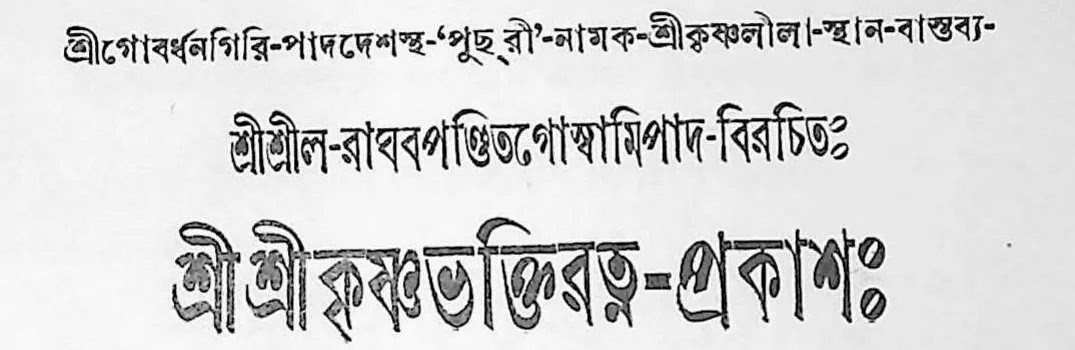
Most of what the old books tell us about Srila Raghava Pandita Goswami comes from the Bhakti-ratnakara, which shows him at Govardhana and on his tour of Vraja with Shrinivasa Acharya and Narottama Dasa Thakura. Two more things are remembered about him, and both are found in a single verse of a book that Kavi Karnapura completed in 1576. That verse says that Raghava is Campakalata, a dear friend of Srimati Radharani in the pastimes of Sri Krishna, and that he wrote a book called the Bhakti-ratna-prakasha.
The book was not lost. It survives in Sanskrit as the Krishna-bhakti-ratna-prakasha, "the light of the jewel of devotion to Krishna". In its pages we can still hear Raghava's own voice: the voice of a learned devotee who begs his readers, again and again, to give up every other shelter and worship the lotus feet of Krishna alone.
Campakalata, a Dear Friend of Srimati Radharani #
In Vraja, Srimati Radharani is surrounded by her sakhis, her friends among the gopis, the cowherd girls who love Krishna. Eight of them are the closest of all, and they are called the ashta-sakhis, "the eight friends". Srila Prabhupada once wrote out a list of the principal gopis for a disciple and explained that "the first eight are called Astasakhi". The fourth name on his list is "Campaklata", that is, Campakalata (letter to Tamala Krishna, 27 May 1970).
What is the service of these eight friends? In the Chaitanya-charitamrita, Krishnadasa Kaviraja Goswami says that the gopis "help increase the joy of Kṛṣṇa’s pastimes with Rādhārāṇī". Srila Prabhupada explains in his purport: "The parama-preṣṭha-sakhīs are eight in number". These are the dearest friends of all, and in the loving dealings of the Divine Couple "they side sometimes with Kṛṣṇa and at other times with Rādhārāṇī", so that the exchange of love becomes even sweeter (Sri Chaitanya-charitamrita Adi 4.217, purport). Campakalata is one of these eight.
What the Gaura-ganoddesha-dipika Says #
Kavi Karnapura completed his Gaura-ganoddesha-dipika in 1576. In it he names many followers of Sri Chaitanya Mahaprabhu and tells who each of them is in Krishna's eternal pastimes. In one verse he speaks of Raghava of Govardhana:
śrī-rādhā-prāṇa-rūpā yā śrī-campakalatā vraje
sādya rāghava-gosvāmī govardhana-kṛta-sthitiḥ
bhaktiratna-prakāśākhya-grantho yena vinirmitaḥ
"Srimati Campakalata-gopi, who considered Srimati Radharani as dear as her own life-breath, appeared as Raghava Gosvami, who lived at Govardhana Hill and wrote the book entitled Bhakti-ratna-prakasa." (Gaura-ganoddesha-dipika 162, translation as published at bvmlu.org)
The verse tells us three things: in Krishna's pastimes Raghava is Campakalata, who holds Srimati Radharani as dear as her own life; in this world he lives at Govardhana; and he is the author of the Bhakti-ratna-prakasha. It also gives the one firm date in Raghava's story. As the verse stands, by 1576 he was already living at Govardhana, and his book had already been written.
Narahari Chakravarti Thakura quotes the same verse in the Bhakti-ratnakara, right after his own portrait of Raghava (Fifth Wave, p. 150). There the last word of the verse reads prakashitah, "made known", instead of vinirmitah, "composed". Only four verses later, the Gaura-ganoddesha-dipika names a different devotee, Raghava Pandit of Panihati, as the gopi Dhanishtha (Sri Chaitanya-charitamrita Adi 10.24, purport). So Kavi Karnapura himself kept the two Raghavas apart.
How to Understand Such an Identity #
The eight sakhis are not ordinary devotees. Srila Prabhupada once corrected a disciple on this very point: "the actual fact is that the eight Gopis are as good as Krishna and Radharani. Therefore, no Vaisnava will claim to be one of the eight Gopis" (letter to Gargamuni, 5 February 1969). In the same letter he gives the example of Sri Chaitanya Mahaprabhu, who "claimed Himself as servant of the servant of the servant of Krishna".
This tells us how to read Kavi Karnapura's verse. When the verse calls Raghava Campakalata, that is Kavi Karnapura's statement about him. It is not a claim that Raghava made for himself. In his own book Raghava never mentions Campakalata at all. Where he names himself in his verses, he is simply a poet called Raghava, asking his readers to hear and to worship Krishna. The words about Campakalata come from another great Vaishnava who saw Raghava's greatness, and for us they are a reason to honour him all the more.
Kavi Karnapura's verse is also the oldest statement about Raghava's identity. A much later list says something else. It names sixty-four mahantas, or great devotees, and it comes from a late compilation, the Brihad-bhakti-tattva-sara, as printed in the Gaudiya Vaishnava Abhidhana, a twentieth-century Gaudiya reference work. Among the followers of Svarupa Damodara Goswami it names a "Raghava Gosvami" as the sakhi Sumukhi (vol. 3, p. 1232). That list is late, it does not agree with Kavi Karnapura, and it may not even mean the same Raghava. The Abhidhana's own entry on Raghava of Govardhana follows the Gaura-ganoddesha-dipika and calls him Campakalata (vol. 3, p. 1332).
His Book, the Krishna-bhakti-ratna-prakasha #
Raghava's book is known by three names. Kavi Karnapura, the Bhakti-ratnakara and the Sadhana-dipika call it the Bhakti-ratna-prakasha; the 1955 printed edition and the Abhidhana call it the Krishna-bhakti-ratna-prakasha; and one English translation calls it the Hari-bhakti-ratna-prakasha. The Bhakti-ratnakara says that he wrote "books such as the Bhakti-ratna-prakasha", but no other title of his has come down to us. This one is written in Sanskrit and divided into six chapters. Each chapter is called a prakasha, a "shining", and at the end of each one Raghava offers the chapter to his reader as a jewel.
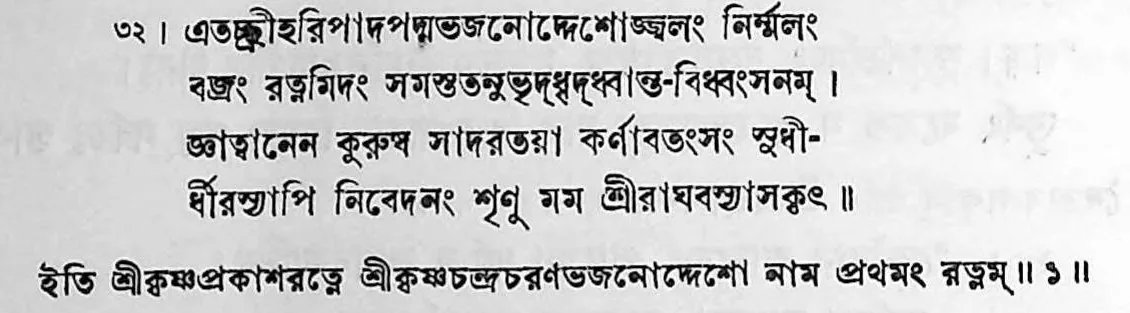
The book opens with eight verses from an older work, the Krama-dipika. In the second of them Raghava bows down to the lotus feet of his guru, without telling us the guru's name (Krishna-bhakti-ratna-prakasha 1.2; see A Brahmana of the South at Govardhana). Then he explains why he wrote. The scriptures already exist, he says, but those who truly understand them are few. Some people are dry logicians, some have doubting minds, some follow the path of karma (work done for its results), some worship many gods, and some teach that all the gods are equal; and so they do not know Krishna, the Supreme Lord and the soul of all. For this reason he gathers the verses of many scriptures into one book, which he calls a sangraha, a "collection". Again and again a doubter raises a question, and the devotees of Krishna answer with verses from the shastras.
The six chapters and their subjects are these:
- Sri Krishna-bhajanoddesha: why Krishna alone should be worshipped
- Nanopasana-varjana: giving up the worship of many gods
- Krishna-purnatamatva: Krishna is the most complete form of God
- Vrindavana-nitya-prakasha: Krishna is always present in Vrindavana
- Sri Nandakishora-svarupa: Krishna's own form as the young son of Nanda
- Bhakti-viracana: devotion itself, the service of Krishna's lotus feet
He quotes the Srimad-Bhagavatam far more often than any other book, and with it the Bhagavad-gita, the Brahma-samhita and several Puranas. He also makes wide use of some lesser-known Pancaratra works, old Vaishnava texts on worship: the Govinda-vrindavana (a part of the Brihad-gautamiya-tantra), the Sammohana-tantra, the Krishna-yamala, the Narada-pancaratra and the Varaha-samhita (Gaudiya Grantha Mandira; Abhidhana, vol. 3, p. 1514).
He also draws on the writings of Rupa Goswami. In the fifth chapter (5.2-3), without naming the book, he gives two verses from Rupa Goswami's Bhakti-rasamrita-sindhu (2.1.221-222), which teach that the Lord is called complete, more complete or most complete, according to how fully He shows His qualities. Krishnadasa Kaviraja Goswami quotes the same two verses in the Chaitanya-charitamrita, and Srila Prabhupada translates the second of them: "When He manifests all His qualities in fullness, He is called most complete" (Sri Chaitanya-charitamrita Madhya 20.400). From these verses Raghava draws his own conclusion: in Vrindavana Krishna is most complete, and in other places He shows less of Himself. So the book shows that Raghava knew Rupa Goswami's work and built on it.
Six Jewels for the Reader #
Every chapter ends with a verse in which Raghava names himself and offers the chapter as a jewel to wear. The first chapter is a diamond for the ear, the second a pearl for the neck, the third a sapphire for the forehead, the fourth a ruby to wear on the heart, and the fifth an emerald for a crown. At the very end the whole book is called a cintamani, a wish-fulfilling gem, for the worship of Krishna. The Abhidhana says that the six jewels point to steps that rise higher and higher (vol. 3, p. 1468). This is the first of these verses:
etat śrī-hari-pāda-padma-bhajanoddeśojjvalaṁ nirmalaṁ
vajraṁ ratnam idaṁ samasta-tanu-bhṛd-dhṛd-dhvānta-vidhvaṁsanam
jñātvānena kuruṣva sādaratayā karṇāvataṁsaṁ sudhīr
dhīrasyāpi nivedanaṁ śṛṇu mama śrī-rāghavasyāsakṛt
"This book, describing devotional service to Lord Hari's lotus feet, is a splendid, pure diamond that illuminates the darkness in the hearts of all living entities. O intelligent reader, please accept this diamond as your earring. O thoughtful reader, please continually hear the instructions that I, Raghava Gosvami, present in this book." (Krishna-bhakti-ratna-prakasha 1.32, 1955 Sanskrit edition, p. 4; English from Kushakratha Dasa's translation, The Splendor of the Jewel of Hari Bhakti, 2009)
At the end of the second chapter he calls himself Sri Kaviraja Raghava, kaviraja being a title for a learned poet (2.72). In two verses near the end of the book (6.73-74) he speaks of himself once more, as a poet absorbed in the love of Radha and Krishna, and he also names the place where he wrote the book. He does not name Govardhana there, and no source identifies the place, so we do not know where the book was written.
How the Book Lived On #
Later Gaudiya Vaishnavas valued Raghava's book. The Sadhana-dipika of Radha-krishna Goswami, another Sanskrit work, counts "Sri Bhakti-ratna-prakasha and other works" of "Sri Raghava-pandita Gosvami-pada" among the books through which devotees can still relish the pastimes of the Lord (Sadhana-dipika, Ninth Kaksha, p. 257). One handwritten copy, made in Shaka 1606, that is 1684-85 CE, was kept at Haribol Kutir in Navadvipa, in the collection of Haridasa Dasa, who compiled the Abhidhana (vol. 3, p. 1467).
In Shaka 1661 (1739-40 CE), in the reign of King Gopala Simha of Vana-Vishnupura in Bengal, a poet of that town named Uttama Dasa put the first four jewels of the book into Bengali verse. A manuscript of his translation is no. 3572 in the collection of the Asiatic Society (Abhidhana, vol. 3, p. 1468). Vishnupura was the town where King Vira Hambira, a disciple of Shrinivasa Acharya, had once ruled, and Shrinivasa had been Raghava's companion on the Vraja tour. No source tells us how Raghava's book came to Vishnupura. Another devotee, named Ghanashyama, later wrote a Sanskrit book called the Bhakti-siddhanta-ratna on the model of Raghava's book, and he names Raghava in its first chapter (Abhidhana, vol. 3, p. 1703).
The Sanskrit text was printed in Bengali script in Calcutta in 1955, on Gaura-jayanti, the appearance day of Sri Chaitanya Mahaprabhu. It was edited by Puridasa Mahashaya and published by Haridasa Sharma of Vrindavana, and its title page calls the author "Srila Raghava Pandita Goswami, resident of the Krishna-lila place called 'Puchri' at the foot of Sri Govardhana Hill" (1955 edition). Puchri is the place now usually called Punchari, where pilgrims still visit his cave (see Around Govardhana Hill and His Own Cave). Later, Haridasa Shastri of Vrindavana published the book in Devanagari script, and the free Sanskrit e-text of the Gaudiya Grantha Mandira is based on his edition.
In English there are at least three translations: Kushakratha Dasa's The Splendor of the Jewel of Hari Bhakti (2009), an edition from Golden Age Media (2018), and a translation by Bhanu Swami (2023). Some modern introductions to the book, however, mix up its author with Raghava Pandit of Panihati, the companion of Sri Chaitanya Mahaprabhu in Bengal and Puri, and they tell the Panihati Raghava's stories, such as the bags of food that he sent to Mahaprabhu at Puri every year, as if they were about the author. The Gaura-ganoddesha-dipika itself shows that these are two different devotees (see Srila Raghava Pandita Goswami).
Krishna Alone: The Plea of His Book #
Whatever the subject of a chapter, Raghava comes back again and again to one conclusion, and near the end of the book he gathers it into a single appeal:
nānā-deva-niṣevaṇaṁ parihara prāṇādi-saṁrodhanaṁ
dharmaṁ karma ca dāna-tīrtha-niyama-brahmādikopāsanam
sarveṣāṁ parameśvarasya paramānanda-pradasyātmanaḥ
śrī-kṛṣṇasya sadāvyayasya caraṇa-dvandvāravindaṁ bhaja
"Give up the worship of many gods, the holding of the breath and the like, religious duty and fruitive work, charity, pilgrimage, vows, and the worship of Brahman and the rest. Worship the two lotus feet of Sri Krishna, the eternal and unchanging Supreme Lord of all, the soul of all, who gives the highest bliss." (Krishna-bhakti-ratna-prakasha 6.72, English rendering ours)
This is the same instruction that Lord Krishna gives at the end of the Bhagavad-gita, and Raghava quotes that verse himself a little earlier in the same chapter (6.62):
sarva-dharmān parityajya
mām ekaṁ śaraṇaṁ vraja
ahaṁ tvāṁ sarva-pāpebhyo
mokṣayiṣyāmi mā śucaḥ
"Abandon all varieties of religion and just surrender unto Me. I shall deliver you from all sinful reactions. Do not fear." (Bhagavad-gita 18.66)
This does not mean that Raghava cared nothing for holy places or good works, for he himself lived in the holy land of Vraja. He asks that nothing be followed as a goal apart from Krishna. Srila Prabhupada explains the same point in his purport to this verse: "One may perform a particular occupational duty according to his position in the social order, but if by executing his duty one does not come to the point of Kṛṣṇa consciousness, all his activities are in vain" (Bhagavad-gita 18.66, purport).
Raghava also asks that his book be given only to the right reader: not to the proud, the faithless or those who are against devotion, but to a person of pure mind who serves Krishna's lotus feet, who is devoted to the guru, peaceful and always truthful (6.77-80). Then he closes with four verses of the Bhagavad-gita. The last of them speaks of the Lord who lives in every heart: "surrender unto Him utterly. By His grace you will attain transcendental peace and the supreme and eternal abode" (Bhagavad-gita 18.62). His own last sentence draws the conclusion: knowing all this, one should take shelter of Sri Krishna's lotus feet alone (1955 edition, p. 43).
Raghava lived what he wrote. The Bhakti-ratnakara shows him grey with the dust of Vraja, with no wish to eat, always singing of Radha and Krishna and of Sri Chaitanya (Fifth Wave, p. 150). He made Govardhana his everything, and in his book he asks every reader to make the lotus feet of Krishna their everything. Kavi Karnapura saw in him a dear friend of Srimati Radharani, but Raghava himself asked only to be heard. What he asks us to hear is simple: give up every other shelter, and take shelter of Krishna alone.
Scriptural evidence for this chapter (4)
Quoted in the text above:
Closing
Is He the Same as Raghava Pandit of Panihati? #
No. Gaudiya Vaishnava history has two great devotees called Raghava Pandita, and the Gaura-ganoddesha-dipika itself keeps them apart, only four verses after the verse on Campakalata. Srila Prabhupada quotes that second verse when he writes about Raghava Pandit of Panihati:
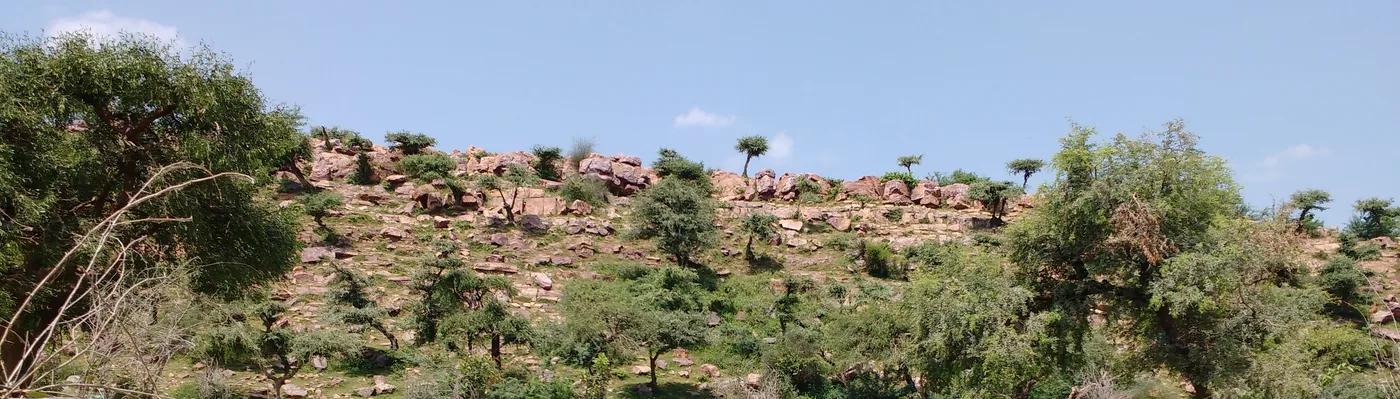
dhaniṣṭhā bhakṣya-sāmagrīṁ kṛṣṇāyādād vraje ’mitām
saiva sāmprataṁ gaurāṅga-priyo rāghava-paṇḍitaḥ
"Rāghava Paṇḍita was formerly a confidential gopī in Vraja during the time of Lord Kṛṣṇa’s pastimes, and his former name was Dhaniṣṭhā. This gopī, Dhaniṣṭhā, always engaged in preparing foods for Kṛṣṇa." (Sri Chaitanya-charitamrita Adi 10.24, purport)
So the two are clearly different:
- Raghava Pandit of Panihati: an associate of Sri Chaitanya Mahaprabhu in Bengal, the gopi Dhanishtha in Krishna's pastimes, famous for the bags of food (raghavera jhali) that he sent to Mahaprabhu at Puri every year. His home and samadhi are at Panihati on the Ganges.
- Raghava Pandita Goswami of Govardhana: a brahmana from the South who is known from the years after Mahaprabhu, when he lived in Vraja with the Goswamis, the gopi Campakalata, the author of the Bhakti-ratna-prakasha, and the guide of Shrinivasa and Narottama. His home was a cave at Govardhana.
Many modern guidebooks and websites call the Raghava of the Govardhana cave "a close associate of Sri Chaitanya Mahaprabhu". This comes from mixing up the two men, and no old source supports it.
Common Questions About Him #
Did Raghava Pandita Goswami meet Sri Chaitanya Mahaprabhu? #
No old source says that he did. In the Bhakti-ratnakara he tells Mahaprabhu's pastimes in Mathura and Vraja at almost every place, but always as something that happened there, never as something he saw, and once he names his source as the elders who told him. The records show him in Vraja among the Goswamis of Vrindavana and Radha-kunda in the years after Mahaprabhu's disappearance; nothing shows him in Mahaprabhu's company.
Who was his guru? #
The old books do not name his guru. His own book opens with verses from the Krama-dipika, and in the second of them he bows to the lotus feet of his spiritual master, without giving a name. The Bhakti-ratnakara shows him close to Raghunatha Dasa Goswami, Jiva Goswami and Krishnadasa Kaviraja Goswami, and honoured by them, but it does not say that any of them was his guru.
Where is Raghava Pandita's cave? #
It is at Punchari, the southern end of Govardhana Hill, near Apsara-kunda and Navala-kunda, on the Govardhana parikrama path. In the Bhakti-ratnakara, Raghava shows Shrinivasa Apsara-kunda "at the end of Govardhana" and the old palasha tree of Shyama-dhaka, and then brings him to his cave, and a 1955 edition of his book calls him "a resident of the Krishna-lila place called Puchri at the foot of Sri Govardhana Hill".
Where is his samadhi, and when did he leave this world? #
The old sources do not say when or where he left this world. The Gaudiya Vaishnava Abhidhana says only that his samadhi is in Vrindavana, without naming the place. No date for his disappearance day was found in the Gaudiya calendars.
What did he write? #
The Krishna-bhakti-ratna-prakasha, also called the Bhakti-ratna-prakasha, a Sanskrit book in six chapters on exclusive devotion to Krishna. The Bhakti-ratnakara says he wrote "books such as" this one, so there may have been others, but no other title has come down to us.
When did he live? #
His exact dates are not known. He was already living at Govardhana, and had already written his book, when the Gaura-ganoddesha-dipika was completed in 1576. He was a friend of Raghunatha Dasa Goswami and was honoured by Jiva Goswami, and he was still living near Govardhana when Jahnava Mata visited Vrindavana.
What His Life Teaches Us #
Raghava Pandita Goswami asked nothing of the world. He lived in a cave, ate little, and spent his days in the places where Krishna played, singing of Radha and Krishna and of Sri Chaitanya. Yet when two young devotees needed a guide, he gave them everything he had heard from the elders, and he made the holy places come alive for them. This is exactly what the scriptures say a pure devotee does:
bhavad-vidhā bhāgavatās
tīrtha-bhūtāḥ svayaṁ vibho
tīrthī-kurvanti tīrthāni
svāntaḥ-sthena gadābhṛtā
"My lord, devotees like your good self are verily holy places personified. Because you carry the Personality of Godhead within your heart, you turn all places into places of pilgrimage." (Srimad-Bhagavatam 1.13.10)
In his purport Srila Prabhupada explains that whoever visits a holy place "must search out the pure devotees residing in such holy places, take lessons from them, try to apply such instructions in practical life and thus gradually prepare oneself for the ultimate salvation, going back to Godhead." Shrinivasa Acharya and Narottama Dasa Thakura did exactly that. They saw Vraja through the eyes of Raghava, and then they carried the books and the mood of the Goswamis to Bengal, where Narottama's songs are still sung by devotees today.
Primary Scriptural Sources
- Bhakti-ratnakara of Narahari Chakravarti (Bengali, 2nd edition, Murshidabad 1912) - archive.org
- Gaura-ganoddesha-dipika of Kavi Karnapura, Sanskrit with diacritics (verse 162)
- Narottama-vilasa of Narahari Chakravarti (Bengali, 1907 edition) - archive.org
- Krishna-bhakti-ratna-prakasha of Raghava Pandita Goswami (Sanskrit, 1955 edition) - archive.org
- Krishna-bhakti-ratna-prakasha, Sanskrit e-text - Gaudiya Grantha Mandira
