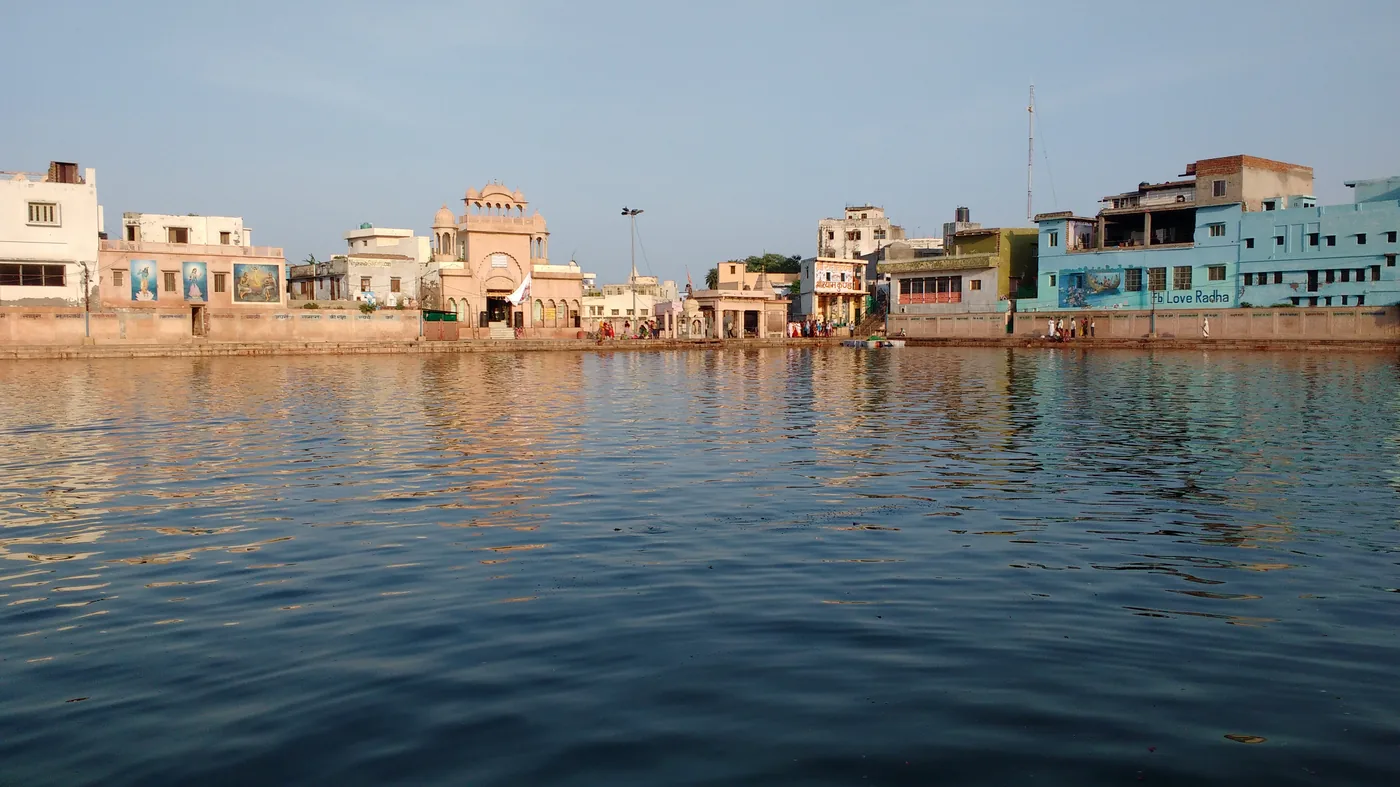
Srila Raghava Pandita Goswami lived in a cave at Govardhana, but now and then he stayed at Radha-kunda, the holy lake at the foot of the same hill, with Raghunatha Dasa Goswami. Narahari Chakravarti Thakura says so in his Bhakti-ratnakara: "now and then he stays with Dasa Goswami" (Bhakti-ratnakara, Fifth Wave, p. 150). He even praises the two saints in one couplet: "Glory to Raghunatha Dasa, who lives at Sri Radha-kunda! Glory, glory to Sri Raghava, who lives at Govardhana!" (Third Wave, opening). (This Raghava is a different person from Raghava Pandit of Panihati.)
To this lake Raghava brought Shrinivasa Acharya and Narottama Dasa Thakura, whom Srila Jiva Goswami had sent with him to see the holy places of Vraja. Here he told them story after story about Raghunatha and brought them before him, and years later he carried Raghunatha's message to Jahnava Mata. The sources show a close and loving bond between the two saints, but they never call Raghava Raghunatha's disciple.
The Lake Most Dear to Krishna #
For Gaudiya Vaishnavas, Radha-kunda is the highest of all holy places, because it is Srimati Radharani's own lake, and Lord Krishna loves it as He loves Her. Srila Rupa Goswami teaches this in his Nectar of Instruction, here in the translation of Srila Prabhupada:
"Of the many objects of favored delight and of all the lovable damsels of Vraja-bhūmi, Śrīmatī Rādhārāṇī is certainly the most treasured object of Kṛṣṇa’s love. And, in every respect, Her divine kuṇḍa is described by great sages as similarly dear to Him. Undoubtedly Rādhā-kuṇḍa is very rarely attained even by the great devotees; therefore it is even more difficult for ordinary devotees to attain. If one simply bathes once within those holy waters, one’s pure love of Kṛṣṇa is fully aroused." (Nectar of Instruction, verse 11)
How, then, does anyone come to live on its banks? Raghava gave Shrinivasa his answer at the lake itself.
How the Two Kundas Appeared and Were Found #
The road came to Radha-kunda from Arit, where, Raghava said, Krishna killed Arishta, a demon in the form of a bull (Bhakti-ratnakara, Fifth Wave, p. 190). Smiling, Srimati Radharani teased Him that this had made Him impure, and only a bath in all the holy places would purify Him. So Krishna struck the ground with His foot, and a kunda filled with the waters of all the holy places. Radha and Her friends quickly dug a kunda of their own; the holy places entered it from Shyama-kunda, praising Her, and both kundas were filled with holy water (pp. 190-191).
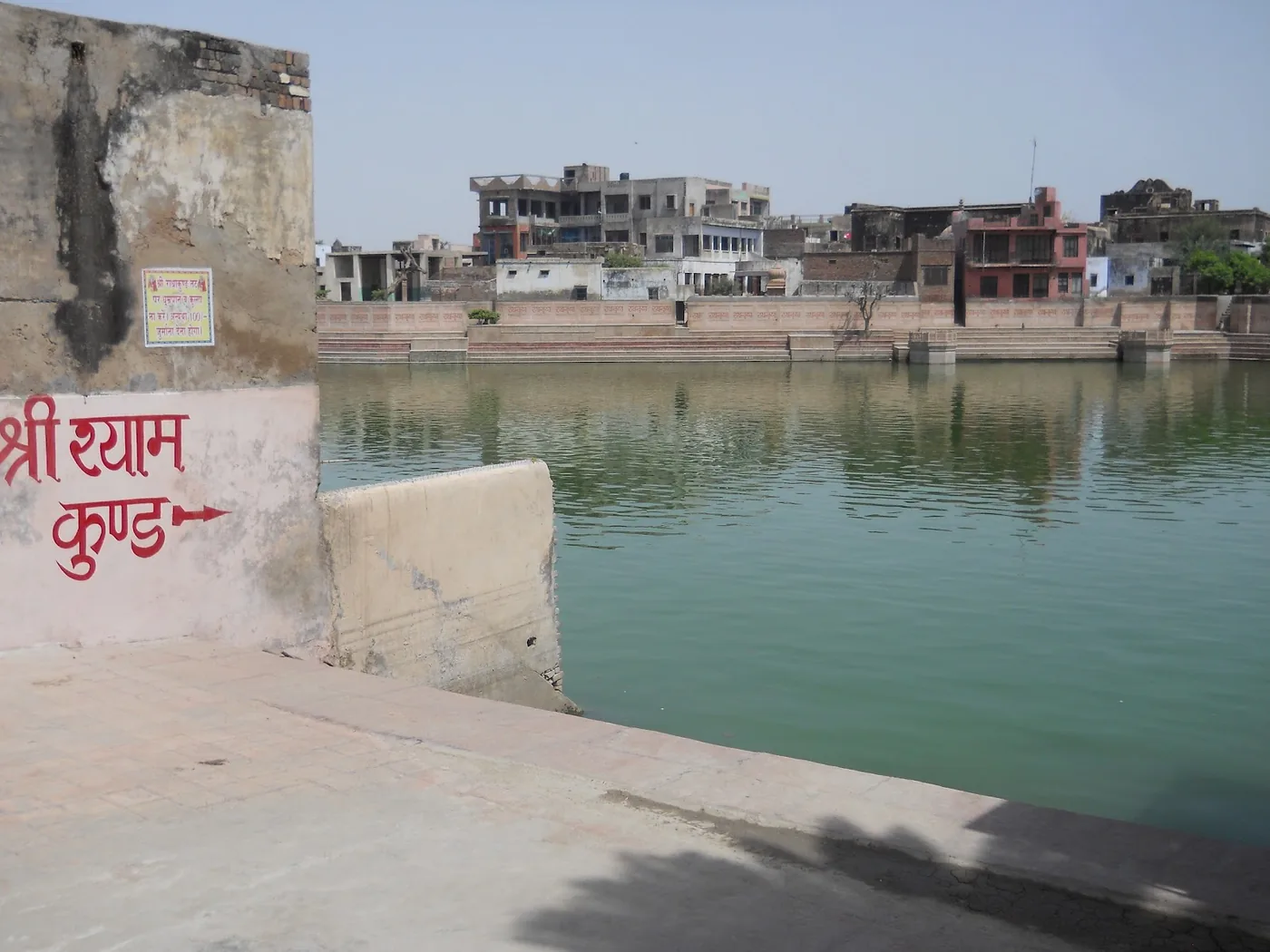
At the lake Raghava said, "See, Shrinivasa, the two kundas, Radha-kunda and Shyama-kunda" (p. 194), and he told how Sri Chaitanya Mahaprabhu had found them. The Lord sat under "this tamala tree" and asked the villagers about the two kundas, but no one could tell Him. Then He, who knows everything, saw the hidden kundas in two paddy fields. He bathed joyfully in their little water, praised the kunda, and marked His body with tilaka made from its clay, while the villagers looked on in wonder (pp. 194-195). Raghava told this, as always, as a pastime of that place, not as something he had seen. The Chaitanya-charitamrita agrees: "However, being the omniscient Supreme Personality of Godhead, He discovered Rādhā-kuṇḍa and Śyāma-kuṇḍa in two paddy fields. There was only a little water, but He took His bath there." (Sri Chaitanya-charitamrita Madhya 18.5)
Then Raghava told "briefly" how the paddy fields became lakes again (p. 195). One day Raghunatha Dasa Goswami thought how good it would be if the two kundas were full of water, and at once he blamed himself, because such a wish showed some desire for wealth. But, Raghava said, "Krishna fulfils what is in a devotee's heart." In a dream Narayana told a wealthy man who had offered many coins at Badarikashrama to take them to Raghunatha at Arit, and to remind him of his wish if he refused them. Raghunatha, stunned by the Lord's message, had the mud cleared from the two kundas, and when he saw them full of clear water he was overjoyed (pp. 195-196). Srila Prabhupada writes: "Later the pond was excavated by Lord Caitanya’s devotees, headed first by the Six Gosvāmīs, such as Rūpa and Raghunātha dāsa." (Nectar of Instruction, verse 9, purport)
Raghava's Stories of Raghunatha #
Then Raghava spoke of Raghunatha's own life of bhajana at Radha-kunda. Raghunatha used to stay under a tree day and night. One day Sanatana Goswami, who had come to the lodging of Gopala Bhatta Goswami at the kunda, saw a tiger drink at the ghata and pass close to Raghunatha as he sat in meditation. Sanatana embraced Raghunatha and told him gently, "From now on, instead of under the tree you will stay in a hut." From then on, for the good of others, Raghunatha lived in a hut (Bhakti-ratnakara, Fifth Wave, pp. 196-197). "O Shrinivasa," Raghava said, "how much of all Raghunatha's ways can I tell with one mouth?"
Raghunatha had given up grains, and his rule was to drink just one leaf-cup of buttermilk. A Vrajavasi named Dasa, whom he loved very much, once made a bigger cup from a large palasha leaf he had found at Sakhisthali, so that Raghunatha would take a little more. Hearing where the leaf came from, Raghunatha threw the cup away and said, "That is Candravali's village; do not go there" (p. 197). In Vraja, as Srila Prabhupada once wrote, "there is Radharani's party and there is Candravali's party" (letter of 6 December 1974). "The bodies of all these devotees are eternally perfect (nitya-siddha)," Raghava said, "and only a wretch doubts it."
Another time Raghunatha ate milk-rice offered to the Lord, in his mind, and his body grew heavy with indigestion. Vitthalanatha, the son of Vallabha Bhatta, brought two physicians, who felt his pulse and said that he had eaten milk-rice. Vitthalanatha was amazed, because milk-rice was impossible for Raghunatha. Then Raghunatha said, "This is the very truth: in my mind I ate milk-rice," and everyone was struck with wonder (pp. 197-198). From these stories Raghava drew his own conviction, and he spoke it to Shrinivasa as a certainty:
ahe śrīnivāsa e niścaya jāna cite / rādhā-kuṇḍa vāsa raghunātha kṛpā haite
śrī-kuṇḍa śrī-govardhana śilā guñjā-hāra / śrī-raghunāthera ei sevā supracāra
"O Shrinivasa, know this for certain in your heart: one gets to live at Radha-kunda by the mercy of Raghunatha. Sri Radha-kunda, the Govardhana-shila and the gunja-mala: this service of Sri Raghunatha is well known." (Bhakti-ratnakara, Fifth Wave, p. 198, 1912 Bengali edition; English rendering ours)
The Govardhana-shila, a stone from Govardhana Hill, and the gunja-mala came to Raghunatha from Sri Chaitanya Mahaprabhu Himself. When Raghunatha lived near Him at Jagannatha Puri, the Lord gave him both and told him, "This stone is the transcendental form of Lord Kṛṣṇa. Worship the stone with great eagerness." (Sri Chaitanya-charitamrita Antya 6.294) Krishnadasa Kaviraja Goswami records how Raghunatha understood the gift:
“śilā diyā gosāñi samarpilā ‘govardhane’
guñjā-mālā diyā dilā ‘rādhikā-caraṇe’ ”
"“By offering me the govardhana-śilā, Śrī Caitanya Mahāprabhu has offered me a place near Govardhana Hill, and by offering me the garland of conchshells, He has offered me shelter at the lotus feet of Śrīmatī Rādhārāṇī.”" (Sri Chaitanya-charitamrita Antya 6.307)
Mahaprabhu gave Raghunatha shelter at Srimati Radharani's feet; and it is by Raghunatha's mercy, Raghava says, that anyone else comes to live at Her lake.
Bringing the Two to Raghunatha Dasa Goswami #
First Raghava showed the two young devotees other kundas nearby: Malyahari-kunda, where a pastime with a pearl necklace took place, as Raghunatha describes in his Mukta-carita, and the kundas called Shiva-khora and Bhanu-khora. "Saying this, Raghava's heart was full of joy" (Bhakti-ratnakara, Fifth Wave, p. 198). Then he took them to Raghunatha:
śrī-rāghava-paṇḍita sakala nivedila / śuni dāsa-gosvāmira citte harṣa haila
śrīnivāsa narottama ati sāvadhāne / bhūme paḍi praṇamilā gosvāmi-caraṇe
gosvāmira śuṣka deha durbalātiśaya / tathāpi uṭhiyā dui bāhu pasāraya
"Sri Raghava Pandita told him everything, and Dasa Goswami's heart was delighted to hear it. Very respectfully, Shrinivasa and Narottama fell to the ground and bowed at the Goswami's feet. The Goswami's body was dried up and extremely weak, yet he rose and opened both his arms to them." (Bhakti-ratnakara, Fifth Wave, p. 198, 1912 Bengali edition; English rendering ours)
Narahari's word for Raghava's report is nivedila, "he submitted", a word of respect for what one humbly places before an elder. Raghunatha embraced the two and spoke softly to Shrinivasa. Krishnadasa Kaviraja, who loved Shrinivasa as his own life, came to them, and so did Dasa and the other Vaishnavas living on the bank, who quickly had food prepared (p. 198). They honoured mahaprasada, food offered to the Lord, "where Sri Gopala Bhatta Goswami's hut is" (p. 199), the hut of Shrinivasa's own guru.
Shrinivasa had been here once before, soon after his initiation, when "Sri Raghava, Krishnadasa Kaviraja and the others all showed Shrinivasa the greatest mercy" (Bhakti-ratnakara, Fourth Wave, p. 145). This time Raghava himself brought him. After a day of great joy, "the Pandita set out at dawn, taking the two with him" (p. 199), to go round Govardhana Hill.
Govinda-ghata and a Night of Krishna-katha #
After the circuit of Govardhana, the Pandita brought Shrinivasa joyfully back to Radha-kunda. At Govinda-ghata, "very dear to Govinda", he bathed and said, "O Shrinivasa, I will tell you the pastime that happened under this tree" (Bhakti-ratnakara, Fifth Wave, p. 210). Once, he said, Sanatana came from Govardhana and questioned a verse of Rupa's that compares a braid of hair to a serpent. Then, at the kunda, Sanatana saw some young girls playing under the tree. He took one girl's braid for a serpent climbing to her head and called out in alarm. The girls smiled a little and vanished, and Sanatana went to Rupa and said, "What you wrote is true."
Rupa had come for Raghunatha's sake. His play Lalita-madhava, in which the pain of separation reaches its limit, had made Raghunatha weep day and night like a madman. As a medicine for him Rupa wrote the Dana-keli-kaumudi. "Reading the Dana-keli," Raghava said, "Raghunatha, best of the wise, was immersed for ever in an ocean of joy. O Shrinivasa, how much can I tell of all the ways of Sanatana, Rupa and Raghunatha?" (pp. 210-211).
Then Raghava showed them the places around the lake: Nimagrama, where the gopis, coming out from Govardhana, gazed at Krishna's face and waved offerings (nirmanchana) to Him; Kunjera, at the edge of Radha-kunda's groves; and Surya-kunda, where Radha worships the sun with Her friends while Krishna Himself plays the priest (Bhakti-ratnakara, Fifth Wave, pp. 211-212). Then they came back to Radha-kunda full of joy:
se divasa rādhā-kuṇḍa-taṭei rahilā / kṛṣṇa-kathāya sei niśā prabhāta karilā
"That day they stayed on the very bank of Radha-kunda, and they passed the whole night until dawn in talk about Krishna." (Bhakti-ratnakara, Fifth Wave, p. 212, 1912 Bengali edition; English rendering ours)
Gathuli and the Service of Gopala #
From Radha-kunda they went to Gathuli, and Raghava told how it got its name: after playing Holi, Radha and Krishna sat on a throne, and a sakhi secretly tied Their garments together in a knot, a ganthi (Bhakti-ratnakara, Fifth Wave, pp. 212-213). There they had darshan of Gopala, the Deity whom Madhavendra Puri had served, and His beauty took away their composure. Vitthalanatha, the son of Vallabha Bhatta, showed them more love than words can tell (p. 213).
Then came Gopala's history. In the mood of a devotee, Sri Chaitanya Mahaprabhu would not set foot on Govardhana Hill, yet He wished to see Gopala, and Gopala came to Gathuli "on a pretext". Seeing Him, the Lord was lost in dancing and singing. In those days two Bengali brahmanas, disciples of Madhavendra Puri, served Gopala. After they passed away, a new servant had to be chosen, and Srila Prabhupada quotes Narahari's lines about that choice in his purport:
śrī-dāsa-gosvāmī ādi parāmarśa kari’
śrī-viṭhṭhaleśvare kailā sevā-adhikārī
"After consulting together, Sri Dasa Goswami and the others made Sri Vitthaleshvara the one in charge of the service." (Sri Chaitanya-charitamrita Madhya 18.47, purport, quoting the Bhakti-ratnakara; English rendering ours, since the purport gives these lines without a translation)
Vitthaleshvara is Vitthalanatha, the younger son of Vallabha Bhatta, who was now always attentive in Gopala's service (pp. 213-214). The book does not mark exactly where Narahari's narration ends and Raghava's words begin, but it closes: "Having told Gopala's qualities, Raghava Pandita left Gathuli full of joy" (p. 214). So Raghava told this history, and the choice in it had been made by Raghunatha and the devotees around him. From Gathuli he led the two on to the forests of Vraja.
A Message for Jahnava Mata #
Years after the tour, the book shows Raghava once more in Raghunatha's service. After the great festival at Kheturi, Jahnava Mata, the wife of Nityananda Prabhu, came to Vrindavana. Raghunatha was delighted to hear of her coming, but he had no strength to travel: his heart was always restless in separation from Sri Rupa, and without food his body had become extremely thin. So he sent his humble message through Krishnadasa Kaviraja and many others (Bhakti-ratnakara, Eleventh Wave, p. 667):
gopāla rāghava paṇḍitādi eka sāthe / cale nandīśvara govardhanādi haite
sabe vṛndāvane kari' īśvarī darśana / jānāilā dāsa-gosvāmira nivedana
"Gopala, Raghava Pandita and others set out together from Nandishvara, Govardhana and other places. In Vrindavana they all had darshan of Ishvari [Jahnava Devi] and conveyed Dasa Goswami's request." (Bhakti-ratnakara, Eleventh Wave, p. 667, 1912 Bengali edition; English rendering ours)
Jahnava Mata told Gopala Bhatta Goswami and the other Goswamis that she would go to Sri-kunda in the morning, and when she saw its beauty her heart overflowed with love (p. 667). Raghava is not named again during her visit, but these lines show him, long after the tour, still living near Govardhana and still close to Raghunatha.
The Mercy of the Vaishnavas #
Rupa Goswami calls Radha-kunda "very rarely attained even by the great devotees". It is not won by learning or effort alone; it is given by the mercy of the pure devotees who live there. Raghava was "expert in all the scriptures" (p. 150), yet this is just what he told Shrinivasa: "one gets to live at Radha-kunda by the mercy of Raghunatha." Raghunatha himself had received that mercy from Mahaprabhu, who, as he said, "has offered me shelter at the lotus feet of Śrīmatī Rādhārāṇī".
Raghava's own life shows how such mercy is received. He stayed with Raghunatha, told the stories of Raghunatha's life with love, brought two young devotees to bow at his feet, and years later carried his humble message to Jahnava Mata. For anyone who longs for Radha-kunda, Raghava shows the way: serve the devotees who belong to it, and pray for their mercy.
