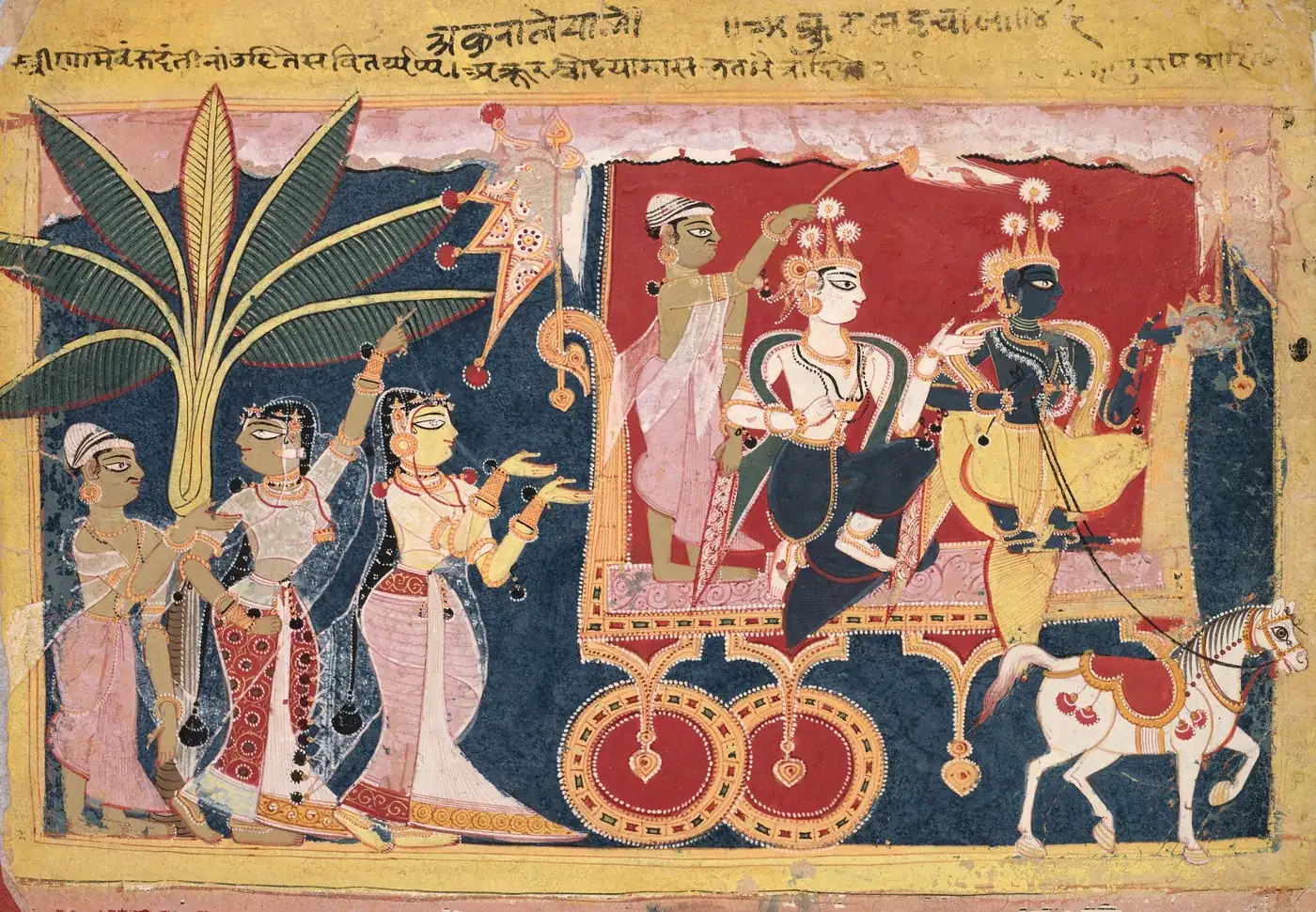
The tour of Vraja that Srila Raghava Pandita Goswami made with Shrinivasa Acharya and Narottama Dasa Thakura was coming to its end. Srila Jiva Goswami had placed the two young devotees in his care (Jiva Goswami Entrusts Shrinivasa and Narottama to Him), and together they had walked through the forests of Vraja-mandala (Through the Forests of Vraja). Now they crossed the Yamuna back to Mathura, bathed at Vishrama-tirtha and set out for Vrindavana (Bhakti-ratnakara, Fifth Wave, pp. 287-288). The book does not say how long the whole tour took.
In these last days Raghava gave some of his deepest teachings. Then came the farewell, the most tender scene the Bhakti-ratnakara gives of him.
From Akrura to the Bhojana-tila #
On the way the party reached Akrura-tirtha, the village named after Akrura, who drove Sri Krishna and Balarama from Vraja to Mathura. Here Raghava told Shrinivasa that Sri Chaitanya Mahaprabhu had once stayed in this quiet place. Srila Prabhupada quotes his words in a purport to the Chaitanya-charitamrita:
dekha, śrīnivāsa, ei akrūra grāmete
śrī-kṛṣṇa-caitanya-prabhu chilena nibhṛte
"“Śrīnivāsa, look at this village of Akrūra. Śrī Caitanya Mahāprabhu stayed there in a solitary place.”" (Sri Chaitanya-charitamrita Madhya 18.70, purport)
Srila Prabhupada does not name the speaker, but in the Bhakti-ratnakara these are Raghava's words, and in the 1912 printed edition the line begins "ahe Shrinivasa" ("O Shrinivasa") instead of "dekha, Shrinivasa" ("look, Shrinivasa") (Fifth Wave, p. 289). Because of the crowds in Vrindavana, Raghava added, the Lord used to come here to take His meals with a joyful heart. "Who can understand His mind?" he asked. Here, as everywhere on the tour, he tells the Lord's pastimes as history and never says that he saw them himself.
A little further on, at the mound called the Bhojana-tila, where the sages' wives once fed Krishna, Raghava stopped to teach Shrinivasa what Vrindavana really is. Quoting verse after verse of scripture, he said that this forest is Krishna's own body, that Krishna never leaves it, and that every creature living there, whether animal, bird, tree, insect or human, reaches Krishna's abode in the end. But this Vrindavana is hidden from ordinary eyes (pp. 290-301):
ahe śrīnivāsa sarva śāstre nirūpaṇa / kṛṣṇera parama priya dhāma vṛndāvana
… tejomaya vṛndāvana ati manohara / prema-netra vinā carma-cakṣu agocara
"O Shrinivasa, all the scriptures establish this: Vrindavana is Krishna's most dear abode. ... Vrindavana is full of spiritual light and supremely charming, but without the eyes of prema it cannot be seen by eyes of flesh." (Bhakti-ratnakara, Fifth Wave, p. 291, 1912 Bengali edition; English rendering ours)
Govinda Seen Face to Face #
From Vrindavana Raghava turned to its Lord, Sri Govindadeva. Govinda, he said, is not a statue standing in place of Krishna; He is Krishna Himself (p. 293).
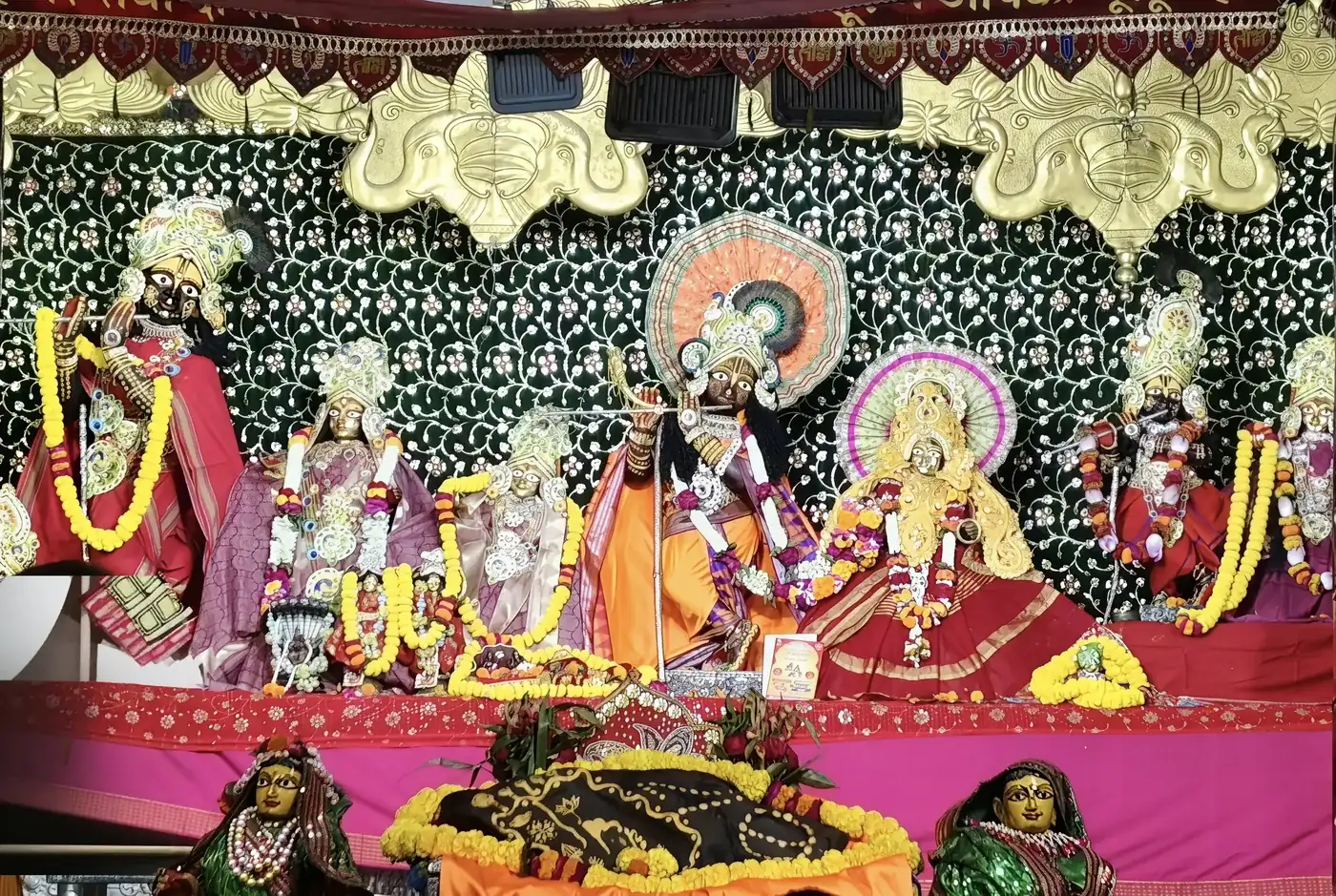
śrī-govinda-deva sākṣāt vrajendra-tanaya / vigrahera nyāya līlā kare icchāmaya
prāpañcika loka dekhe pratimā ākāra / svajana dekhaye śrī-govinda sākṣātkāra
"Sri Govindadeva is directly the son of the king of Vraja. The Lord, who does whatever He wishes, plays the part of a Deity. Worldly people see the form of a statue; His own people see Sri Govinda face to face." (Bhakti-ratnakara, Fifth Wave, p. 293, 1912 Bengali edition; English rendering ours)
Sri Chaitanya Mahaprabhu taught the same truth when He gave Raghunatha Dasa Goswami, with whom Raghava stayed from time to time, a stone from Govardhana Hill:
prabhu kahe, — “ei śilā kṛṣṇera vigraha
iṅhāra sevā kara tumi kariyā āgraha
"Śrī Caitanya Mahāprabhu instructed Raghunātha dāsa, “This stone is the transcendental form of Lord Kṛṣṇa. Worship the stone with great eagerness.”" (Sri Chaitanya-charitamrita Antya 6.294)
As Raghunatha Dasa worshipped it, the Chaitanya-charitamrita adds, "he saw the Supreme Personality of Godhead, Kṛṣṇa, the son of Nanda Mahārāja, directly in the stone" (Antya 6.300). The Lord does not change; what changes is the eye that looks at Him. When Raghava had finished this teaching, the Bhakti-ratnakara says, he walked slowly on from the Bhojana-tila, joyful at heart (p. 301).
The Disciplic Line at Advaita-vata #
The way into Vrindavana passed Kaliya-hrada and Praskandana, where Mahaprabhu Himself had gone from Akrura-tirtha to bathe (Chaitanya-charitamrita Madhya 18.71). Srila Prabhupada's purport to that verse quotes the Bhakti-ratnakara:
e kālīya-tīrtha pāpa vināśaya
kālīya-tīrtha-sthāne bahu-kārya-siddhi haya
"“When one takes a bath in Kālīya-hrada, he is freed from all sinful reactions. One can also be successful in business by bathing in Kālīya-hrada.”" (Sri Chaitanya-charitamrita Madhya 18.71, purport)
Beside Kaliya-hrada, at the Dvadashaditya-tila, Raghava told how Sanatana Goswami had lived in that lonely spot by Mahaprabhu's order, and how Mahaprabhu, seeing him anxious, appeared to him there in a dream and embraced him (p. 303).
At the banyan tree called Advaita-vata he spoke "in the ecstasy of prema" (p. 304). He told the life of Advaita Acharya, who had worshipped Krishna under that tree, and then the life of Mahaprabhu, Sri Gaurasundara, whom he called Krishna Himself, the son of the king of Vraja. Coming to the Lord's diksha, His initiation, from Ishvara Puri, he raised a question himself: if the Lord is the guru of the whole world, how can He have a guru? "For the instruction of people," he answered. The Lord practises dharma Himself in order to establish it, and so He made the Madhva sampradaya, the disciplic line of Madhvacharya, glorious. Then Raghava stated the rule:
sampradā-niviṣṭa haile kārya-siddhi haya / anyatra dīkṣite mantra niṣphala niścaya
śrī mādhva rudra sanaka sampradāya cāri / kalite vidita kahe purāṇe vistāri'
"One who belongs to a sampradaya reaches the goal; a mantra received outside one is surely fruitless. There are four sampradayas, the Shri, Madhva, Rudra and Sanaka, known in Kali-yuga, as the Puranas explain in detail." (Bhakti-ratnakara, Fifth Wave, p. 308, 1912 Bengali edition; English rendering ours)
The Bhakti-ratnakara backs this with a verse of the Padma Purana, and Srila Prabhupada explains the same verse: "In the Padma Purāṇa it is also said, sampradāya-vihīnā ye mantrās te niṣphalā matāḥ. There are four sampradāyas, or disciplic successions, namely the Brahma sampradāya, the Rudra sampradāya, the Śrī sampradāya and the Kumāra sampradāya. If one wants to advance in spiritual power, one must receive his mantras from one of these bona fide sampradāyas; otherwise he will never successfully advance in spiritual life." (Srimad-Bhagavatam 6.8.42, purport)
So a guru does not make himself a guru. His authority comes down to him through the line, and he gives only what he has received. Raghava then recited the Madhva line itself, twenty names numbered one by one, from Narayana, Lord Brahma, Narada Muni and Vyasadeva, through Madhvacharya himself, down to Lakshmipati Tirtha, Madhavendra Puri and Ishvara Puri, ending: "his disciple Prabhu Gauracandra, the Lord" (pp. 310-311). He confirmed it from Kavi Karnapura's Gaura-ganoddesha-dipika. Both listeners had received diksha within this sampradaya, Shrinivasa from Gopala Bhatta Goswami and Narottama from Lokanatha Goswami, and it is the same guru-parampara that comes down to Srila Prabhupada.
His Last Teaching on Vraja #
At Imli-tala Raghava showed the tamarind tree under which Mahaprabhu used to sit, floating in tears of His own bliss; at Shringara-vata he told the life of Nityananda Prabhu; then came Nidhuvana, Keshi-tirtha, Dhira-samira and Vamshivata (pp. 317-327). From there, at the rasa-sthali and from grove to grove, the Bhakti-ratnakara places in Raghava's mouth its long treatise on the rasa dance, on music and dance, and on the heroes and heroines of rasa, about a hundred and twenty printed pages (pp. 325-450). Its author, Narahari Chakravarti Thakura, was himself a musician, and the learning is surely his own; but the book presents it as Raghava's teaching to Shrinivasa.
At last, near Brahma-kunda and Govindasvami-tirtha, Raghava summed up how a devotee should feel about Vraja, backing each point with a verse of Raghunatha Dasa Goswami's Vraja-vilasa-stava:
ohe śrīnivāsa bhakta sadā samprārthaye / anya prasaṅgeo yena vraje vāsa haye
vraja-bhūme vaise ye se kṛṣṇa-priya hana / tā sabāre vande nitya bhāgyavanta-gaṇa
vraja-sthita tṛṇa-gulma kīṭādika yata / se sabe praṇame bhāgyavanta avirata
"O Shrinivasa, a devotee always prays that, by some means or other, he may get to live in Vraja. Whoever lives in the land of Vraja is dear to Krishna; the fortunate always bow down to them all. To the grass, the bushes, the insects and every other thing that is in Vraja, the fortunate bow down again and again." (Bhakti-ratnakara, Fifth Wave, p. 449, 1912 Bengali edition; English rendering ours)
Some devotees, he added, call out the names of Radha and Krishna with tears in their eyes and long to sprinkle Krishna's play-places with those tears (p. 450). The words fit his own life: the Bhakti-ratnakara had described him as grey with the dust of Vraja and carried away by his tears, as told in A Brahmana of the South at Govardhana.
The Farewell to Shrinivasa and Narottama #
Then Raghava turned to the two young men who had walked beside him through Vraja, and spoke from his heart:
ohe śrīnivāsa vṛndāvanera mādhurī / mane abhilāṣa sadā rākhi netre bhari'
tomā doṅhā laiyā mahā ānande bhraminu / puna nā ha-ibe hena mane vicārinu
janme janme tumi dui prabhura kiṅkara / eta kahi' paṇḍitera adhairya antara
"'O Shrinivasa, the one wish of my heart is always to keep the sweetness of Vrindavana filling my eyes. Taking you two with me, I have wandered in great joy, and I feel in my heart that this will not happen again. Birth after birth, you two are servants of the Lord.' Saying this, the Pandita's heart lost all composure." (Bhakti-ratnakara, Fifth Wave, p. 450, 1912 Bengali edition; English rendering ours)
Narottama and Shrinivasa floated in tears, and all their composure was gone.
paṇḍitera pada-tale paḍe loṭāiyā / paṇḍita nayana-jale siñce kole laiyā
"They fell rolling at the Pandita's feet, and the Pandita took them on his lap and bathed them with his tears." (Bhakti-ratnakara, Fifth Wave, p. 451, 1912 Bengali edition; English rendering ours)
The three sat together in a solitary place, singing of the lives of Radha and Krishna and of Sri Chaitanya until they lost all outward awareness. Bowing again and again to the land of Vrindavana, they made prayers that, the book says, cannot be told, and only after some time did they become steady again (p. 451).
Back to Jiva Goswami and Govardhana #
Then the three went to see Sri Govindadeva. At the temple Sri Krishna Pandita joyfully gave them Govinda's garland and prasada, and Raghava told him the whole journey in order. From there they hurried to Jiva Goswami's lodging, and Jiva was overjoyed to see them (pp. 451-452).
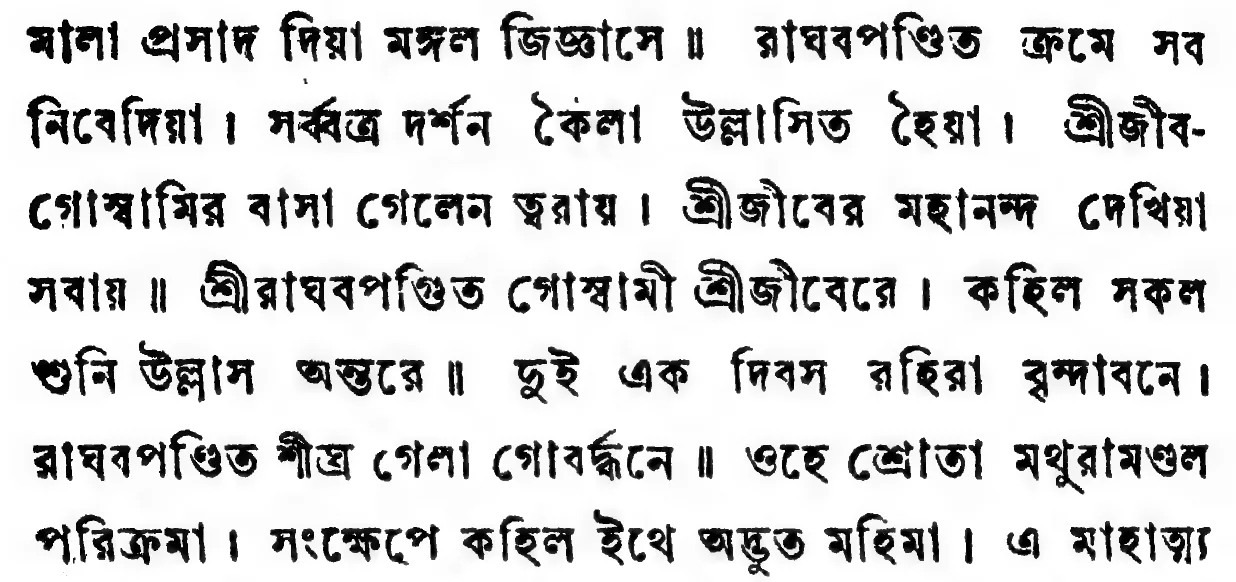
śrī-rāghava-paṇḍita gosvāmī śrī-jīvere / kahila sakala śuni' ullāsa antare
dui eka divasa rahiyā vṛndāvane / rāghava-paṇḍita śīghra gelā govardhane
"Sri Raghava Pandita Goswami told Sri Jiva everything, and Jiva's heart rejoiced to hear it. After staying one or two days in Vrindavana, Raghava Pandita quickly went back to Govardhana." (Bhakti-ratnakara, Fifth Wave, p. 452, 1912 Bengali edition; English rendering ours)
Jiva Goswami had placed the two young men in his care, so Raghava gave him a full account. Then, after only a day or two, he hurried home to Govardhana, the hill the Bhakti-ratnakara calls "his everything" (p. 150), as told in Around Govardhana Hill and His Own Cave.
How Shrinivasa Remembered Him #
The Bhakti-ratnakara shows Raghava with the two devotees one last time. When Shrinivasa was to take the books of the Goswamis to Bengal, as told in his own life, the great Vaishnavas of Vraja gathered at Govinda's temple, and the book names Raghava among them (Sixth Wave, p. 486):
premī kṛṣṇadāsa kṛṣṇadāsa brahmacārī / rāghava-paṇḍita prema-bhakti adhikārī
"... the loving Krishnadasa, Krishnadasa Brahmachari, and Raghava Pandita, who possessed prema-bhakti ..." (Bhakti-ratnakara, Sixth Wave, p. 486, 1912 Bengali edition; English rendering ours)
The books were loaded onto a cart, and Jiva Goswami and a few others went with it as far as Mathura, where they spent the day and the night in Krishna-katha, talk about Krishna. At the parting next morning, the book names Raghava, with Krishnadasa Kaviraja Goswami, among those who could not hold back their grief:
kṛṣṇadāsa kavirāja paṇḍita rāghava / śrī-gopāla mādhavādi yateka vaiṣṇava
sakale adhairya hailā vidāyera kāle / śrīnivāsa ādi sikta hailā netra-jale
"Krishnadasa Kaviraja, Pandita Raghava, Sri Gopala, Madhava and all the other Vaishnavas lost their composure at the time of parting, and Shrinivasa and the others were drenched with tears." (Bhakti-ratnakara, Sixth Wave, p. 487, 1912 Bengali edition; English rendering ours)
Shrinivasa never forgot the tour. Long afterwards, visiting Navadvipa with Narottama and Ramachandra Kaviraja, he hesitantly told Mahaprabhu's old servant Ishan Thakur of his wish (Twelfth Wave, p. 716):
śrī-rāghava saṅge vraje bhramaṇa karite / mane haila nadīyā bhramiba ei mate
"'While I was touring Vraja with Sri Raghava, it came to my mind that I would tour Nadiya in the same way.'" (Bhakti-ratnakara, Twelfth Wave, p. 716, 1912 Bengali edition; English rendering ours)
Ishan Thakur answered, "What you have thought of, Sri Gaurasundara will fulfil." One night during that visit, sleeping in the courtyard of Mahaprabhu's house, Shrinivasa dreamed of Sri Gaurasundara shining among His devotees, and among them he saw Raghava, named by his home (p. 999):
bhūgarbha śrī-lokanātha raghunātha-dāsa / rāghava-paṇḍita govardhane yāra vāsa
"... Bhugarbha, Sri Lokanatha, Raghunatha Dasa, and Raghava Pandita, whose home is at Govardhana." (Bhakti-ratnakara, Twelfth Wave, p. 999, 1912 Bengali edition; English rendering ours)
This was a vision of the Lord's eternal company, in which Jiva Goswami and others of the later generation also appear, so it says nothing about a meeting with Mahaprabhu in this world. But it shows the place the book gives him: among the Lord's own devotees.
Servants of the Lord, Birth After Birth #
Raghava's farewell to the two ended in a blessing: "Birth after birth, you two are servants of the Lord." This is the truth of every soul, as Sri Chaitanya Mahaprabhu taught Sanatana Goswami:
jīvera ‘svarūpa’ haya — kṛṣṇera ‘nitya-dāsa’
kṛṣṇera ‘taṭasthā-śakti’ ‘bhedābheda-prakāśa’
sūryāṁśa-kiraṇa, yaiche agni-jvālā-caya
svābhāvika kṛṣṇera tina-prakāra ‘śakti’ haya
"“It is the living entity’s constitutional position to be an eternal servant of Kṛṣṇa because he is the marginal energy of Kṛṣṇa and a manifestation simultaneously one with and different from the Lord, like a molecular particle of sunshine or fire. Kṛṣṇa has three varieties of energy." (Sri Chaitanya-charitamrita Madhya 20.108-109)
Because service to Krishna is the soul's own nature, it does not end with one journey or one life. Raghava felt that such days would not come again, but what he blessed in them would never end. In these last days he had shown the two young devotees the holy places through the eyes of scripture, the Deity as Krishna Himself, the line through which the mantra comes, and how to bow to everything in Vraja. Years later Shrinivasa still remembered it all simply as touring Vraja "with Sri Raghava".
