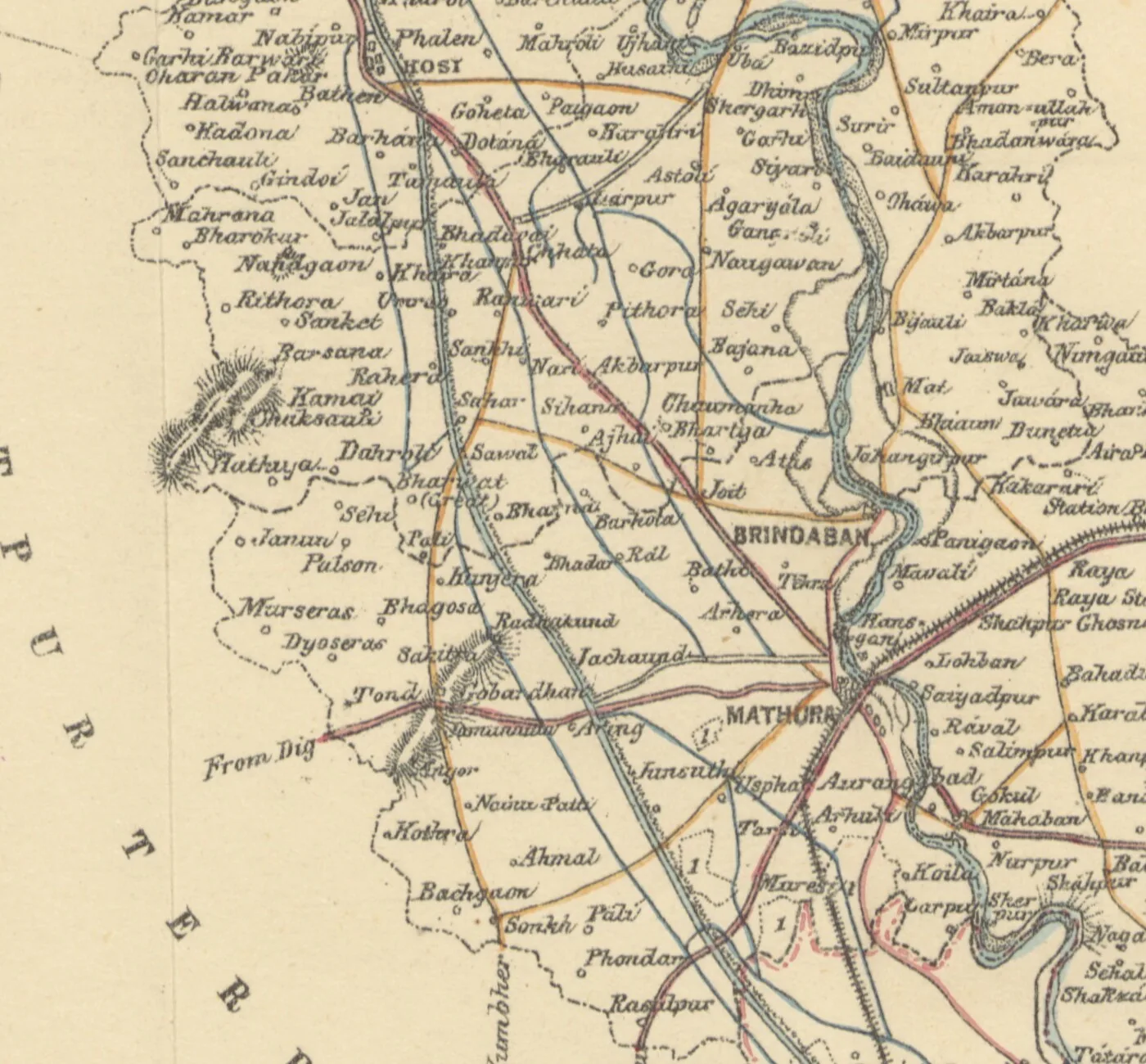
From Gathuli, Srila Raghava Pandita Goswami led Shrinivasa Acharya and Narottama Dasa Thakura away from Govardhana into the wider forests of Vraja. Srila Jiva Goswami had sent the two young devotees with him to see all the holy places (see Jiva Goswami Entrusts Shrinivasa and Narottama to Him), and they had already seen Mathura, Radha-kunda and the circuit of Govardhana. The Fifth Wave of Narahari Chakravarti Thakura's Bhakti-ratnakara now follows them to Kamyavana, through Varshana and Nandishvara, along the Yamuna, across the river to Mahavana and Gokula, and back to Mathura. At almost every place Raghava turns to Shrinivasa, says "O Shrinivasa, see," and tells what happened there: the pastimes of Krishna, the visits of Sri Chaitanya Mahaprabhu and Nityananda Prabhu, and the lives of the Goswamis who had lived in these forests.
The book does not say how many days the journey took. On this part of the road it mentions nights at Sanatana Goswami's hut at Nandishvara, at the village of Surukhuru and at Raval. But it lets us see the guide clearly. He weeps at the places where the Goswamis lived, he walks slowly because the beauty of the forest overwhelms him, he climbs a mound to look over the countryside, and he spends whole nights talking about Krishna.
From Kamyavana to Nandishvara #
Leaving Gathuli, Raghava showed one village after another, often giving both the old name and the name people used in his day, such as Pramodana, "now Paramadana" (Bhakti-ratnakara, Fifth Wave, p. 214). Then they reached Kamyavana, a forest so full of holy ponds that the book gives up trying to list them. Srila Prabhupada quotes its words:
ei kāmyavane kṛṣṇa-līlā manohara
karibe darśana sthāna kuṇḍa bahutara
kāmyavane yata tīrtha lekhā nāhi tāra
"“In this Kāmyavana, Kṛṣṇa performed enchanting pastimes. Here you will be able to take darśana of many ponds and other transcendental spots. I cannot even describe in writing all the sacred tīrthas found at Kāmyavana.”" (Sri Chaitanya-charitamrita Madhya 18.55, purport)
From Kamyavana they went on to Varshana, the town of King Vrishabhanu, the father of Srimati Radharani, and from there to Nandishvara (pp. 215-221). At Nandishvara Raghava pointed to the top of the hill: "See, on top of the hill Sri Nanda and Yashoda shine with their son in a wonderful cave." Then he told what Sri Chaitanya Mahaprabhu had done there (p. 222). The Lord entered the cave and saw Nanda and Yashoda on either side and Krishna in the middle, and His eyes blossomed with joy. He bowed at the feet of Nanda and Yashoda, touched Krishna's whole form, and began to dance and sing in the ecstasy of prema, and the people who watched said that Nanda's son seemed to have appeared again. Raghava ended humbly: "I do not know how to tell the prema that Sri Krishna-Chaitanya, crest-jewel of sannyasis, revealed here."
Krishnadasa Kaviraja Goswami tells the same scene in the Chaitanya-charitamrita: "Śrī Caitanya Mahāprabhu offered His respects to Nanda Mahārāja and mother Yaśodā, and with great ecstatic love He touched the body of Lord Kṛṣṇa" (Sri Chaitanya-charitamrita Madhya 18.62). As always, Raghava tells the story in the third person and never says that he saw it.
Lokanatha Goswami at Umrao #
From Nandishvara they went through Yavata, Kokilavana and many other villages of Radha and Krishna's pastimes (pp. 223-247). At Umrao, beside Kishori-kunda, "very dear to Vrishabhanu's daughter," Raghava told how Lokanatha Goswami had lived there (p. 247). There is no end, he said, to telling of Lokanatha's renunciation. Whatever came to him, fruits, roots, greens or grain, he offered with care to his Deity, Sri Radha-vinoda. In the rains and the cold he lived under a tree with only a worn quilt and a very worn cloth. When the rain poured down he let himself be soaked, but he kept the Deity dry in the hollow of the tree. At other times he carried Him in a worn bag on his chest, his heart full of joy. And remembering the pastimes of Sri Gauracandra, he would weep there. As Raghava spoke, his own heart overflowed:
aiche kata kahi dhairya dharite nā pāre / rāghava-paṇḍita netra jalei sāṅtāre
śrīnivāsa narottama dhūlāya loṭāya / chāḍe dīrgha-śvāsa bhāse netrera dhārāya
kata kṣaṇe śrī-paṇḍita susthira haiyā / doṅhe sthira kari āge cale doṅhe laiyā
"Saying many such things, Raghava Pandita could not keep his composure: he swam in his own tears. Shrinivasa and Narottama rolled in the dust, heaving long sighs and floating in streams of tears. After some time Sri Pandita became calm, calmed the two, and went on, taking them with him." (Bhakti-ratnakara, Fifth Wave, p. 248, 1912 Bengali edition; English rendering ours)
Narottama, rolling in the dust that day, was Lokanatha Goswami's own disciple (see Discipleship under Lokanatha Gosvami). He was hearing of his guru's renunciation at the very place where it had happened, from a devotee who wept as he told it. A little further on, in Khadiravana, Raghava spoke words that Srila Prabhupada also quotes:
dekhaha khadira-vana vidita jagate
viṣṇu-loka-prāpti ethā gamana-mātrete
"“Behold the forest named Khadiravana, renowned throughout the universe. If one comes to Khadiravana, he can immediately be elevated to Viṣṇuloka.”" (Sri Chaitanya-charitamrita Madhya 18.63, purport)
There he showed Sangama-kunda, a very secluded place where Lokanatha stayed from time to time with Bhugarbha Goswami (p. 249).
Tears at Sanatana Goswami's Hut #
After showing many more places, they came back to Nandishvara full of joy. Raghava told Shrinivasa a little about the lives of Nanda and his family and then stopped beside Pavana-sarovara, where Sanatana Goswami had lived:
sanātana gosvāmira kuṭīra darśane / hailā adhairya aśru jharaye nayane
rāghava paṇḍita kahe śrīnivāsa prati / kahi kichu yaiche gosvāmira ethā sthiti
"On seeing Sanatana Goswami's hut, he lost all composure and tears streamed from his eyes. Raghava Pandita said to Shrinivasa, 'Let me tell you a little of how the Goswami lived here.'" (Bhakti-ratnakara, Fifth Wave, p. 250, 1912 Bengali edition; English rendering ours)
The book does not name the one who wept, but the next line has Raghava speaking, so the tears were most likely his own. Sanatana, he said, had come from Vrindavana to this lonely forest and stayed hidden, so absorbed in Krishna that he made no effort to get food. Then Krishna came to him as a cowherd boy, a turban on His head and a pot of milk in His hands. "You stay in a lonely place and nobody knows you," the boy said. "Drink this milk; I will take the pot later. If you stay like this, the Vrajavasis will be pained." Sanatana drank the milk and was overcome with prema, and the Lord had the people of Vraja build him a hut (pp. 250-251). Raghava also told how Srimati Radharani, dressed as a cowherd girl, once brought Rupa Goswami the ingredients for milk-rice to feed Sanatana, and how Rupa's heart burned with the fire of separation while nothing showed outside, so that his breath raised blisters on another devotee's body (pp. 251-252).
Then Raghava went to Sanatana's hut. There they found Gopala Mishra, a brahmana of good character, the son of Sanatana Goswami's family priest and Sanatana's own disciple, and with him Uddhava Dasa, Madhava, Gopala Dasa and others. They all met with great joy, the Vrajavasis at once brought food, and "there was a great festival there that day" (p. 252). One line, printed in brackets in the 1912 edition, adds that they all spent the night in nama-sankirtana, singing the holy names together. Narahari writes: "Whoever hears such a wonderful account soon attains the treasure of love for Krishna." At dawn Raghava said goodbye and set off again on the parikrama path with the two.
Baithan and Sheshashayi #
The first village was Baithan. Here, Raghava said, Sanatana had stayed, "bound by the love of the Vrajavasis" (pp. 252-253). Then he told one of the warmest stories in the book. Sanatana loved the people of Vraja more than his own life. When he moved on from a village, young and old ran after him weeping, until he sent them home with comforting words and tears of his own, and the next village would see him coming from afar and cry out, "Look, Rupa-Sanatana!" They sat him under a tree and fed him curd, milk and butter, and he asked every family about their children, their cows, their crops and their health, and grieved at their troubles (pp. 253-255).
Further on they came to Sheshashayi, the shrine of the Lord who lies on the serpent Shesha (p. 257). Here, Raghava said, Sri Krishna-Chaitanya came to see the Deity and lost His composure in prema. The fortunate people who saw His effulgence wept for joy, and some said, "This sannyasi is this very Sheshashayi Bhagavan." Then Raghava added a word of his own:
ahe śrīnivāsa prabhu caritra apāra / prabhu jānāile se pāraye jānibāra
"O Shrinivasa, the Lord's life has no end. Only one whom the Lord Himself lets know can know it." (Bhakti-ratnakara, Fifth Wave, p. 257, 1912 Bengali edition; English rendering ours)
These words are a teaching, and also a window into Raghava's humility. Mahaprabhu's life is known by His mercy, through those to whom He reveals it. Raghava never claims to have seen what he describes; in Mathura he had said plainly that he heard such an account "from the mouths of the elders" (Bhakti-ratnakara, Fifth Wave, p. 165).
Along the Yamuna to Nanda-ghata #
At Rama-ghata on the Yamuna, Raghava told of Balarama's rasa dance there, and of how Nityananda, who is Balarama, stayed there on His pilgrimage (pp. 266-267). Nityananda was always lost in play with the cowherd boys and lived on curd, milk, roots and fruits. In the mood of Baladeva He could not hide Himself, and people said, "This is that son of Rohini, wandering in Vraja in the dress of an avadhuta." Raghava showed them a shakata tree that came, he said, from Nityananda's tooth-stick. Lying under that tree on a little altar of dust, Nityananda used to ask again and again, "When will the Lord of Navadvipa become manifest?" Then, the book says, "the Pandita walked on slowly; seeing the beauty of the forest he could not keep his composure" (p. 267). On the road to Bhandira, which people "now call Akshaya-vata," he spoke to Shrinivasa "with great affection, in very sweet words." A little later comes a scene that shows how he guided them:
eta kahi kṛṣṇa-kuṇḍa-ṭīlāya caḍiyā / caturdike cāhe mahā praphullita haiyā
… eta kahi kautuke nāmiyā ṭīlā haite / śrīnivāsa prati kahe parama snehete
"Saying this, he climbed the mound of Krishna-kunda and looked all around, his face blooming with joy. ... Saying this, he came down from the mound playfully and spoke to Shrinivasa with the greatest affection." (Bhakti-ratnakara, Fifth Wave, p. 271, 1912 Bengali edition; English rendering ours)
Back at Nanda-ghata, Raghava said, "Here, in this solitary place, Sri Jiva lived completely unknown," and told the story (pp. 271-274). When the scholar Vallabha Bhatta offered to correct the opening verse of Rupa Goswami's Bhakti-rasamrita-sindhu, the young Jiva followed him to the Yamuna and answered all his objections. Rupa then sent Jiva away until his mind was steady, and Jiva came to this lonely forest. He lived in a hut of leaves, often fasting, longing only for the Lord's lotus feet, until Sanatana heard of him from the villagers, found him, and had Rupa call him back. "O Shrinivasa, this is his hut," Raghava said. He was showing the two young men the hut of the very teacher who had sent them on this tour. Then they crossed the Yamuna and stayed that day at the village of Surukhuru (p. 274).
Mahavana, Raval and Back to Mathura #
The last stretch of the forests took them along the far bank of the Yamuna, by Mahavana and Raval, and brought them round to Mathura, where the journey had begun.
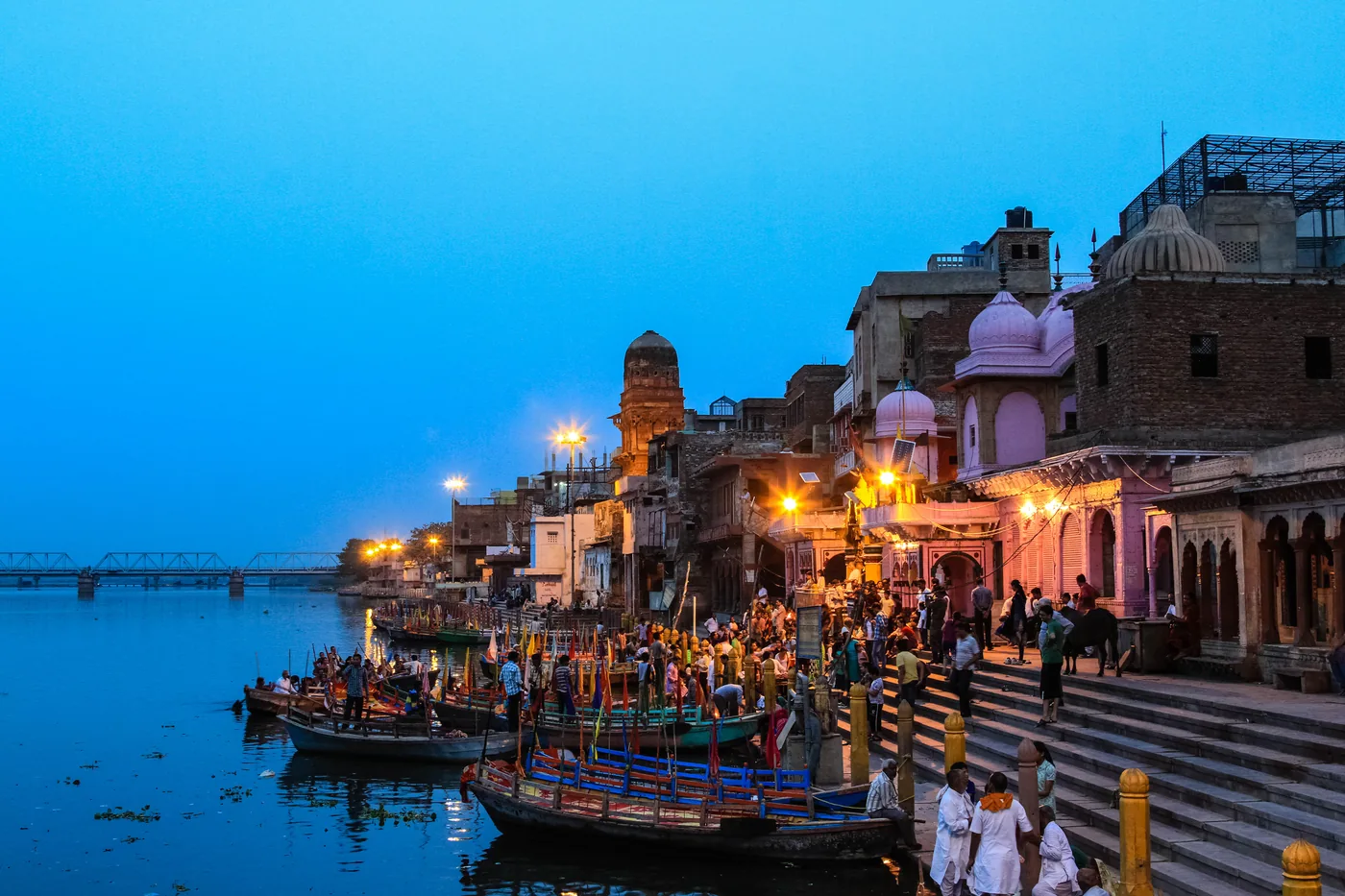
Raghava showed them Bhadravana, Bhandiravana and Bilvavana, and then Lohavana: "At Lohavana, Lord Kṛṣṇa used to tend cows. The demon named Lohajaṅgha was killed at this place" (Sri Chaitanya-charitamrita Madhya 18.67, purport). At Mahavana, the book says, "the Sri Pandita, in the ecstasy of prema," spoke softly to the two (p. 277), in words that Srila Prabhupada also quotes:
dekha nanda-yaśodā-ālaya mahāvane
ei dekha śrī-kṛṣṇa-candrera janma sthala
śrī-gokula, mahāvana — dui ‘eka’ haya
"“Behold the house of Nanda and Yaśodā in Mahāvana. See the birthplace of Lord Kṛṣṇa. Mahāvana and the birthplace of Lord Kṛṣṇa, Gokula, are one and the same.”" (Sri Chaitanya-charitamrita Madhya 18.67, purport)
Then he told how Mahaprabhu, seeing the place of Krishna's birth festival, was lost in dancing and singing while people ran from every side crying "Hari! Hari!", and how He lost His composure on seeing the Deity of Madana-gopala. He showed where Sanatana Goswami had lived at Mahavana, so loved there that the people "felt their life return just by seeing Sanatana" (p. 283). At Raval, the place of Srimati Radharani's childhood pastimes, he told how Gauracandra had come there from Gokula, and how the people, drinking in the sight of His face, said, "He is certainly Krishna" (pp. 286-287). That night they stayed at Raval:
aiche kata kahi' rātri rāvale rahila / kṛṣṇa-kathā-rase niśī prabhāta haila
śrī-rāghava śrīnivāsa narottama sane / ye preme nimagna tā varṇiba kona jane
"Speaking of many such things, they stayed the night at Raval, and in the joy of talking about Krishna the night turned to dawn. Who can describe the prema in which Sri Raghava was immersed together with Shrinivasa and Narottama?" (Bhakti-ratnakara, Fifth Wave, p. 287, 1912 Bengali edition; English rendering ours)
In the morning they crossed the Yamuna into Mathura. Raghava showed Shrinivasa the homes of Ugrasena, Vasudeva and Kamsa, the prison where Vasudeva had been kept, and the road by which Vasudeva carried the newborn Krishna to Gokula, explaining everything in great detail. They bathed at Vishrama-tirtha with joy and went on to Ambika-vana, where Raghava "said gently to the two" how Nanda Maharaja had once been seized there by a serpent (pp. 287-288). From there the road led to Akrura and Vrindavana, where Raghava gave his last teachings, as told in Last Teachings in Vrindavana and the Farewell.
Hearing at the Holy Places #
Through all these forests, the greatest gift Raghava gave Shrinivasa and Narottama was not only the sight of the holy places but the hearing: the stories and verses that let them see each place with understanding and love. Lord Krishna teaches in the Bhagavad-gita that real knowledge comes in just this way:
tad viddhi praṇipātena
paripraśnena sevayā
upadekṣyanti te jñānaṁ
jñāninas tattva-darśinaḥ
"Just try to learn the truth by approaching a spiritual master. Inquire from him submissively and render service unto him. The self-realized souls can impart knowledge unto you because they have seen the truth." (Bhagavad-gita 4.34)
Centuries later Srila Prabhupada showed the same spirit. He once remembered a parikrama party of the Gaudiya Math that he went to see before his initiation. One evening it was announced that the pilgrims would set out on parikrama and that his spiritual master, Srila Bhaktisiddhanta Sarasvati Thakura, would also speak, so anyone who wished could stay and hear him. About a dozen stayed and the rest went. Srila Prabhupada stayed: "I preferred to hear him than go to parikramā." (Morning walk, Mayapur, 10 February 1976) His spiritual master, he said, very much appreciated it.
This is what Raghava taught at Sheshashayi: the Lord's life is known only when He makes it known, and He makes it known through those who speak of Him. Shrinivasa never forgot what he heard on this journey. Years later, in Navadvipa, he said that touring Vraja "with Sri Raghava" had made him wish to tour Nadiya in the same way (Bhakti-ratnakara, Twelfth Wave, p. 716).
