Srila Raghava Pandita Goswami made his home at Govardhana Hill in the days of Srila Jiva Goswami and Raghunatha Dasa Goswami. Devotees remember him above all as the guide with whom Jiva Goswami sent Shrinivasa Acharya and Narottama Dasa Thakura to see the holy places of Vraja. When Narahari Chakravarti Thakura comes to that journey in the Fifth Wave, or chapter, of his Bhakti-ratnakara, he stops his story for a moment to tell us who this guide was. His few lines are the fullest picture of Raghava that any old book gives:
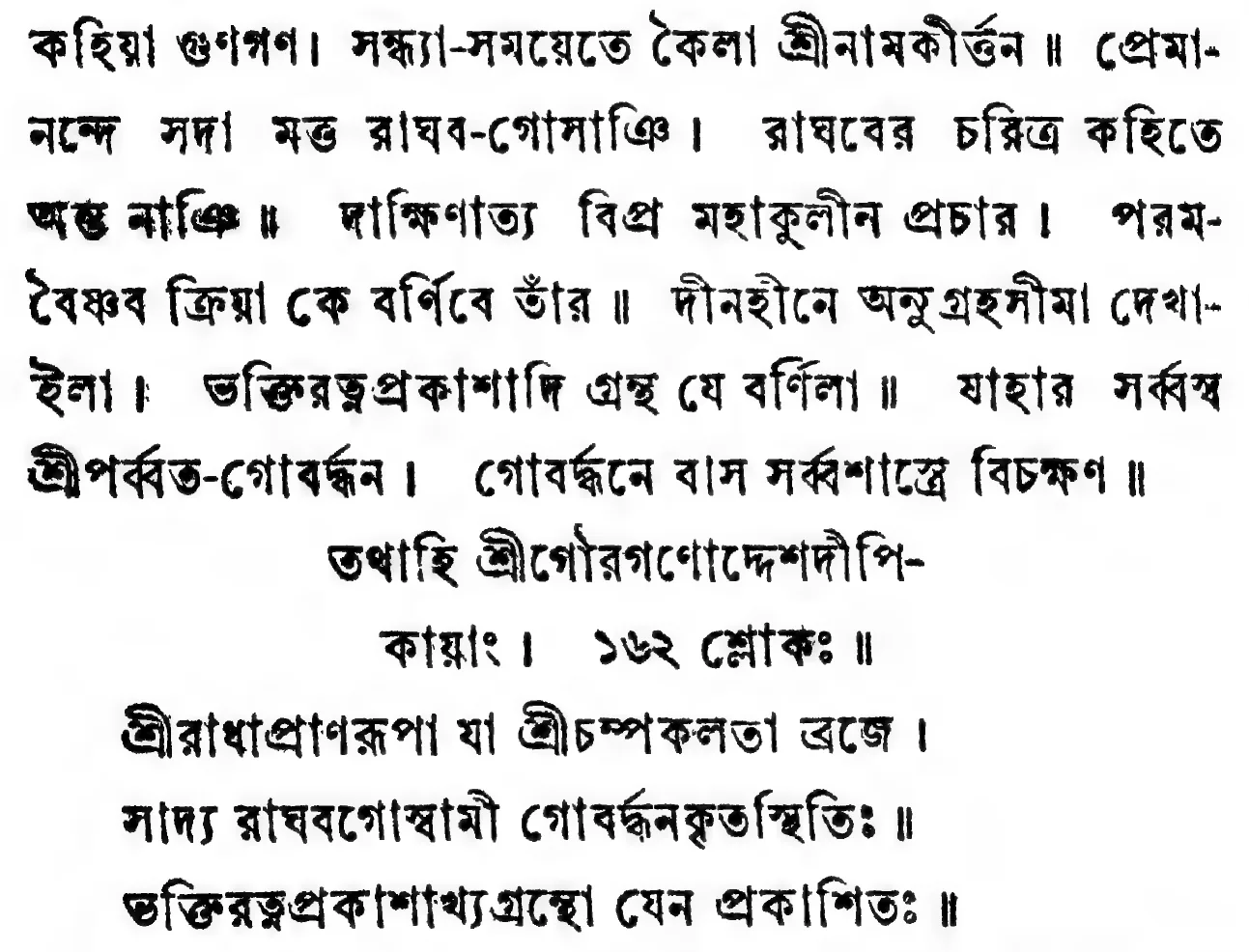
premānande sadā matta rāghava-gosāñi / rāghavera caritra kahite anta nāñi
dākṣiṇātya vipra mahā-kulīna pracāra / parama-vaiṣṇava kriyā ke varṇibe tāṅra
dīna-hīne anugraha-sīmā dekhāilā / bhakti-ratna-prakāśādi grantha ye varṇilā
yāhāra sarvasva śrī-parvata-govardhana / govardhane vāsa sarva-śāstre vicakṣaṇa
"Raghava Gosai is always intoxicated with the joy of prema; there is no end to telling of Raghava's character. He is known as a brahmana from the South, of a very high-born family. Who can describe the ways of that great Vaishnava? He showed the utmost mercy to the lowly and the poor, and he wrote books such as the Bhakti-ratna-prakasha. Sri Govardhana Hill is his everything; he lives at Govardhana and is expert in all the scriptures." (Bhakti-ratnakara, Fifth Wave, p. 150, 1912 Bengali edition; English rendering ours)
Narahari then quotes a verse of Kavi Karnapura that names Raghava as Campakalata, one of the eight principal sakhis, the closest companions, of Srimati Radharani (see Campakalata and the Krishna-bhakti-ratna-prakasha), and he adds four couplets on how Raghava lived. Apart from the story of the Vraja tour and a few short notices elsewhere, this is almost all that the old books tell us about his life.
A Brahmana From the South #
Narahari gives Raghava's origin in half a line. He calls him a dakshinatya vipra, a brahmana from the South of India, and maha-kulina, a man of a very high-born family. He gives this as what was generally known ("he is known as"), and he says nothing more. He does not name Raghava's village or parents, or tell us how or when he came to Vraja (Bhakti-ratnakara, Fifth Wave, p. 150).
A twentieth-century Gaudiya reference work, the Gaudiya Vaishnava Abhidhana of Haridasa Dasa, adds that he was "a brahmana, a resident of Ramanagara in the South" (vol. 3, p. 1332). It gives no source for this, and it does not say which Ramanagara is meant, though South India has several places of that name. The same book says clearly that he is a different person from Raghava Pandita of Panihati (vol. 4, p. 1939). The Panihati Raghava was a companion of Sri Chaitanya Mahaprabhu, and the Bhakti-ratnakara says that he was born at Panihati in Bengal (Eighth Wave, p. 538).
Raghava was not the only devotee from the South in the Vraja of the Goswamis: Gopala Bhatta Goswami had also come from there. Narahari salutes the two just one couplet apart in the opening prayers of his book (First Wave, p. 3), but the books show no other link between them.
Narahari mentions Raghava's high birth only in passing, and at once he asks, "Who can describe the ways of that great Vaishnava?" In bhakti, a good family does not make anyone a devotee, and a humble family does not stop anyone from becoming one. Sri Chaitanya Mahaprabhu told Sanatana Goswami:
nīca-jāti nahe kṛṣṇa-bhajane ayogya
sat-kula-vipra nahe bhajanera yogya
"“A person born in a low family is not unfit for discharging devotional service to Lord Kṛṣṇa, nor is one fit for devotional service simply because he is born in an aristocratic family of brāhmaṇas." (Sri Chaitanya-charitamrita Antya 4.66)
That is why Narahari spends half a line on Raghava's birth and the rest of his portrait on his devotion.
Govardhana Was His Everything #
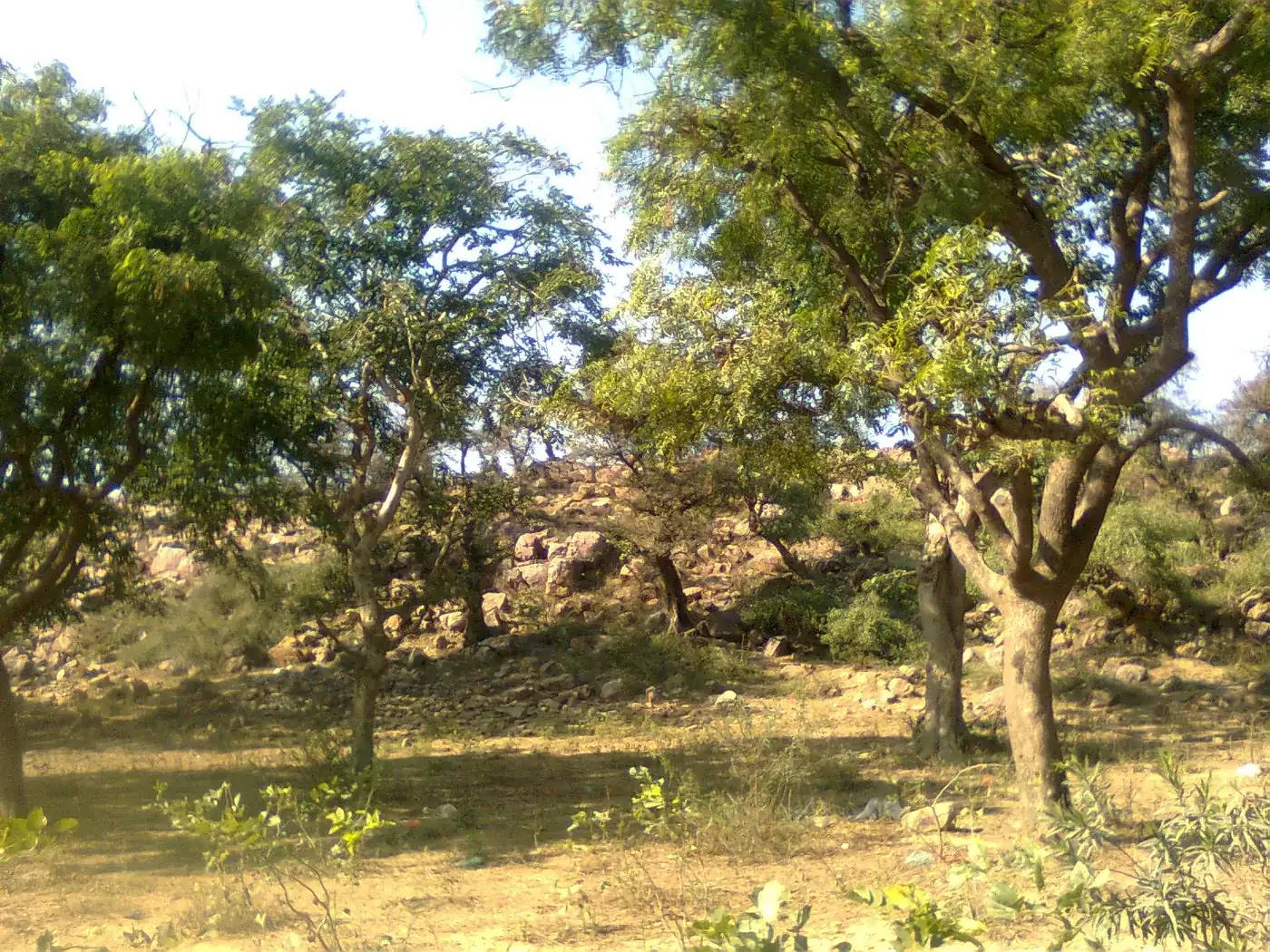
Narahari's strongest words about Raghava are about a place: "Sri Govardhana Hill is his everything; he lives at Govardhana" (Bhakti-ratnakara, Fifth Wave, p. 150). The Bengali word he uses, sarvasva, means "one's all", everything that a person has. For Raghava, that was Govardhana.
In the very first prayers of his book, Narahari names Raghava simply by the place where he lived:
jaya raghunātha-bhaṭṭa raghunātha-dāsa / jaya śrī-rāghava govardhanāraṇye vāsa
"Glory to Raghunatha Bhatta and Raghunatha Dasa! Glory to Sri Raghava, who lives in the forest of Govardhana!" (Bhakti-ratnakara, First Wave, p. 3, 1912 Bengali edition; English rendering ours)
His home there was a cave near Apsara-kunda, which the Bhakti-ratnakara places "at the end of Govardhana". On the Vraja tour he brought Shrinivasa to it and said, "This is my cave; I live right here" (Fifth Wave, p. 203). The visit is told in Around Govardhana Hill and His Own Cave.
To a Gaudiya Vaishnava, Govardhana is no ordinary hill. When Sri Chaitanya Mahaprabhu first saw it, "He immediately offered obeisances, falling down on the ground like a rod. He embraced one piece of rock from Govardhana Hill and became mad" (Sri Chaitanya-charitamrita Madhya 18.16). He would not even climb it (Madhya 18.23). Srila Prabhupada explains that Rupa Goswami and Sanatana Goswami followed His example and did not climb the hill either, "because they considered it nondifferent from Kṛṣṇa, the Supreme Personality of Godhead" (Madhya 18.47, purport). Dancing at the sight of the hill, Mahaprabhu recited the praise that the gopis, the cowherd girls of Vraja, sing of it in the Srimad-Bhagavatam:
hantāyam adrir abalā hari-dāsa-varyo
yad rāma-kṛṣṇa-caraṇa-sparaśa-pramodaḥ
mānaṁ tanoti saha-go-gaṇayos tayor yat
pānīya-sūyavasa-kandara-kanda-mūlaiḥ
"“ ‘Of all the devotees, this Govardhana Hill is the best! O my friends, this hill supplies Kṛṣṇa and Balarāma, as well as Their calves, cows and cowherd friends, with all kinds of necessities — water for drinking, very soft grass, caves, fruits, flowers and vegetables. In this way the hill offers respect to the Lord. Being touched by the lotus feet of Kṛṣṇa and Balarāma, Govardhana Hill appears very jubilant.’ ”" (Sri Chaitanya-charitamrita Madhya 18.34)
Govardhana gives Sri Krishna and His friends everything they need. A devotee who makes Govardhana his everything chooses to live beside the best of Krishna's servants.
A Life of Prema and Renunciation #
Right after Kavi Karnapura's verse, Narahari describes Raghava's way of life. It is a life full of prema, pure love for Krishna, and of strict renunciation.
These are his words:
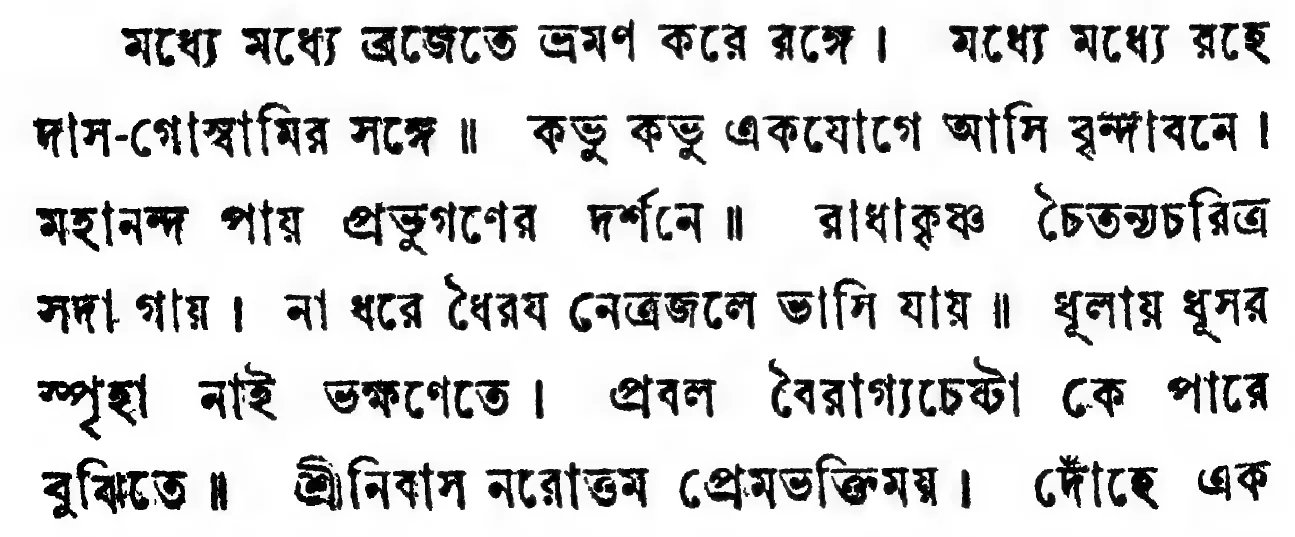
madhye madhye vrajete bhramaṇa kare raṅge / madhye madhye rahe dāsa-gosvāmira saṅge
rādhā-kṛṣṇa caitanya-caritra sadā gāya / nā dhare dhairaya netra-jale bhāsi yāya
dhūlāya dhūsara spṛhā nāi bhakṣaṇete / prabala vairāgya-ceṣṭā ke pāre bujhite
"Now and then he wanders joyfully through Vraja, and now and then he stays with Dasa Goswami. He always sings of Radha and Krishna and of the life of Sri Chaitanya; he cannot stay composed and is carried away by his tears. Grey with the dust of Vraja, he has no wish to eat. Who can understand his intense renunciation?" (Bhakti-ratnakara, Fifth Wave, p. 150, 1912 Bengali edition; English rendering ours)
"Dasa Goswami" is Raghunatha Dasa Goswami, who lived in strict bhajana at Radha-kunda. Their friendship is told in At Radha-kunda With Raghunatha Dasa Goswami. In one more couplet, left out above, Narahari adds that sometimes Raghava came to Vrindavana and was overjoyed to see the Goswamis there. With all his renunciation he was full of kindness: the first lines of the portrait say that he "showed the utmost mercy to the lowly and the poor".
The tears that Narahari speaks of come again and again on the Vraja tour. Once in Mathura, thinking of Sri Chaitanya's life, Raghava lost all composure, and Shrinivasa and Narottama fell weeping at his feet (Fifth Wave, p. 184; see Jiva Goswami Entrusts Shrinivasa and Narottama to Him).
Such a life brings to mind the five practices of bhakti that Sri Chaitanya Mahaprabhu called the best of all. Living in the land of Krishna is one of them:
sādhu-saṅga, nāma-kīrtana, bhāgavata-śravaṇa
mathurā-vāsa, śrī-mūrtira śraddhāya sevana
"“One should associate with devotees, chant the holy name of the Lord, hear Śrīmad-Bhāgavatam, reside at Mathurā and worship the Deity with faith and veneration." (Sri Chaitanya-charitamrita Madhya 22.128)
Mahaprabhu goes on to say that "Even a slight performance of these five awakens love for Kṛṣṇa" (Madhya 22.129). Several of them filled Raghava's days: he lived in Vraja, he kept the company of Raghunatha Dasa Goswami and the other Goswamis, and he was always singing about Radha and Krishna and about Sri Chaitanya.
Remembered Among the Goswamis #
In the prayers that open several waves of his book, Narahari salutes Raghava among the great Vaishnavas of Vraja. At the start of the Third Wave he names him right after the Goswamis of Vrindavana, and he joins him with Raghunatha Dasa Goswami in a single couplet:
jaya raghunātha-dāsa śrī-kuṇḍa-nivāsī / jaya jaya śrī-rāghava govardhana-vāsī
"Glory to Raghunatha Dasa, who lives at Sri Radha-kunda! Glory, glory to Sri Raghava, who lives at Govardhana!" (Bhakti-ratnakara, Third Wave, opening, 1912 Bengali edition; English rendering ours)
The next names in that prayer are Shrinivasa, Narottama and Ramacandra. This is fitting, because in the Fifth Wave it is Raghava who leads Shrinivasa and Narottama through Vraja. A "Sri Raghava", very probably the same devotee, is saluted again with Bhugarbha and Lokanatha at the opening of the Seventh Wave, and once more at the opening of the Twelfth.
When Shrinivasa first came to Radha-kunda, before the tour, Narahari names Raghava even before Krishnadasa Kaviraja among those who blessed him: "Sri Raghava, Krishnadasa Kaviraja and the others all showed Shrinivasa the greatest mercy" (Fourth Wave, p. 145). Narahari's other book, the Narottama-vilasa, remembers him in the same circle, when Narottama was brought to Radha-kunda to meet Raghunatha Dasa Goswami:
śrī-rāghava paṇḍita gosāñi govardhane / pāilā paramānanda dekhi narottame
"Sri Raghava Pandita, who had been living at Govardhana, was extremely happy to see Narottama." (Narottama-vilasa, Second Vilasa, verse 310, translated by Dravida Dasa)
Later, when the Vaishnavas of Vraja gathered to send the Goswamis' books to Bengal, Narahari names among them "Raghava Pandita, who possessed prema-bhakti" (Sixth Wave, p. 486).
Outside Narahari's books, an early Sanskrit work, the Sadhana-dipika of Radha-krishna Goswami, honours Raghava through his writing. It lists "Sri Bhakti-ratna-prakasha and other works" of "Sri Raghava-pandita Gosvami-pada" among the books through which devotees, even now, can relish the pastimes of the Lord (Sadhana-dipika, Ninth Kaksha, p. 257). The list runs from Vishnu Puri, who lived before Mahaprabhu, to Nayanananda, who lived after Him, so it does not tell us when Raghava lived. It shows that his book was counted among the trusted works of the Gaudiya Vaishnavas.
Gosai, Pandita and Goswami #
The Bhakti-ratnakara calls him both Raghava Gosai and Raghava Pandita, within the same wave. Kavi Karnapura calls him Raghava-gosvami, and the Sadhana-dipika joins the titles: "Sri Raghava-pandita Gosvami-pada". No source says who first gave him these titles, or when.
Pandita means a learned man. Narahari calls Raghava "expert in all the scriptures", and the Vraja tour shows it: on its first evening he recited the glories of Mathura to Shrinivasa and Narottama from the Puranas (Fifth Wave, pp. 151-165).
Gosai is the Bengali form of gosvami, or Goswami. Srila Prabhupada explains the word: "Svāmī means master, and gosvāmī means master of the go, or senses" (Nectar of Instruction, verse 1, purport). He adds that a gosvami is one who can control the urges of speech, mind, anger, tongue, belly and genitals. Narahari's picture of Raghava, grey with the dust of Vraja and with no wish to eat, shows that the name fitted him.
What the Sources Do Not Tell Us #
Much of Raghava's outer life is not recorded. No source we have names his guru. In his own book he bows down to the lotus feet of his spiritual master, in a verse taken from an older work, the Krama-dipika, but he does not give his guru's name (Krishna-bhakti-ratna-prakasha 1.2). No disciples of his are named either. Shrinivasa and Narottama, whom he led through Vraja, were not his disciples: Shrinivasa had been initiated by Gopala Bhatta Goswami, and Narottama was the disciple of Lokanatha Goswami.
No year is recorded for his birth or for his passing. No source we have gives the day of his disappearance, and no pranama-mantra, the short prayer with which devotees offer obeisances, has come down to us for him. The one firm date comes from Kavi Karnapura's Gaura-ganoddesha-dipika, which was completed in 1576. As its verse stands, Raghava was by then already living at Govardhana and had already written his book. The Bhakti-ratnakara shows him still active years after the Vraja tour, when Jahnava Devi came to Vrindavana (Eleventh Wave, p. 667). The Gaudiya Vaishnava Abhidhana says that "his samadhi is in Sri Vrindavana" (vol. 3, p. 1332), but it does not say where, and no other source gives the place.
One more thing is missing from the old books: any meeting between Raghava and Sri Chaitanya Mahaprabhu. On the Vraja tour he tells the Lord's pastimes at almost every place, but always in the third person, and never with the words "I saw". Once he names his source plainly: "I heard this from the mouths of the elders; it is a well-known account" (Fifth Wave, p. 165). Some modern guidebooks call him a close associate of Mahaprabhu, but they have mixed him up with Raghava Pandita of Panihati (see Srila Raghava Pandita Goswami).
A Holy Man in a Holy Place #
Narahari's portrait ends where Raghava's best-known service begins: he took two young devotees with him and showed them Vraja. Years later, in Navadvipa, Shrinivasa still remembered that journey as touring Vraja "with Sri Raghava" (Twelfth Wave, p. 716). For Shrinivasa and Narottama, the way into the holy land was a holy person. This is how the Srimad-Bhagavatam speaks of such devotees:
bhavad-vidhā bhāgavatās
tīrtha-bhūtāḥ svayaṁ vibho
tīrthī-kurvanti tīrthāni
svāntaḥ-sthena gadābhṛtā
"My lord, devotees like your good self are verily holy places personified. Because you carry the Personality of Godhead within your heart, you turn all places into places of pilgrimage." (Srimad-Bhagavatam 1.13.10)
Srila Prabhupada draws out what this means for every pilgrim: "If anyone visits a holy place, he must search out the pure devotees residing in such holy places, take lessons from them, try to apply such instructions in practical life and thus gradually prepare oneself for the ultimate salvation, going back to Godhead" (Srimad-Bhagavatam 1.13.10, purport). Raghava made Govardhana his everything, and for Shrinivasa and Narottama he became the guide through whom they saw all of Vraja. A pilgrim to Govardhana today can follow his example: bow down to the hill he loved, hear about Krishna from the devotees who live there, and sing, as he always did, about Radha and Krishna and about Sri Chaitanya.
