Kṛṣṇa swallows the forest fire on the night after Kāliya
कालिय-दमन के बाद की रात कृष्ण ने दावानल पिया
In short
On the night after Kṛṣṇa subdued Kāliya, a forest fire surrounded the people and cows of Vraja as they rested near the Yamunā. Kṛṣṇa swallowed it (Śrīmad-Bhāgavatam 10.17.20–25). The Bhāgavatam names no pond. The guidebooks remember the pastime at Dāvānala-kuṇḍa (Davanal Kund), a little east of Kāliya-ghāṭa (a bathing place) in Vṛndāvana.[1–13]
On this page
At a glance
- Scripture: Śrīmad-Bhāgavatam 10.17.20–25, in the translation of Śrīla Prabhupāda's disciples, and Śrīla Prabhupāda's Kṛṣṇa book, chapter 17.[1–3]
- When: at midnight, on the night of the day Kṛṣṇa subdued Kāliya, in the hot season.[1]
- The prayer: the Vrajavāsīs (the people of Vraja) called on Kṛṣṇa and Balarāma and said they could not give up His feet.[1 +2]
- The end: Kṛṣṇa swallowed the terrible fire. According to Śrīla Sanātana Gosvāmī, His people could not even notice it.[2 +2]
- The place: the Bhāgavatam and its commentators name no pond. The first texts that name Dāvānala-kuṇḍa date from 1905 and 1920.[17–19]
- A different fire: the later fire in the Muñja forest, when Kṛṣṇa told the boys to close their eyes, belongs to another chapter.[20]
Which forest fire did Kṛṣṇa swallow?
The Bhāgavatam tells of two forest fires in Vraja. The first came on the night after the Kāliya pastime. The Vrajavāsīs and their cows stayed near the bank of the Kālindī (another name of the Yamunā), and at midnight a fire surrounded them.[1–3] The second came later, in the Muñja forest, while the boys were grazing the cows. There Kṛṣṇa told them to close their eyes and not be afraid.[20] The second fire is told with the Bhāṇḍīra banyan.[20] Read more: The Bhāṇḍīra banyan →
This article is about the first fire. The Kāliya pastime that leads up to it has its own article.[1–3] Read more: How Kṛṣṇa subdued the serpent Kāliya →
Where did the Vrajavāsīs spend the night after Kāliya?
After the Kāliya pastime, the people and the cows were weak from hunger, thirst and tiredness. So they spent that night where they were, near the bank of the Kālindī.[1–3] Śrīla Prabhupāda tells it simply:
General teaching (does not name the place)“Since it was almost night and all the inhabitants of Vṛndāvana, including the cows and calves, were very tired, they decided to take their rest on the riverbank. In the middle of the night, while they were taking rest, there was suddenly a great forest fire,”
Śrīla Prabhupāda, Kṛṣṇa, the Supreme Personality of Godhead, Chapter 17 'Extinguishing the Forest Fire' · vedabase.io
The commentators on the Tenth Canto, the teachers who explained the Bhāgavatam verse by verse, explain the words "near the bank" (summarised here, not translated). Śrīla Sanātana Gosvāmī and Śrīla Jīva Gosvāmī say that the Vrajavāsīs feared the poisoned water, so they kept away from the edge of Kāliya's lake. Otherwise, they reason, the fire could not have surrounded them on all sides.[17] Śrīla Sanātana Gosvāmī adds that they stayed at the edge of the Yamunā's bank, a little away from the lake. The village of Vraja, then near Nandīśvara, was too far to reach at night.[17]
Śrīla Jīva Gosvāmī also explains why they were hungry with the cows right beside them. People suspected that the cows had touched the poison. So the milk was not used for Kṛṣṇa, and the Vrajavāsīs did not drink it themselves either.[17] His Gopāla-campū tells it as a mother's care. All night Yaśodā kept her son on her lap. She would not let Him drink even the milk she had milked, fearing that everything there was touched by poison.[21]
Another commentator, Nārāyaṇa Bhaṭṭa, writes in his note on Śrīmad-Bhāgavatam 10.30.22 that the forest fire arose at night on the bank of the lake. That was the day Kāliya was subdued (summarised here, not translated).[17 +2]
Śrīla Viśvanātha Cakravartī Ṭhākura comments on Śrīla Kavi-karṇapūra's Ānanda-vṛndāvana-campū (a work in mixed prose and verse). He gives the camp a name. The Vrajavāsīs had left the lake behind and were staying at a place people knew as Kuḍumāra. From there they could not fetch Yamunā water to fight the fire (summarised here, not translated).[24]
How did the fire start?
The Bhāgavatam says only that the fire arose from the dry summer forest. It surrounded the sleeping people on all sides and began to burn them.[1]
tāṃ rātriṃ tatra rājendra kṣut-tṛḍbhyāṃ śrama-karṣitāḥ / ūṣur vrayaukaso gāvaḥ kālindyā upakūlataḥ
tadā śuci-vanodbhūto dāvāgniḥ sarvato vrajam / suptaṃ niśītha āvṛtya pradagdhum upacakrame
tata utthāya sambhrāntā dahyamānā vrajaukasaḥ / kṛṣṇaṃ yayus te śaraṇaṃ māyā-manujam īśvaram
During the night, while all the people of Vṛndāvana were asleep, a great fire blazed up within the dry summer forest. The fire surrounded the inhabitants of Vraja on all sides and began to scorch them.
Translation: Śrīla Prabhupāda's disciples (BBT)The commentators add a view that they credit to others (summarised here, not translated). Śrīla Sanātana Gosvāmī, with Śrīla Jīva Gosvāmī and Śrīla Viśvanātha Cakravartī Ṭhākura, reports the view of others that the fire was a demon in the form of a forest fire. In that view he was a friend of Kāliya and a follower of Kaṁsa. Śrīla Baladeva Vidyābhūṣaṇa gives this as his own reading. None of them says that anyone set the forest on fire.[25]
Śrīla Jīva Gosvāmī's Gopāla-campū tells it differently. Kaṁsa heard that the Vrajavāsīs were staying right on the bank of the Yamunā. He ordered men who were nearby to go there, light a strong fire all around them and disappear, and the forest fire spread.[21] Śrīla Kavi-karṇapūra gives a third view in his Ānanda-vṛndāvana-campū. Unlike other forests, he says, Vṛndāvana holds no forest fire within it. So this fire was brought about, as it were, by Kṛṣṇa's own will, for a pastime that would amaze everyone (summarised here, not translated).[26] The Garga-saṁhitā speaks of a fire born when bamboos rubbed together.[27]
The Vrajavāsīs' prayer
With the fire all around them, the people of Vraja woke up. They took shelter of the one they knew could save them.[1 +2]
[Vṛndāvana’s residents said:] Kṛṣṇa, Kṛṣṇa, O Lord of all opulence! O Rāma, possessor of unlimited power! This most terrible fire is about to devour us, Your devotees!
Translation: Śrīla Prabhupāda's disciples (BBT)They asked Him to save them from that fire of death, since they could never give up His feet, which drive away all fear.[1 +2] Śrīla Prabhupāda writes:
General teaching (does not name the place)“Thus they prayed to Kṛṣṇa, saying that they could not take any shelter other than His lotus feet. Lord Kṛṣṇa, being compassionate upon His own townspeople, immediately swallowed up the whole forest fire and saved them. This was not impossible for Kṛṣṇa, because He is unlimited.”
Śrīla Prabhupāda, Kṛṣṇa, the Supreme Personality of Godhead (Kṛṣṇa book), Chapter 17, 'Extinguishing the Forest Fire' · vedabase.io
How did Kṛṣṇa put the fire out?
The Bhāgavatam's answer is one verse:
itthaṃ sva-jana-vaiklavyaṃ nirīkṣya jagad-īśvaraḥ / tam agnim apibat tīvram ananto 'nanta-śakti-dhṛk
Seeing His devotees so disturbed, Śrī Kṛṣṇa, the infinite Lord of the universe and possessor of infinite power, then swallowed the terrible forest fire.
Translation: Śrīla Prabhupāda's disciples (BBT)The commentators ask how His loving parents could let Him drink a fire (summarised here, not translated). Śrīla Sanātana Gosvāmī answers that Kṛṣṇa had seen the fire spreading even before they called. By His unlimited power He drank it in such a way that Nanda, Yaśodā and the others could not notice it at all. Śrīla Jīva Gosvāmī adds that they therefore had no chance to stop Him.[15, 16] Śrīla Jīva Gosvāmī's Krama-sandarbha and Śrīla Viśvanātha Cakravartī Ṭhākura explain the drinking in two ways: as something acted out, or as the work of His power that destroys.[15, 16]
In his Gopāla-campū, Śrīla Jīva Gosvāmī ends the fire with a verse. When Hari (Kṛṣṇa) simply blew on it, the lamp of the forest fire went out, though the sages imagine that He drank it. At dawn the Vrajavāsīs found Vraja as it had been.[28] In the Brahma-vaivarta Purāṇa, an old scripture, the fire draws back at Kṛṣṇa's nectar-like glance. In the Garga-saṁhitā He tells the cowherds to close their eyes before He drinks it (both summarised here, not translated).[27, 29]
The forest fire of material life
The picture of this pastime has passed into the devotees' prayers. Śrīla Prabhupāda explains the word dāvānala, forest fire, in his purport (his explanation of a verse) on the forest of material life:
General teaching (does not name the place)“A life in this material world is exactly like a blazing forest fire. No one goes to set fire to the forest, yet the fire takes place.”
Śrīla Prabhupāda, Śrīmad-Bhāgavatam, 5.14.15, purport · vedabase.io
The Bhakti-ratnākara makes the same link at the place itself. It says that whoever sees the place where Kṛṣṇa drank the forest fire, on the day Kāliya was subdued, is freed from the forest fire of worldly life.[9]
Where is Dāvānala-kuṇḍa?
The older texts point out a place, not a pond. The Nārada Purāṇa's praise of Vṛndāvana names a holy tīrtha (holy bathing place) right after the Kāliya tīrtha. There Kṛṣṇa saved the gopas (the cowherd men), with their women, children and wealth, from the forest fire. It says that bathing there removes sin.[30] In the books of Śrīla Murāri Gupta and Śrīla Locana dāsa Ṭhākura, Śrī Caitanya's guide shows Him this place right after Kāliya's lake and the Dvādaśāditya-ghāṭa. It is where Kṛṣṇa saved the boys from the fire by drinking it (summarised here, not translated).[31, 32] The Bhakti-ratnākara points out the place to Śrīla Śrīnivāsa Ācārya on his walk around Vṛndāvana, near Brahma-kuṇḍa and Veṇu-kūpa.[9]
The pond's name appears later. The Bengali Bhaktamāla of 1905 is the earliest known text that names Dāvānala-kuṇḍa (the kuṇḍa, or sacred pond, of the forest fire). It says that there Kṛṣṇa drank the forest fire and saved His people. The Vṛndāvana-kathā (1920) places the stone-built kuṇḍa in the old garden called Kevārivana and says that its water is good to drink.[18, 19] The guidebooks name the kuṇḍa as the place where the Vrajavāsīs rested and Kṛṣṇa swallowed the fire. They put it a little east of Kāliya-ghāṭa.[4–13]
Śrī Vraja-maṇḍala Parikramā (2007) says that Kevārivana got its name from a question. After the fire the gopas and gopīs asked "Ke nivāri?", "Who saved us?" This is a local explanation of the name and not certain.[10, 33] The guidebooks show the Dāvānala-bihārī Mandira of the Nimbārka tradition (one of the old Vaiṣṇava schools) beside the kuṇḍa. The Color Guide to Vṛndāvana (2000) calls it about two hundred years old, without giving a source.[5 +6] The historian A. W. Entwistle (1987) reports that the temple's image is said to have been found by a Mahant (temple head) named Lakshmandas, who also had the tank built. He gives no date.[36] He also names two ashrams founded near the kuṇḍa, one by a disciple in the Nimbārka line and one by a Mahant of the Kaladhari temple, again without dates.[37, 38]
Where the sources differ
The Bhāgavatam, its commentators, the campūs and the guidebooks tell differently where and why the Vrajavāsīs spent the night.[17, 24]
Accounts differ Where and why the Vrajavāsīs spent the night of the fire after Kāliya was subdued
- Śrīmad-Bhāgavatam 10.17.20weak from hunger, thirst and fatigue, they and the cows spent the night where they were, near the bank of the Kālindī
- Śrīla Sanātana Gosvāmī, Śrīla Jīva Gosvāmī, Śrīla Viśvanātha Cakravartī Ṭhākura and Śrīla Baladeva Vidyābhūṣaṇa on ŚB 10.17.20a little away from the water's edge of Kāliya's lake, at the edge of the Yamunā's bank, for fear of the poisoned water; Sanātana: because the Vraja settlement, then near Nandīśvara, was too far to reach at night; Sanātana and Jīva: their hunger, thirst and the fatigue of weeping; Viśvanātha and Baladeva: to keep looking at Kṛṣṇa
- BBT purport to ŚB 10.17.20 (Śrīla Prabhupāda's disciples)so overjoyed to get Kṛṣṇa back that they did not want to go home; they stayed on the Yamunā's bank to see Him continuously
- Kṛṣṇa book ch. 17it was almost night and all were very tired, so they rested on the riverbank
The commentators, the Gopāla-campū and the guidebooks describe differently what the fire was.[21, 25]
Accounts differ What the forest fire was: the Canto 10 commentaries and the books that report them
- Śrīla Sanātana Gosvāmī, Śrīla Jīva Gosvāmī, Śrīla Viśvanātha Cakravartī Ṭhākura and Vaṁśīdhara on ŚB 10.17.21'some say' it was a demon, a friend of Kāliya and a follower of Kaṁsa, in the form of a forest fire (one description, reported as others' view)
- Śrīla Baladeva Vidyābhūṣaṇa on ŚB 10.17.21the same, as his own reading
- BBT purport to ŚB 10.17.21 (Śrīla Prabhupāda's disciples)two alternatives, attributed to Sanātana and Viśvanātha: a friend of Kāliya avenging him, or a demon following Kaṁsa
- Vṛndāvana, the Playground of God (2010)Sanātana: a friend of Kāliya who wanted revenge; 'other ācāryas': perhaps a follower of Kaṁsa
The texts tell in different ways how Kṛṣṇa ended the fire, and whether anyone closed their eyes.[15 +2]
Accounts differ How Kṛṣṇa ended the fire after the Kāliya pastime
- Śrīmad-Bhāgavatam 10.17.25; Kṛṣṇa book 17He swallowed (drank) the fire; nothing about closing eyes
- Garga-saṁhitā 2.12.32He told them to close their eyes and drank the fire
- Śrī Vraja-maṇḍala Parikramā (2007)He told everyone to close their eyes, closed His own, and swallowed it like cool water
- Vṛndāvana, the Playground of God (2010)He turned His back on everyone and swallowed it, so they would not see
Places in this article
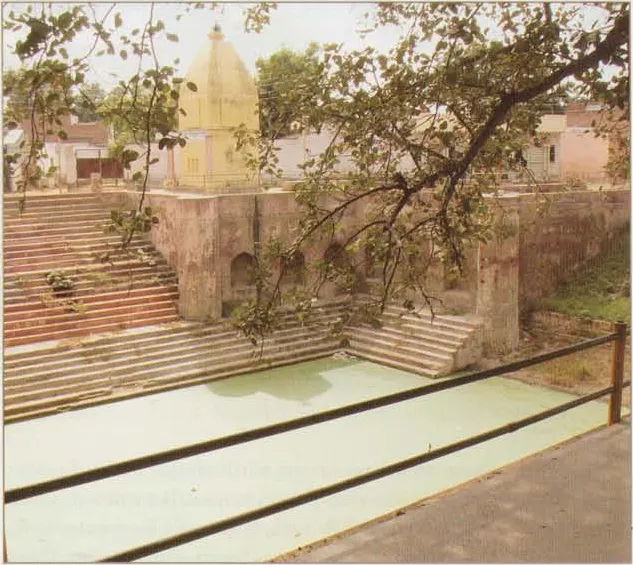
Dāvānala-kuṇḍa
दावानल-कुण्डDāvānala-kuṇḍa is a pond in Kevārivana, a little east of Kāliya-daha, in south-western Vṛndāvana.
Dāvānala-bihārī Mandira
दावानल-बिहारी मन्दिरThe Dāvānala-bihārī Mandira is the temple of Śrī Dāvānala-bihārī, Kṛṣṇa who swallowed the forest fire.
Kevārivana
केवारिवनKevārivana is one of the old forests within the parikramā (the walk around the town) of Vṛndāvana, north-west of Aṭalavana, and the forest of Dāvānala-kuṇḍa.

Kāliya-ghāṭa
कालिय-घाटKāliya-ghāṭa is the bathing place on the old bank of the Yamunā in Vṛndāvana that marks Kāliya's lake, the Kāliya-hrada of the scriptures, today called Kāliya-daha.
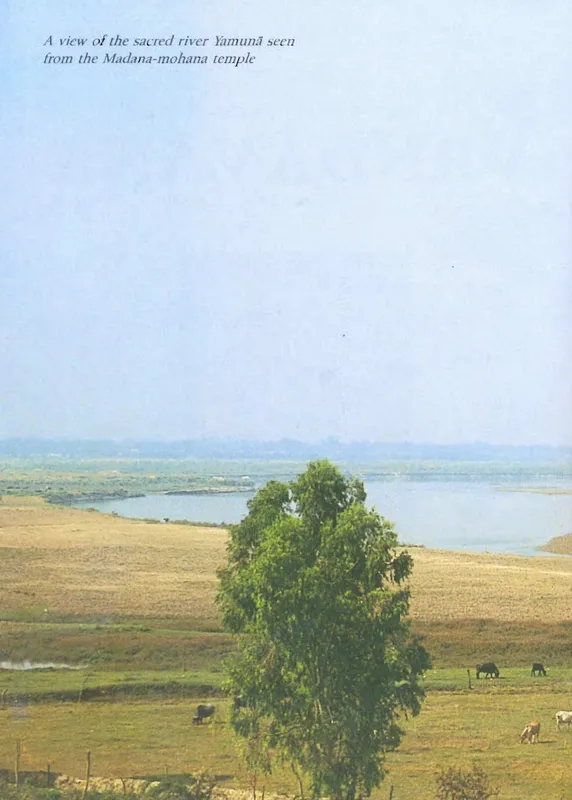
Yamunā
यमुनाThe Yamunā, also called the Kālindī, is the river that runs through Vraja-maṇḍala.
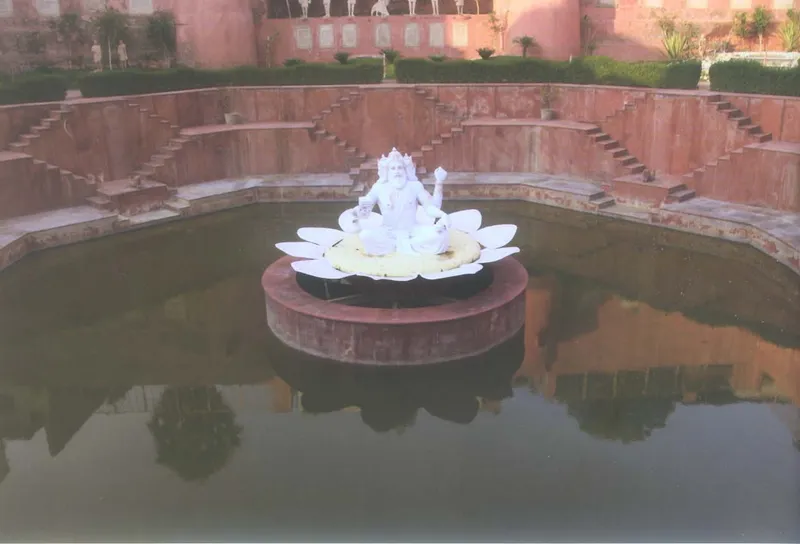
Brahma-kuṇḍa (Vṛndāvana)
ब्रह्म-कुण्ड (वृन्दावन)Brahma-kuṇḍa is a tank in Vṛndāvana, north of the Raṅgajī temple.
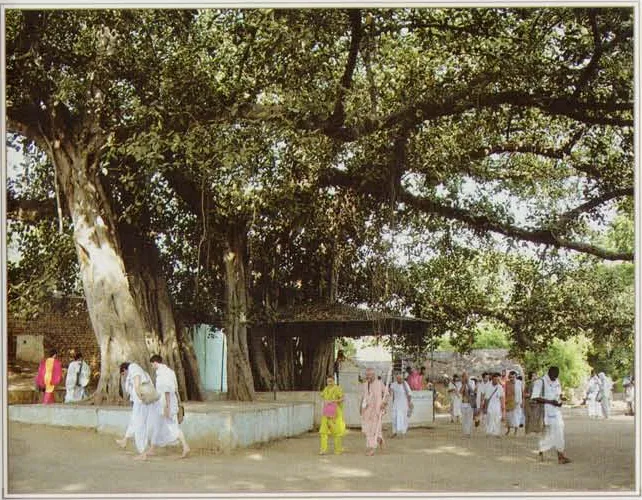
Bhāṇḍīravana
भाण्डीरवनBhāṇḍīravana, the forest of the Bhāṇḍīra banyan, is one of the twelve forests of Vraja, and Śrīla Prabhupāda counts it among the five forests on the eastern bank of the Y …
Questions and answers
The Bhāgavatam tells of two fires. This one came on the night after Kṛṣṇa subdued Kāliya, while the Vrajavāsīs rested near the Yamunā. A later fire in the Muñja forest is told in another chapter.[1–3, 20]
Near the bank of the Kālindī, the Bhāgavatam says. Śrīla Sanātana Gosvāmī and Śrīla Jīva Gosvāmī explain that they kept a little away from Kāliya's poisoned lake. The village was too far to reach at night.[1, 17]
The Bhāgavatam says it arose from the dry summer forest. The commentators report a view that it was a demon, a friend of Kāliya and Kaṁsa. The Gopāla-campū says that Kaṁsa's men lit it.[1 +2]
He swallowed it. According to Śrīla Sanātana Gosvāmī, He did it in such a way that Nanda, Yaśodā and the others could not notice it. Śrīla Prabhupāda writes that this was not impossible for Kṛṣṇa, because He is unlimited.[2 +2]
No. Later, in the Muñja forest, Kṛṣṇa told the boys to close their eyes and then swallowed the fire. The Bhāgavatam tells that in chapter 19. The fire after Kāliya is in chapter 17.[1–3, 20]
According to the guidebooks, it is a little east of Kāliya-ghāṭa in Vṛndāvana, in the area called Kevārivana, with the Dāvānala-bihārī temple beside it. The earliest known mention of the name is in books of 1905 and 1920.[5 +6]
Sources
- Śrīmad-Bhāgavatam 10.17.20–22, GRETIL
- Śrīmad-Bhāgavatam 10.17.25, GRETIL
- Śrīla Prabhupāda, Kṛṣṇa, the Supreme Personality of Godhead, Chapter 17 'Extinguishing the Forest Fire' · vedabase.io
- Śrī Vraja-maṇḍala Parikramā (2007), PDF p. 321
- Śrī Vraja-maṇḍala Parikramā (2007), PDF p. 322
- Vṛndāvana, the Playground of God (2010), Bhakti Caitanya Svāmī, PDF p. 128
- The Color Guide to Vṛndāvana (2000), Written and Photographed by Rājaśekhara dāsa Brahmacārī, PDF p. 66
- the undated parikramā notes Vṛndāvana, ¶91
- Śrīla Narahari Cakravartī, Bhakti-ratnākara, Fifth Wave, printed p. 448 (1912 edition), 2nd ed., 1912
- Śrī Vraja-maṇḍala Parikramā (2007), PDF p. 345
- Vṛndāvana-Dhāma Ki Jaya! (c. 1986), by Dhruva Mahārāja dāsa, PDF p. 100
- Vṛndāvana, the Playground of God (2010), Bhakti Caitanya Svāmī, PDF p. 129
- The Color Guide to Vṛndāvana (2000), Written and Photographed by Rājaśekhara dāsa Brahmacārī, PDF p. 67
- Śrīmad-Bhāgavatam 10.17.23–24, GRETIL
- Śrīla Prabhupāda, Kṛṣṇa, the Supreme Personality of Godhead (Kṛṣṇa book), Chapter 17, 'Extinguishing the Forest Fire' · vedabase.io
- Śrīla Sanātana Gosvāmī: commentary on ŚB 10.17.25, Bhagavata Vidya Pith edition, ed. Bhagavata Rishi and Krishna Shankar Shastri, 1996
- Śrīla Sanātana Gosvāmī: commentary on ŚB 10.17.20, Bhagavata Vidya Pith edition, ed. Bhagavata Rishi and Krishna Shankar Shastri, 1996
- Śrī Śrī Bhaktamāla grantha, mālā 26 (Vṛndāvana-mahimā-varṇana), printed p. 348, left column
- Vṛndāvana-kathā, ch. 17, section '২। উদ্যান' (gardens), printed p. 195
- Śrīmad-Bhāgavatam 10.19.11–12, GRETIL
Show all 38 references
- Śrīla Jīva Gosvāmī, Gopāla-campū, Pūrva-campū 13, ¶[57], [61]–[62]
- Śrīla Sanātana Gosvāmī: commentary on ŚB 10.17.17, Bhagavata Vidya Pith edition, ed. Bhagavata Rishi and Krishna Shankar Shastri, 1996
- Śrīla Nārāyaṇa Bhaṭṭa: commentary on ŚB 10.30.22
- Ānanda-vṛndāvana-campū, stavaka 9, v.49, mūla and Viśvanātha Cakravartī's commentary
- Śrīla Sanātana Gosvāmī: commentary on ŚB 10.17.21, Bhagavata Vidya Pith edition, ed. Bhagavata Rishi and Krishna Shankar Shastri, 1996
- Ānanda-vṛndāvana-campū, stavaka 9, prose after v.49, mūla and Viśvanātha Cakravartī's commentary
- Garga-saṁhitā, Vṛndāvana-khaṇḍa (2) 12.28–32, Sanskrit Wikisource
- Śrīla Jīva Gosvāmī, Gopāla-campū, Pūrva-campū 13, v.52 and ¶[63]
- Brahma-vaivarta Purāṇa, Kṛṣṇa-janma-khaṇḍa (4) 19.177–179, Sanskrit Wikisource
- Nārada Purāṇa, उत्तरार्धः/अध्यायः 80 v.80-64–65 (Uttara-bhāga, chapter 80, verses 64–65)
- Kṛṣṇa-caitanya-caritāmṛta, 4.7.11
- Caitanya-maṅgala, Śeṣa-khaṇḍa, printed p. 173, right column
- Śrī Vraja-maṇḍala Parikramā (2007), PDF p. 340
- Mathurá (1883), F. S. Growse, B.C.S., M.A. Oxon., C.I.E. (as the title page gives him, p. 189
- Muttra (1911), D. L. Drake-Brockman, I.C.S. (edited and compiled), p. 241
- A. W. Entwistle, ch. 8 §66.40 'Dawanal Kund', printed p. 417, Egbert Forsten, Groningen, 1987
- A. W. Entwistle, ch. 5 §37 'The Nimbark Sampraday in modern times', printed p. 220, Egbert Forsten, Groningen, 1987
- A. W. Entwistle, ch. 8 §66.7 'Kaladhari Mandir', printed p. 404, Egbert Forsten, Groningen, 1987
Further sources
- Śrīmad-Bhāgavatam 10.17.20–25 and 10.19, translation by the disciples of Śrīla Prabhupāda (BBT), and Śrīla Prabhupāda's Kṛṣṇa, chapter 17.
- The Canto 10 commentaries (Sanskrit), Śrīla Jīva Gosvāmī's Gopāla-campū and Śrīla Kavi-karṇapūra's Ānanda-vṛndāvana-campū with Śrīla Viśvanātha Cakravartī Ṭhākura's commentary, summarised, not translated.