The Muktā-carita and Mālyahāriṇī-kuṇḍa
मुक्ता-चरित और माल्यहारिणी-कुण्ड
In short
The Muktā-carita, the story of the pearls, is a prose work by Śrīla Raghunātha dāsa Gosvāmī, who lived at Rādhā-kuṇḍa (Radha Kund). Its first scene is set by a lake called Mālya-haraṇa at Govardhana. The Bhakti-ratnākara points to Mālyahāriṇī-kuṇḍa, a small pond near Rādhā-kuṇḍa, as the place of its pastime.[1–6]
On this page
At a glance
- Śrīla Prabhupāda names the Muktā-carita among the three books of Śrīla Raghunātha dāsa Gosvāmī.[1]
- In the book Kṛṣṇa Himself tells the story to Queen Satyabhāmā in Dvārakā. It begins at the Dīpāvalī festival (the festival of lamps) in the month of Kārttika (October–November) at Govardhana.[2]
- The book opens with the author's thanks to his guru, by whose mercy, he says, he received Rādhā-kuṇḍa and Govardhana.[1, 7]
- The Bhakti-ratnākara shows Mālyahāri-kuṇḍa to Śrīla Śrīnivāsa Ācārya as the place of a pastime on the pretext of pearl necklaces, told in the Muktā-carita.[3–6]
- A guidebook of 2007 places Mālyahāriṇī-kuṇḍa on the western side of Rādhā-kuṇḍa, at the end of a road running north-west.[4, 8, 9]
- The Śrīmad-Bhāgavatam does not tell this pastime.[2]
What is the Muktā-carita?
The Muktā-carita is one of the works in which Śrīla Raghunātha dāsa Gosvāmī described the pastimes of Rādhā and Kṛṣṇa. Śrīla Prabhupāda lists his writings in a purport:[1]
General teaching (does not name the place)“Raghunātha dāsa Gosvāmī compiled three books, named Stava-mālā (or Stavāvalī), Dāna-carita and Muktā-carita.”
Śrīla Prabhupāda, Śrī Caitanya-caritāmṛta, Ādi-līlā 10.91, purport · vedabase.io
Śrīla Raghunātha dāsa Gosvāmī spent most of his long life on the bank of Rādhā-kuṇḍa. The Caitanya-caritāmṛta says that he bathed in the kuṇḍa, the sacred pond, three times a day. Śrīla Prabhupāda writes that the place of his devotional service still exists there.[1 +2] His life there is told in “Śrīla Raghunātha dāsa Gosvāmī's life at Rādhā-kuṇḍa”.[1, 11]
The book is written in prose. In it Kṛṣṇa Himself, in Dvārakā, tells the story to Queen Satyabhāmā. We quote only the translations of the Bhaktivedanta Book Trust (BBT), so the book is summarised here, not translated.[2]
How does the book begin?
The book opens with a prayer. Śrīla Raghunātha dāsa Gosvāmī bows to his guru. By his guru's mercy, he says, he received the holy name and the mantra. He also received Śrī Caitanya, Svarūpa Dāmodara, Śrīla Rūpa Gosvāmī and his elder brother. And he received Mathurā, the cowherd land, Rādhā-kuṇḍa, Govardhana and the hope of serving Rādhā and Kṛṣṇa.[1, 7]
So the kuṇḍa appears on the first page, in his own words, as a gift he received.[7] In another work, his ten vows, he says that he lives at the Queen's kuṇḍa by Govardhana and will die at that dearest lake.[12]
What happens in the story, in outline?
The story begins in the month of Kārttika, at the Dīpāvalī festival, the festival of lamps, at Govardhana Hill. Śrī Rādhā and Her friends sit in a pavilion of mādhavī creepers on the bank of a lake called Mālya-haraṇa, making ornaments of pearls.[2]
In outline, the book goes on to tell how Kṛṣṇa sowed pearls in a field by the Yamunā, near the place where the people of Gokula fetch water. At the end He makes pearl ornaments with His own hand and sends them in golden boxes to Śrī Rādhā and Her friends at Rādhā-kuṇḍa.[9 +4]
The story itself, with its conversations, is not retold here, for the reason given below.[17]
What does the book say about Rādhā-kuṇḍa?
The Muktā-carita also praises Rādhā-kuṇḍa. In one passage Nāndīmukhī, a helper of the Divine Couple, recites a verse. On lovely Govardhana Hill, it says, is Rādhā-kuṇḍa, dear to Hari (Kṛṣṇa); as Rādhā is dear to Viṣṇu, so is Her kuṇḍa. She then recites Śrīla Rūpa Gosvāmī's verse on the rank of Rādhā-kuṇḍa (summarised here, not translated).[18, 19] That verse of the Upadeśāmṛta places Rādhā-kuṇḍa above Govardhana, the forest of Vṛndāvana, Mathurā and Vaikuṇṭha, the spiritual world.[20–24] Read more: How Rādhā-kuṇḍa appeared: the accounts side by side →
The book then says that these glories were told by the divine sage, the guru of Paurṇamāsī, an elderly lady of Vraja, and by other great sages. It places the cave-home of the Pulinda girls, forest girls of Vraja, on the southern bank of Rādhā-kuṇḍa.[18]
The same verse, that Rādhā's kuṇḍa is as dear to Kṛṣṇa as Rādhā Herself, is recited by Śrī Caitanya Mahāprabhu at Rādhā-kuṇḍa in the Caitanya-caritāmṛta, in Śrīla Prabhupāda's translation:[18 +5]
যথা রাধা প্রিয়া বিষ্ণোস্তস্যাঃ কুণ্ডং প্রিয়ং তথা ।
সর্বগোপীষু সৈবৈকা বিষ্ণোরত্যন্তবল্লভা ॥ ৮ ॥
yathā rādhā priyā viṣṇos
tasyāḥ kuṇḍaṁ priyaṁ tathā
sarva-gopīṣu saivaikā
viṣṇor atyanta-vallabhā
“ ‘Just as Śrīmatī Rādhārāṇī is most dear to Lord Kṛṣṇa, so Her lake, known as Rādhā-kuṇḍa, is also very dear to Him. Of all the gopīs, Śrīmatī Rādhārāṇī is certainly the most beloved.’
Translation: Śrīla A.C. Bhaktivedanta Swami PrabhupādaWhich other places of Vraja does the book name?
The book is full of the places of Vraja. A few examples, each told only as a place:[30–36]
- It gives Sakhī-sthalī as the home of Candrāvalī, near a banyan grove.[30–34]
- It names the lake Pāvana, near Nandīśvara, in passing; Śrīla Rūpa Gosvāmī also counts this lake among Kṛṣṇa's own places.[35, 36]
- It speaks of a rāsa place near Govardhana, with a dense forest, different from the rāsa place on the bank of the Yamunā. The rāsa is Kṛṣṇa's circle dance with the gopīs, the cowherd girls.[37, 38]
- It mentions Śrī Gopīśvara, the form of Śiva who dwells in Vṛndāvana.[39]
- It places Śrī Rādhā's home at Yāvaṭa, near Jaṭilā.[40–42]
- It has Kṛṣṇa speak of a Gaurī-tīrtha with a temple of the goddess Gaurī, without saying where it is.[43]
Where is Mālyahāriṇī-kuṇḍa?
The Muktā-carita sets only its first scene at the lake Mālya-haraṇa, and it does not say where the lake lies. Later in the book Kṛṣṇa also speaks of a garden near the bank of the Mālya-haraṇa kuṇḍa.[2, 44]
In two of his hymns, the Vraja-vilāsa-stava (79) and the Govardhanāśraya-daśaka (4), Śrīla Raghunātha dāsa Gosvāmī names a lake Mālyahāra among the lakes around Govardhana. Again he does not say where it is.[45–47]
The link with the present kuṇḍa comes from the Bhakti-ratnākara, a Bengali book by Śrīla Narahari Cakravartī Ṭhākura (Fifth Wave, or chapter). Showing Śrīla Śrīnivāsa Ācārya the places of Rādhā-kuṇḍa, Śrīla Rāghava Paṇḍita Gosvāmī points to Mālyahāri-kuṇḍa, right after the place where the two great kuṇḍas meet. He says that a wonderful pastime took place here on the pretext of pearl necklaces, which Śrīla Raghunātha dāsa Gosvāmī described in the Muktā-carita (summarised here, not translated).[3–6]
The names Mālya-haraṇa, Mālyahāra and Mālyahāri are close, but no text says that they are one place. The identification rests on the Bhakti-ratnākara and the guidebooks that follow it.[3 +6]
How do the guidebooks direct pilgrims to it?
A guidebook of 2007 places Mālyahāriṇī-kuṇḍa on the western side of Rādhā-kuṇḍa, at the end of a road running north-west from the kuṇḍa. A guidebook of 1999 prints a photograph of the road to it from Rādhā-kuṇḍa village. These are the books' descriptions of their time.[4, 8, 9]
How old are these sources?
The sources for the kuṇḍa come from very different times.[3 +7]
- Śrīla Raghunātha dāsa Gosvāmī, the author of the Muktā-carita and the hymns, was born most probably in A.D. 1494, as Śrīla Prabhupāda's purport gives it.[48–51]
- The Bhakti-ratnākara, which first links the book with Mālyahāri-kuṇḍa, was written in the eighteenth century.[3–6]
- The two guidebooks that place the kuṇḍa on the western side were printed in 1999 and 2007.[4, 8, 9]
- Mālyahāra Lake: the lake that Śrīla Raghunātha dāsa Gosvāmī names among the lakes of Govardhana in his hymns.[45–47]
- Śivakhora and Bhānukhora: two kuṇḍas that the Bhakti-ratnākara names right after Mālyahāri-kuṇḍa on the same round, without a story.[52]
- Muktā-kuṇḍa near Varṣāṇā: the Bhakti-ratnākara says that here Śrī Rādhā, in friendly rivalry with Kṛṣṇa, made a pearl field.[53]
- Motī-kuṇḍa at Nandagrāma: according to the Bhakti-ratnākara, Nanda's son made a pearl field at the Muktā-kuṇḍa of Nandīśvara. The Garga-saṁhitā tells a different pearl pastime, in which a lake called Muktā-sarovara arose where Kṛṣṇa scattered pearls. It does not say where the lake is. It adds that giving a single pearl there brings the merit of giving a hundred thousand.[54–56]
These pearl stories belong to their own places and their own books. They are not the story of the Muktā-carita.[9 +6]
Why is it remembered, and how should one hear it?
In the Bhakti-ratnākara, Mālyahāri-kuṇḍa is one of the places shown to a pilgrim at Rādhā-kuṇḍa, so that its pastime and the Gosvāmī who wrote it may be remembered there.[2 +6]
Śrīla Prabhupāda taught that such pastimes are understood by following the instructions of Śrīla Rūpa Gosvāmī, not by a forced approach:[17]
Names this place“Who will understand Rādhā-Kṛṣṇa's loving affairs unless one has gone really through the instruction of Rūpa Gosvāmī? Rādhā-Kṛṣṇa loving affairs is not so easy. Rādhā-kuṇḍa is not so easy that by force I go to Rādhā-kuṇḍa, I become a candidate.”
Śrīla Prabhupāda, Room Conversation, Vṛndāvana, 5 September 1976 · vedabase.io
For this reason the story is only introduced here. A visit to the kuṇḍa can be a time to remember Śrīla Raghunātha dāsa Gosvāmī, who wrote the book. It can also be a time to pray for the qualification to hear such pastimes in the right way.[2 +3]
Where the sources differ
The sources differ on which parts of the pastime belong to Mālyahāriṇī-kuṇḍa. In the Muktā-carita only the stringing of the pearls is at the lake; Kṛṣṇa's field is by the Yamunā, and the gopīs' fields are at their own homes. A modern talk sets the whole pastime, the planting included, at Mālyahāra-kuṇḍa.[9 +5]
Accounts differ Which parts of the Muktā-carita pearl pastime happened at Mālyahāriṇī-kuṇḍa
- Muktā-carita (Śrīla Raghunātha dāsa Gosvāmī), paras 13, 20, 31, 588the pearl stringing is at the mādhavī pavilion on the bank of the Mālya-haraṇa lake; Kṛṣṇa's field is by the Gokula water-ghāṭa on the Yamunā; the gopīs' fields are at their own places; the boxes are sent to a bower-temple at Rādhā-kuṇḍa
- The Colour Guide to Rādhā-kuṇḍa (1999) pp. 66-68 printed and Śrī Vraja-maṇḍala Parikramā (2007)the stringing at the kuṇḍa; Kṛṣṇa planted His pearls near the bank of the Yamunā
- Pastimes at Malyahara Kund and Shivakhora (unnamed speaker)the story of the Muktā-carita 'took place at Malyahara kund' (no other site named, planting included)
- Bhakti-ratnākara, Fifth Wave (1912 p. 198)'here' at Mālyahāri-kuṇḍa took place a wonderful pastime on the pretext of pearl necklaces (no detail of which scene)
Where the pearl fields of Vraja were is also told in different ways by the Garga-saṁhitā, the Muktā-carita and the Bhakti-ratnākara.[9 +7]
Accounts differ Where Kṛṣṇa's (and the gopīs') pearl fields were.
- Garga-saṁhitā, Girirāja-khaṇḍa 6.20, 6.35in the fields outside (Nanda's village); the Muktā-sarovara arose there; no village or direction named
- Muktā-caritaKṛṣṇa's field by the Yamunā, near the ghāṭa where Gokula fetches water
- Bhakti-ratnākara, Fifth WaveKṛṣṇa's field at the Muktā-kuṇḍa of Nandīśvara (v.1033); Rādhikā's field at a Muktā-kuṇḍa of Varṣāṇā (v.913)
- Śrī Vraja-maṇḍala Parikramā (2007)Kṛṣṇa's field by Motī-kuṇḍa, Nandagrāma; Rādhikā's field at Varṣāṇā's Muktā-kuṇḍa
Places in this article
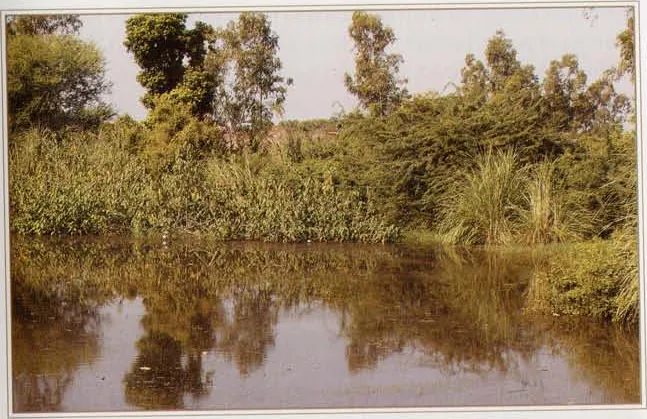
Mālyahāriṇī-kuṇḍa
माल्यहारिणी-कुण्डMālyahāriṇī-kuṇḍa is a pond on the western side of Rādhā-kuṇḍa, at the end of a road that runs north-west from the village.
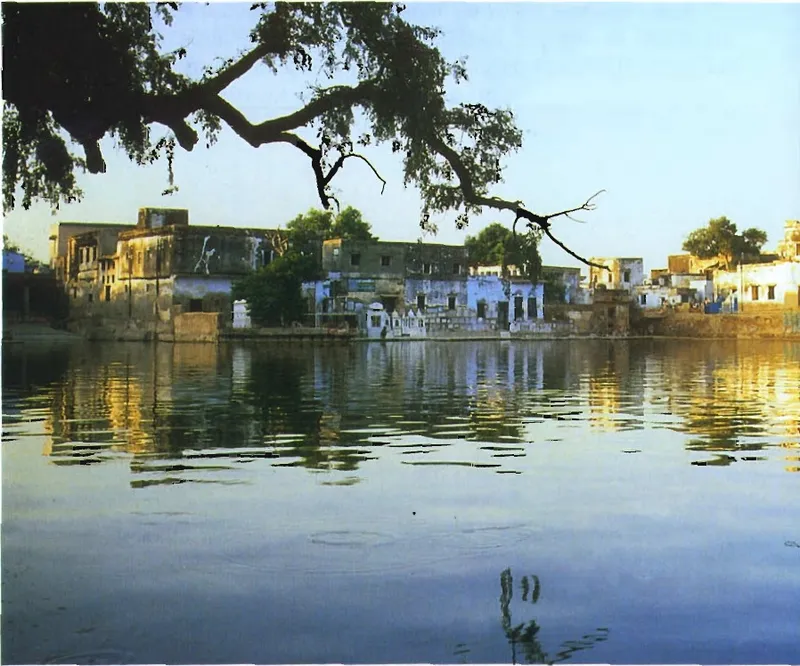
Rādhā-kuṇḍa
राधा-कुण्डRādhā-kuṇḍa is the lake of Śrī Rādhā at the foot of Govardhana Hill, in the village of Āriṭa.
Mālyahāra Lake
माल्यहार सरोवर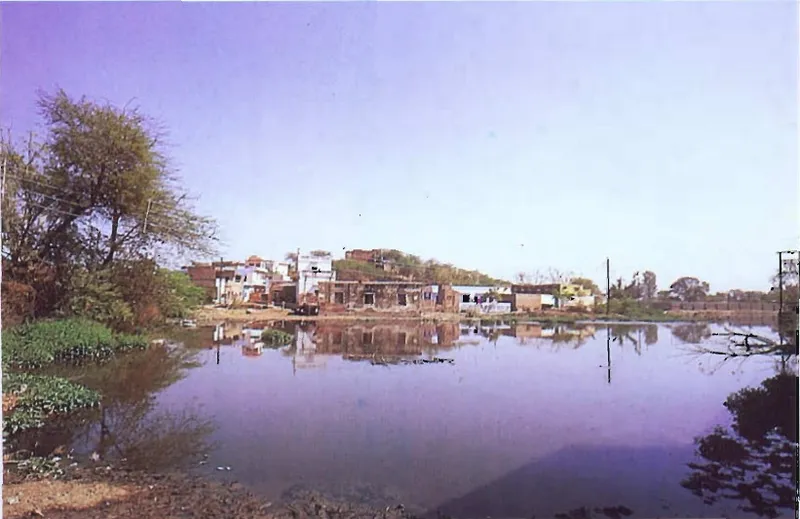
Śivakhora
शिवखोरŚivakhora is a pond at the entrance of the village of Rādhā-kuṇḍa: pilgrims coming along the parikramā path from Uddhava-kuṇḍa see it on their right.
Bhānukhora
भानुखोरMuktā-kuṇḍa (Varṣāṇā)
मुक्ता-कुण्ड (बरसाना)Muktā-kuṇḍa, the pond of pearls, lies west of Varṣāṇā; the guidebook Śrī Vraja-maṇḍala Parikramā (2007) also calls it Ratna-kuṇḍa.
Motī-kuṇḍa (Nandagrāma)
मोती-कुण्ड (नन्दग्राम)Motī-kuṇḍa, the "pearl pond", also called Muktā-kuṇḍa, is a pond at Nandagrāma.
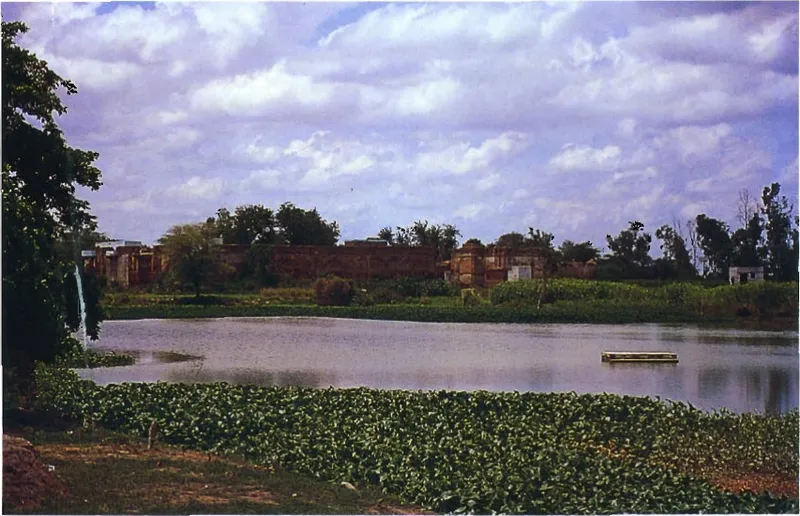
Sakhī-sthalī
सखी-स्थलीSakhī-sthalī, the place of the sakhīs (girl companions), is the village now called Sakhītharā near Govardhana.
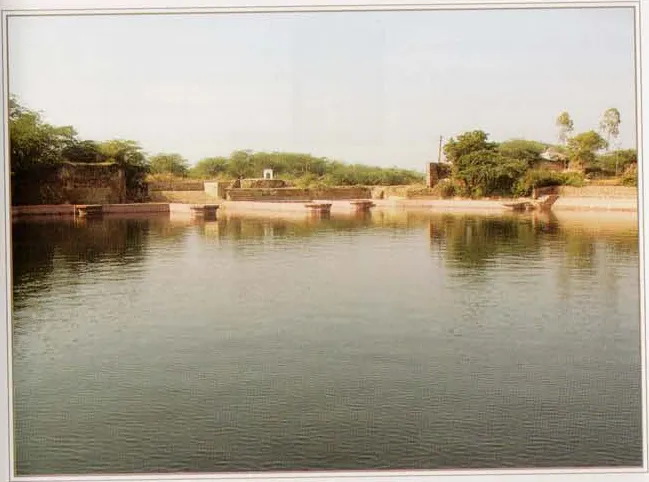
Pāvana-sarovara
पावन-सरोवरPāvana-sarovara is the lake at the foot of Nandīśvara Hill, on the north side of Nandagrāma.
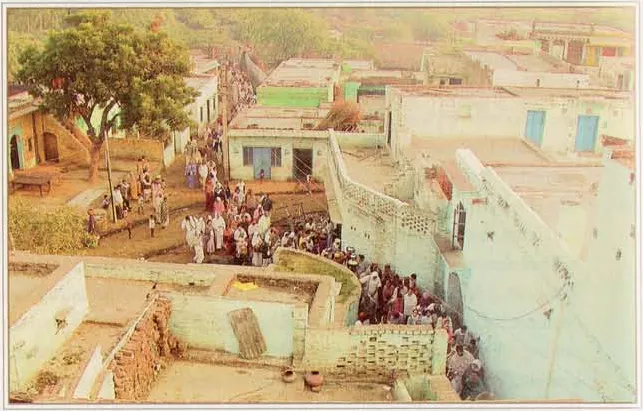
Jāvaṭa
जावटJāvaṭa, also called Yāvaṭa or Yāva-grāma, is the village of Abhimanyu, his mother Jaṭilā and his sister Kuṭilā, where Śrī Rādhā lives in Kṛṣṇa's pastimes.
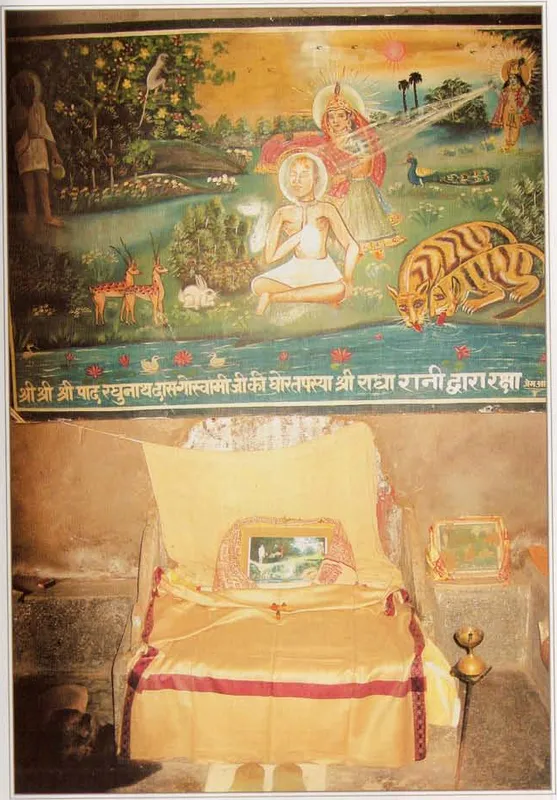
Raghunātha dāsa Gosvāmī's bhajana-kuṭī
रघुनाथ दास गोस्वामी की भजन-कुटीŚrīla Raghunātha dāsa Gosvāmī's bhajana-kuṭī, his hut for chanting and prayer, stands between Rādhā-kuṇḍa and Śyāma-kuṇḍa, next to the kuṭīs of Śrī Gopāla Bhaṭṭa Gosvāmī …
Questions and answers
A prose work by Śrīla Raghunātha dāsa Gosvāmī, the story of the pearls, in which Kṛṣṇa tells Queen Satyabhāmā about a pastime of Vraja. Śrīla Prabhupāda names it among his three books.[1, 2]
Śrīla Raghunātha dāsa Gosvāmī, who lived for most of his life at Rādhā-kuṇḍa. He also wrote the Stavāvalī and the Dāna-carita.[1, 11]
A guidebook of 2007 places it on the western side of Rādhā-kuṇḍa, at the end of a road running north-west from the kuṇḍa.[4, 8, 9]
Because the Bhakti-ratnākara points to Mālyahāri-kuṇḍa as the place of the pearl-necklace pastime told in the Muktā-carita. The book itself names a lake called Mālya-haraṇa without saying where it is.[2–6]
No. The Muktā-carita tells its own story. The Garga-saṁhitā tells another pearl pastime with a lake called Muktā-sarovara, and the Bhakti-ratnākara names pearl fields at Muktā-kuṇḍas near Nandīśvara and Varṣāṇā.[53–56]
Śrīla Prabhupāda taught that such pastimes are understood only after going through Śrīla Rūpa Gosvāmī's instructions, so this article introduces the book, the place and their meaning.[17]
Sources
- Śrīla Prabhupāda, Śrī Caitanya-caritāmṛta, Ādi-līlā 10.91, purport · vedabase.io
- Śrīla Raghunātha dāsa Gosvāmī, Muktā-carita, prose, para 13, GRETIL
- Śrīla Narahari Cakravartī, Bhakti-ratnākara, Fifth Wave (pañcama taraṅga), 1912 ed. printed p. 198, 2nd ed., 1912
- Śrī Vraja-maṇḍala Parikramā (2007), PDF p. 95
- The Colour Guide to Rādhā-kuṇḍa (1999), Rājaśekhara dāsa Brahmacārī, PDF p. 70
- the undated parikramā notes Govardhana, ¶157
- Śrīla Raghunātha dāsa Gosvāmī, Muktā-carita, invocation, fourth verse, GRETIL
- Śrī Vraja-maṇḍala Parikramā (2007), PDF p. 101
- The Colour Guide to Rādhā-kuṇḍa (1999), Rājaśekhara dāsa Brahmacārī, PDF p. 71
- Śrīla Kṛṣṇadāsa Kavirāja Gosvāmī, Śrī Caitanya-caritāmṛta, Ādi-līlā 10.101, online edition · vedabase.io
- Vṛndāvana-Dhāma Ki Jaya! (c. 1986), by Dhruva Mahārāja dāsa, PDF p. 33
- Śrīla Raghunātha dāsa Gosvāmī, Sva-niyama-daśaka v.9 (Grantha Mandira Stavāvalī, section (12))
- Śrīla Raghunātha dāsa Gosvāmī, Muktā-carita, prose, para 20, GRETIL
- Śrīla Raghunātha dāsa Gosvāmī, Muktā-carita, prose, para 31, GRETIL
- Śrīla Raghunātha dāsa Gosvāmī, Muktā-carita, prose, para 588, GRETIL
- Śrī Vraja-maṇḍala Parikramā (2007), PDF p. 96
- Śrīla Prabhupāda, Room Conversation, Vṛndāvana, 5 September 1976 · vedabase.io
- Śrīla Raghunātha dāsa Gosvāmī, Muktā-carita para 304–308, GRETIL
- Śrīla Raghunātha dāsa Gosvāmī, Muktā-carita, para 305, GRETIL
- Śrīla Rūpa Gosvāmī, Upadeśāmṛta 9 (The Nectar of Instruction, text 9), online edition · vedabase.io
Show all 57 references
- Śrīla Rūpa Gosvāmī, Upadeśāmṛta, Śrī Upadeśāmṛta, text 10, online edition · vedabase.io
- Śrīla Rūpa Gosvāmī, Upadeśāmṛta, Śrī Upadeśāmṛta, text 11, online edition · vedabase.io
- Śrīla Prabhupāda, The Nectar of Instruction (Śrī Upadeśāmṛta), Text 9, purport · vedabase.io
- Śrīla Prabhupāda, The Nectar of Instruction (Śrī Upadeśāmṛta), Text 11, purport · vedabase.io
- Śrīla Rūpa Gosvāmī, Laghu-bhāgavatāmṛta, Uttara-khaṇḍa (2), 1.45, GRETIL
- Śrīla Rūpa Gosvāmī, Ujjvala-nīlamaṇi, 4.4–4.5, GRETIL
- Śrīla Jīva Gosvāmī, Ṣaṭ-sandarbha, Prīti-sandarbha, anuccheda 109, GRETIL
- Śrīla Jīva Gosvāmī, Gopāla-campū, Pūrva-campū, pūraṇa 31, prose [83], GRETIL
- Śrī Caitanya-caritāmṛta, Madhya-līlā 18.8, online edition · vedabase.io
- Śrīla Raghunātha dāsa Gosvāmī, Muktā-carita, prose, GRETIL
- Śrīla Raghunātha dāsa Gosvāmī, Muktā-carita, prose, GRETIL
- Śrīla Raghunātha dāsa Gosvāmī, Muktā-carita, prose, GRETIL
- Śrīla Raghunātha dāsa Gosvāmī, Muktā-carita, prose, GRETIL
- Śrīla Raghunātha dāsa Gosvāmī, Śrī Śrī Rādhā-Kṛṣṇojjvala-kusuma-keli, Stavāvalī hymn 19 (Rādhā-Kṛṣṇojjvala-kusuma-keli), v.11 v.11')
- Śrīla Rūpa Gosvāmī, Rādhā-Kṛṣṇa-gaṇoddeśa-dīpikā, part 2, v.118 (sthāna-vivaraṇa)
- Śrīla Raghunātha dāsa Gosvāmī, Muktā-carita, GRETIL
- Śrīla Raghunātha dāsa Gosvāmī, Muktā-carita, prose, paragraph 473 of the, GRETIL
- Śrīla Raghunātha dāsa Gosvāmī, Muktā-carita, prose, paragraph 194 of the, GRETIL
- Śrīla Raghunātha dāsa Gosvāmī, Muktā-carita, text para 359, GRETIL
- Śrīla Raghunātha dāsa Gosvāmī, Muktā-carita, prose paragraphs 347-348 in the (Kṛṣṇa tells the story; Subala has brought Rādhā's letter), GRETIL
- Śrīla Rūpa Gosvāmī, Rādhā-Kṛṣṇa-gaṇoddeśa-dīpikā, part 2 vv.93 and 96
- Śrīla Kṛṣṇadāsa Kavirāja Gosvāmī, Govinda-līlāmṛta, sarga 2 v.42 and its ṭīkā
- Śrīla Raghunātha dāsa Gosvāmī, Muktā-carita, prose paragraph 258 of the, GRETIL
- Śrīla Raghunātha dāsa Gosvāmī, Muktā-carita, prose, para 258, GRETIL
- Śrīla Raghunātha dāsa Gosvāmī, Vraja-vilāsa-stava, verse 79
- Śrīla Raghunātha dāsa Gosvāmī, Govardhanāśraya-daśaka, verse 4
- Govardhana Hill: India's Most Sacred Mountain (2001), Rajasekhara dasa Brahmacari, PDF p. 81
- Śrīla Prabhupāda, Śrī Caitanya-caritāmṛta, Ādi-līlā 10.91, purport (quoting Bhaktisiddhānta Sarasvatī's Anubhāṣya for the birth year) · vedabase.io
- The Colour Guide to Rādhā-kuṇḍa (1999), Rājaśekhara dāsa Brahmacārī, PDF p. 88
- the undated parikramā notes Rādhā-kuṇḍa, ¶41
- Govardhana Hill: India's Most Sacred Mountain (2001), Rajasekhara dasa Brahmacari, PDF p. 155
- Śrīla Narahari Cakravartī, Bhakti-ratnākara, Fifth Wave (pañcama taraṅga), 1912 ed. p. 198, 2nd ed., 1912
- Śrīla Narahari Cakravartī, Bhakti-ratnākara, Fifth Wave, 1912 ed. p. 220; Grantha Mandira text v.913, 2nd ed., 1912
- Śrīla Narahari Cakravartī, Bhakti-ratnākara, Fifth Wave, 1912 ed. p. 229; Grantha Mandira text v.1033, 2nd ed., 1912
- Garga-saṁhitā, Girirāja-khaṇḍa (3), adhyāya 6, verse 35, Sanskrit Wikisource
- Garga-saṁhitā, Girirāja-khaṇḍa (3), adhyāya 6, verse 36, Sanskrit Wikisource
- Pastimes at Malyahara Kund and Shivakhora, ¶12
Further sources
- Śrīla Raghunātha dāsa Gosvāmī, Muktā-carita (Sanskrit); Vraja-vilāsa-stava 79 and Govardhanāśraya-daśaka 4 (Stavāvalī): summarised here, not translated.
- Śrī Caitanya-caritāmṛta, Ādi-līlā 10.91 and 10.101, Madhya-līlā 18.8, with translation and purports by Śrīla Prabhupāda (BBT); Śrīla Prabhupāda, room conversation, Vṛndāvana, 5 September 1976.
- Bhakti-ratnākara, Fifth Wave (Bengali, 1912 edition); Garga-saṁhitā, Girirāja-khaṇḍa 6.35–36: summarised here, not translated.
- Śrī Vraja-maṇḍala Parikramā (2007); The Colour Guide to Rādhā-kuṇḍa (1999).