How Mānasī-gaṅgā came to be: the Gaṅgā of the mind at Govardhana
मानसी-गंगा कैसे प्रकट हुईं: गोवर्धन की मन से प्रकटी गंगा
In short
Mānasī-gaṅgā, the big lake in the town of Govardhana, means the Gaṅgā of the mind. The Garga-saṁhitā says it came from the heavenly Gaṅgā water poured over Kṛṣṇa after He lifted Govardhana. Śrīla Jīva Gosvāmī explains the name as a mind melted in love for Kṛṣṇa. The pilgrims' guidebooks add stories of their own.[1–3]
On this page
At a glance
- The name: Mānasī-gaṅgā, or Mānasa-gaṅgā, the Gaṅgā (Ganges) of the mind.[2, 3]
- The Bhāgavatam tells of Kṛṣṇa's great bath after the lifting of the hill, but it names no lake that came from it.[4–6]
- The Garga-saṁhitā: the heavenly Gaṅgā water of that bath became Mānasī-gaṅgā.[1]
- According to the Vraja-bhakti-vilāsa, Kṛṣṇa made the lake with His mind at the gopīs' word, a playful pastime, not a real fault.[7, 8]
- Śrī Caitanya Mahāprabhu bathed here in the morning before He walked round Govardhana.[9]
- On Dīpāvalī night many people bathe here and set ghee lamps on all its banks, says a 2007 guidebook.[10]
What is Mānasī-gaṅgā?
Mānasī-gaṅgā is the large lake in the middle of the town of Govardhana. Its name means the Gaṅgā of the mind. The Bhāgavatam does not name such a lake.[2–6]
How it came to be, and why it is of the mind, the Garga-saṁhitā, the Vraja-bhakti-vilāsa, Śrīla Jīva Gosvāmī and the modern guidebooks answer in at least six ways. Their accounts are set side by side here, scripture first, without mixing them into one story.[1 +4]
The lake is honoured in old books. The Garga-saṁhitā names Mānasī-gaṅgā first among the holy places (tīrthas) of the hill. It calls the lake the destroyer of a flood of great sins.[11] It even says that a thousand horse sacrifices and a hundred rājasūya sacrifices are not equal to it (summarised here, not translated).[12]
What does the Bhāgavatam tell?
The Tenth Canto tells of a great bath of Kṛṣṇa after He held up Govardhana for seven days. Surabhi, the mother of the cows, bathed Him with her milk on Brahmā's order. Indra, urged by the mothers of the demigods, bathed Him with water of the heavenly Gaṅgā from the trunk of his elephant Airāvata. He gave Him the name Govinda (ŚB 10.27.21–23).[4–6]
Śrīla Prabhupāda tells the same bath in the Kṛṣṇa book.[6]
General teaching (does not name the place)“Then the surabhi cow bathed Kṛṣṇa with her milk, and Indra bathed Him with the water of the celestial Ganges through the trunk of his carrier elephant. After this, the surabhi cows and all the demigods and their mothers joined the heavenly king, Indra, in worshiping Lord Kṛṣṇa by bathing Him with Ganges water and the milk of the surabhis.”
Śrīla Prabhupāda, Kṛṣṇa, the Supreme Personality of Godhead (Kṛṣṇa book), Chapter 27, 'Prayers by Indra, the King of Heaven' · vedabase.io
The Bhāgavatam says nothing of a lake that arose from this bath. Explaining the next verse, Śrīla Jīva Gosvāmī places the bath at the spot of Govardhana known as Śakra-kuṇḍa or Govinda-kuṇḍa; he does not name Mānasī-gaṅgā (summarised here, not translated).[13] The whole pastime is told in “The lifting of Govardhana Hill, Indra's homage and the name Govinda”.[4–6]
How did the heavenly Gaṅgā become a lake?
The Garga-saṁhitā tells the same bath in more detail and draws the lake from it. In its telling, Airāvata pours the heavenly Gaṅgā over Kṛṣṇa on Govardhana. The hill melts with joy and keeps the marks of His hand and feet.[1, 14]
The heavenly water that falls becomes Mānasī-gaṅgā, the destroyer of sins, and Surabhi's milk becomes Govinda-kuṇḍa (Girirāja-khaṇḍa 3.4.8–16, summarised here, not translated).[1, 15]
So the Bhāgavatam tells the bath without a lake, and the Garga-saṁhitā tells the bath and the lake together.[1, 4–6]
Why is it called the Gaṅgā of the mind?
Two old books explain the word mānasī, of the mind, in two ways.[2 +3]
Made by Kṛṣṇa's mind: the Vraja-bhakti-vilāsa
The Vraja-bhakti-vilāsa of Śrīla Nārāyaṇa Bhaṭṭa Gosvāmī is a handbook for pilgrims in Vraja. It says that at the gopīs' word Kṛṣṇa made the holy Mānasī-gaṅgā with His mind, milky and pure. It was to free Him from the offence of killing a bull (summarised here, not translated).[7, 8]
The book then gives a prayer to say while bathing in the lake and sipping its water. The prayer calls her the milky Gaṅgā born from the Lord's mind, the giver of liberation (summarised here, not translated).[8]
The book does not say which bull, and no other text is known to name it. Whatever the bull, the offence cannot mean that sin touched Kṛṣṇa. He is the Supreme Lord and is never touched by sin. The book itself says that He made the lake at the gopīs' word, inside His loving exchange with them, a līlā (a divine pastime).[7 +2]
A mind melted in love: Śrīla Jīva Gosvāmī
Śrīla Jīva Gosvāmī gives no story of the lake's birth in his Gopāla-campū, only the meaning of the name. True to its name, he writes, Mānasa-gaṅgā, the friend of Govardhana, is made of the mind (mānasa) melted in love for Kṛṣṇa.[2, 3]
He then reasons simply. The Gaṅgā became the remover of all sins by a slight touch of Lord Vāmana's foot. So this Gaṅgā, joined with Vraja and with Kṛṣṇa Himself, who always plays there, is far greater. In another verse he pictures the lake as a stream of love for Kṛṣṇa that enters the hill itself (summarised here, not translated).[2, 3]
Is Mānasī-gaṅgā connected with the bull demon Ariṣṭa?
Some readers link the bull of the Vraja-bhakti-vilāsa with Ariṣṭa, the demon who came in the form of a bull. No text is known to say that the book means him.[7 +4]
The Bhāgavatam (10.36) tells how Ariṣṭa came to the cowherd village and was killed by Kṛṣṇa. It tells of no atonement and no bath afterwards.[17–19] Śrīla Prabhupāda ends the pastime the same way.[19]
General teaching (does not name the place)“Once a demon named Ariṣṭāsura entered the village in the form of a great bull with a gigantic body and huge horns, digging up the earth with his hooves. … With Balarāma, He triumphantly entered Vṛndāvana village, and the inhabitants glorified Him and Balarāma with great jubilation.”
Śrīla Prabhupāda, Kṛṣṇa, the Supreme Personality of Godhead (Kṛṣṇa book), Chapter 36, 'Kaṁsa Sends Akrūra for Kṛṣṇa' · vedabase.io
Śrīla Jīva Gosvāmī, on the end of that chapter, quotes the Ādi-varāha. Kṛṣṇa fought Ariṣṭa north of the Gaṅgā, which he explains as Mānasa-gaṅgā. Then Kṛṣṇa made a tīrtha, a holy pond, with His heel and bathed in it with the cowherds (summarised here, not translated).[16]
He adds that Kṛṣṇa's wish to be purified was only play, since the demon had merely taken a bull's form. The bath was a way to show the glory of the new pond. In the joking words Kṛṣṇa then speaks to Śrī Rādhā, no sin had arisen in Him at all.[16]
So, in Śrīla Jīva Gosvāmī's reading, Mānasī-gaṅgā is only a landmark of the fight. The bath after it was in Kṛṣṇa's own kuṇḍa (sacred pond) near Govardhana, not in this lake. That episode tells how Kṛṣṇa's kuṇḍa and Rādhā-kuṇḍa beside it appeared, not how Mānasī-gaṅgā came to be.[16]
Who bathes in Mānasī-gaṅgā, and when?
Śrī Caitanya Mahāprabhu bathed here. After a night in the temple of Harideva, He bathed in Mānasa-gaṅgā in the morning and then walked round Govardhana Hill.[9 +3]
prātaḥ-kāle prabhu ‘mānasa-gaṅgā’ya kari’ snāna
govardhana-parikramāya karilā prayāṇa
In the morning, Śrī Caitanya Mahāprabhu took His bath in a lake called Mānasa-gaṅgā. He then circumambulated Govardhana Hill.
Translation: Śrīla A.C. Bhaktivedanta Swami PrabhupādaThe Varāha Purāṇa, an old scripture, joins the lake to that walk. One who has bathed in Mānasa-gaṅgā, seen Hari at Govardhana and walked round the hill, it says, has no more reason to grieve (summarised here, not translated).[23] The walk is told in “Govardhana parikramā”.[23]
The 2001 guidebook Govardhana Hill records this custom. It says that Vaiṣṇavas and the people of Vraja first bathe in Mānasī-gaṅgā. Then they take darśana (a respectful seeing) of Harideva before they begin the walk round the hill.[24] On the lake's bank, the same book describes the Mukhāravinda temple, where a stone is worshipped as the lotus mouth of the hill.[25–28]
The lake is busiest on one night of the year. Śrī Vraja-maṇḍala Parikramā (2007) says that on Dīpāvalī great numbers of people bathe in the lake, take darśana of Śrī Harideva and set ghee lamps on all its banks.[10]
Where the sources differ
The guidebooks tell more stories, and they do not agree. None of them is known from a scripture or a Gosvāmī's book, and some may be local memory.[7 +4]
- The bull. According to Śrī Vraja-maṇḍala Parikramā (2007) and the undated notes Govardhana, Kṛṣṇa made Mānasī-gaṅgā from His mind at the gopīs' request. He bathed in it after killing the bull Vṛṣabhāsura, the bull-demon, as the Bhāgavatam calls Ariṣṭa. No known scripture or commentary sets such a bath at Mānasī-gaṅgā.[7 +5]
- The calf demon. According to Govardhana Hill (2001) and Vṛndāvana-Dhāma Ki Jaya! (about 1986), it is said that after Kṛṣṇa killed the calf demon Vatsāsura the cowherd boys asked Him to bathe in the Gaṅgā. So He called the Gaṅgā here from His mind. The Bhāgavatam sets that killing on the bank of the Yamunā and tells of no bath after it.[31–35]
Accounts differ Which demon's killing Kṛṣṇa atoned for, and where (Mānasī-gaṅgā or elsewhere)
- Vraja-bhakti-vilāsa, printed pp. 112-113the offence of killing a bull (vṛṣa-hatyā); Devakī's son was freed from it (the edition's Hindi adds 'यहाँ', here, i.e. at the Mānasī-gaṅgā; the Sanskrit has no place word)
- Śrī Vraja-maṇḍala Parikramā (2007), the undated parikramā notes Govardhanathe bull Vṛṣabhāsura; purification at Mānasī-gaṅgā
- Varāha Purāṇa 164.31-36 (Varāha Purāṇa-139952)after killing Ariṣṭa in the form of a bull, Kṛṣṇa, anxious about the bull-killing, bathed in the tīrtha He had made with His heel, and Rādhā made Her own kuṇḍa nearby (Rādhā-kuṇḍa). The Gaṅgā appears only as a landmark: the battle with Ariṣṭa took place to the north of the Gaṅgā (164.31b-32a; the text does not say which Gaṅgā); the purification is not placed at the Gaṅgā
- verses quoted by Śrīla Viśvanātha Cakravartī 'from the Purāṇas' in the ŚB 10.36.16 purport (BBT)after killing Ariṣṭa, Kṛṣṇa's pond is made with His heel; Rādhā plans to fill Her own pond with Mānasa-gaṅgā water
The wording of these accounts is our summary of the sources, not a published translation.
Two more stories come only from the guidebooks, and they may be local memory rather than scripture.[10 +6]
- Nanda's pilgrimage. According to the four guidebooks, Nanda Mahārāja and the people of Vraja planned to go and bathe in the Gaṅgā. Kṛṣṇa showed them the Gaṅgā at Govardhana instead, where Gaṅgā-devī, the goddess of the river, appeared. Two of them say she came on the night of Dīpāvalī.[10 +5]
- The Yamunā's request. Two books tell a local story that is said to explain the lake. At the Yamunā's request Kṛṣṇa called her elder sister Gaṅgā to Vraja and played in her waters with the gopīs.[10, 39]
The guidebooks also say that Mānasī-gaṅgā is one with the Gaṅgā and greater than her. A bath in the Gaṅgā removes sins, they say, while a bath here gives prema-bhakti, loving devotion to Kṛṣṇa. The Gopāla-campū and the Garga-saṁhitā praise the lake above the Gaṅgā and above great sacrifices, but neither promises prema-bhakti in these words.[2 +5]
Accounts differ How the Mānasī-gaṅgā came to be (origin stories)
- Garga-saṁhitā, Girirāja-khaṇḍa 3.4.15after the lifting of the hill, the celestial Gaṅgā water that fell when Kṛṣṇa was bathed on Govardhana became the Mānasī-gaṅgā on the hill
- Vraja-bhakti-vilāsa (Śrīla Nārāyaṇa Bhaṭṭa), printed p. 112at the gopīs' word Kṛṣṇa made the Mānasī Gaṅgā with His mind, to be freed from the offence of killing a bull (the bull is not named)
- Śrī Vraja-maṇḍala Parikramā (2007) and the undated parikramā notes Govardhanaat the gopīs' insistence Kṛṣṇa created it from His mind and bathed in it to atone for killing the bull Vṛṣabhāsura
- Govardhana Hill: India's Most Sacred Mountain (2001) and Vṛndāvana-Dhāma Ki Jaya! (c. 1986)after Kṛṣṇa killed the calf-demon Vatsāsura near Govardhana, the cowherd boys asked Him to bathe in the Ganges and He called the Ganges from His mind
Places in this article
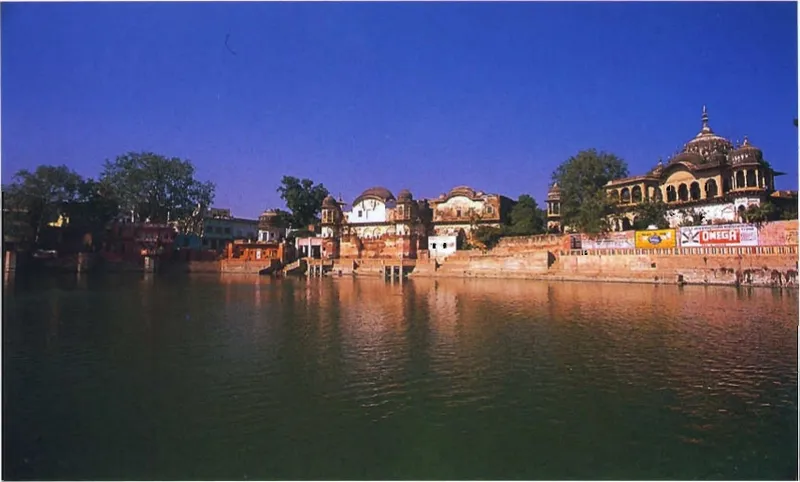
Mānasī-gaṅgā
मानसी-गंगाMānasī-gaṅgā is the large lake in the middle of Govardhana town, on Govardhana Hill.
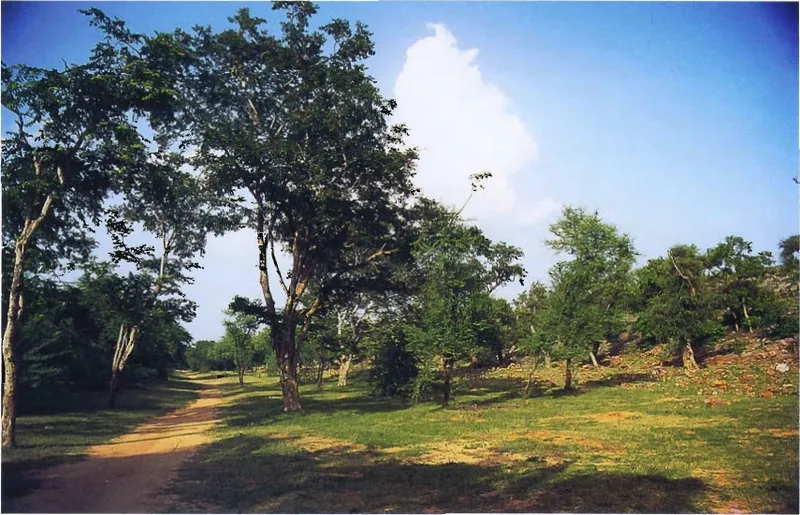
Govardhana parikramā path
गोवर्धन परिक्रमा मार्गThe Govardhana parikramā path is the circuit round Govardhana Hill that pilgrims walk; a parikramā is a walk round a holy place in worship.
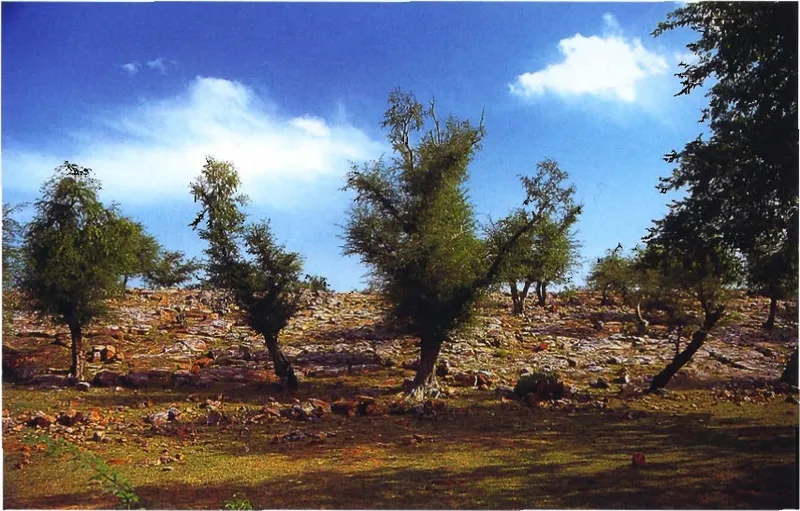
Govardhana
गोवर्धनGovardhana is the hill that Kṛṣṇa lifted with one hand and held up for seven days, so that the people and cows of Vraja could shelter under it from Indra's rain.
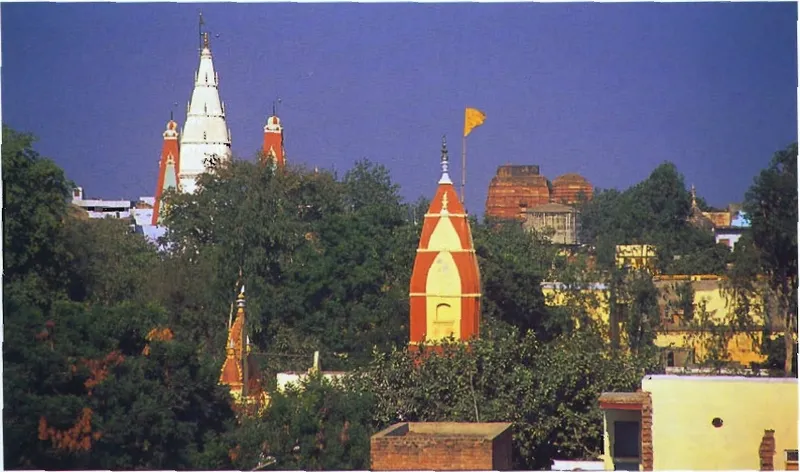
Govardhana (town)
गोवर्धन (कस्बा)Govardhana town lies at Govardhana Hill, around the lake Mānasī-gaṅgā, which the guidebook Govardhana Hill (2001) places in the middle of the town.
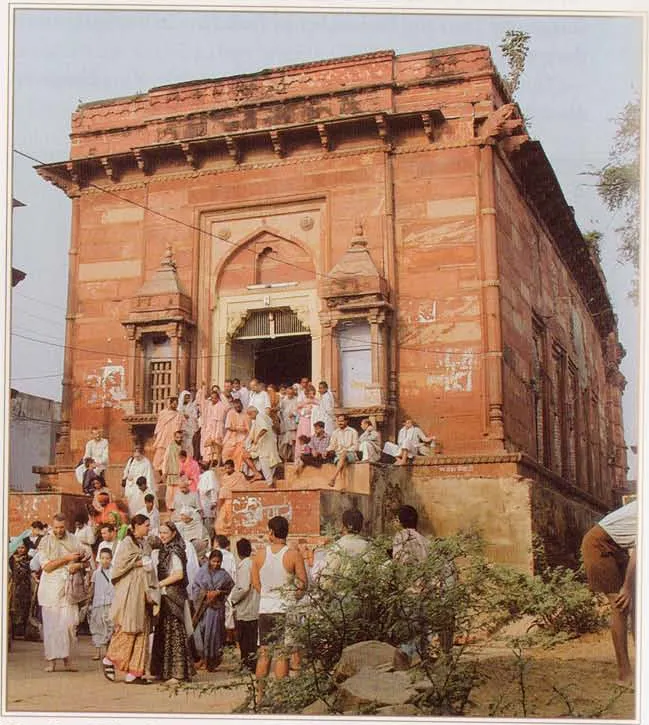
Harideva Mandira
हरिदेव मन्दिरHarideva, Kṛṣṇa as the lifter of Govardhana Hill, is the Deity of Govardhana town, worshipped in His temple on the southern bank of Mānasī-gaṅgā; Śrī Vraja-maṇḍala Parikr …
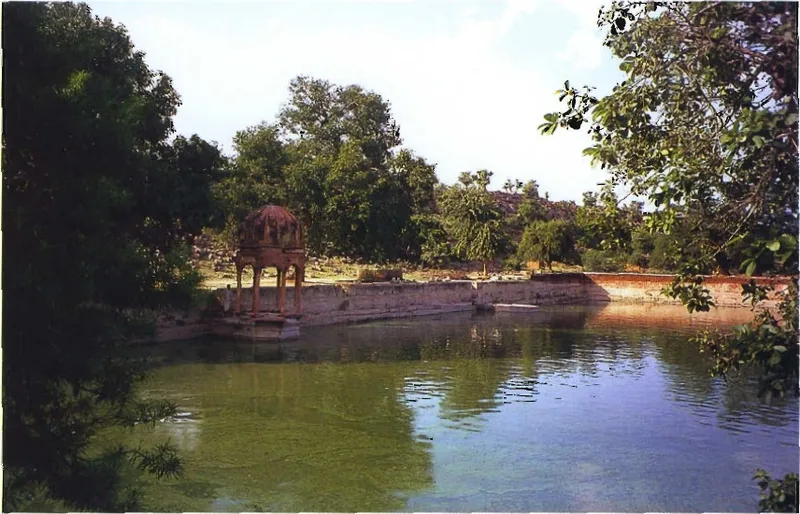
Govinda-kuṇḍa (Govardhana)
गोविन्द-कुण्ड (गोवर्धन)Govinda-kuṇḍa is a kuṇḍa (sacred pond) near the village of Aniyora on Govardhana Hill.
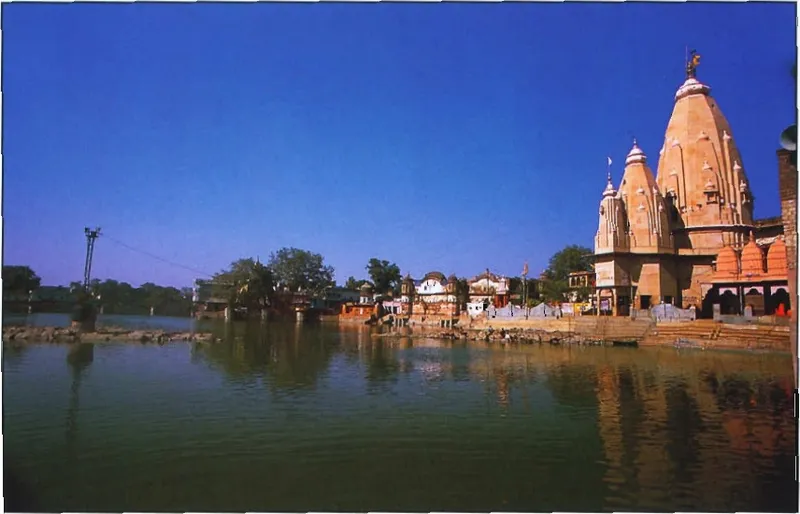
Mukhāravinda Mandira
मुखारविन्द मन्दिरThe Mukhāravinda Mandira is a sandstone temple on Mānasī-gaṅgā in Govardhana town.
Questions and answers
The Garga-saṁhitā says it came from the heavenly Gaṅgā water poured over Kṛṣṇa on Govardhana after He lifted the hill. The Vraja-bhakti-vilāsa says Kṛṣṇa made it with His mind at the gopīs' word.[1, 7, 8]
Because, says the Vraja-bhakti-vilāsa, Kṛṣṇa made it with His mind. Śrīla Jīva Gosvāmī explains that it is made of the mind melted in love for Kṛṣṇa.[2 +3]
No sin ever touches Kṛṣṇa. Śrīla Jīva Gosvāmī explains that His wish to be purified after killing Ariṣṭa was only play, and that the bath was in Kṛṣṇa's own kuṇḍa, not in Mānasī-gaṅgā.[16]
On Dīpāvalī. Śrī Vraja-maṇḍala Parikramā (2007) says that great numbers of people bathe in the lake that night, see Śrī Harideva and set ghee lamps on all its banks.[10]
Yes. The Caitanya-caritāmṛta says that after a night in Harideva's temple He bathed in Mānasa-gaṅgā in the morning and then walked round Govardhana.[9 +3]
The Bhāgavatam does not name it. It tells of Kṛṣṇa's bath after the lifting of the hill, and the Garga-saṁhitā says the lake came from that bath.[1, 4–6]
Sources
- Garga-saṁhitā, Girirāja-khaṇḍa (3), adhyāya 4, verse 15, Sanskrit Wikisource
- Śrīla Jīva Gosvāmī, Gopāla-campū, Pūrva-campū 1, prose [52] and verse 1.23 (jgc_1,1.23), GRETIL
- Śrīla Jīva Gosvāmī, Gopāla-campū, Pūrva-campū 1.8 (jgc_1,1.8), GRETIL
- Śrīmad-Bhāgavatam 10.27.21, GRETIL
- Śrīmad-Bhāgavatam 10.27.22–23, GRETIL
- Śrīla Prabhupāda, Kṛṣṇa, the Supreme Personality of Godhead (Kṛṣṇa book), Chapter 27, 'Prayers by Indra, the King of Heaven' · vedabase.io
- Śrīla Nārāyaṇa Bhaṭṭa, Vraja-bhakti-vilāsa, Govardhana section, printed p. 112, 1st ed., publ. Bābā Kṛṣṇadāsa, Kusuma-sarovara, Saṁvat 2008
- Śrīla Nārāyaṇa Bhaṭṭa, Vraja-bhakti-vilāsa, Govardhana section, printed p. 113, mantra 4, 1st ed., publ. Bābā Kṛṣṇadāsa, Kusuma-sarovara, Saṁvat 2008
- Śrīla Kṛṣṇadāsa Kavirāja Gosvāmī, Śrī Caitanya-caritāmṛta, CC Madhya-līlā 18.32, online edition · vedabase.io
- Śrī Vraja-maṇḍala Parikramā (2007), PDF p. 117
- Garga-saṁhitā, Girirāja-khaṇḍa (3), adhyāya 7, verse 7, Sanskrit Wikisource
- Garga-saṁhitā, Girirāja-khaṇḍa (3), adhyāya 10, verse 39, Sanskrit Wikisource
- Śrīla Jīva Gosvāmī: commentary on ŚB 10.27.24, Bhagavata Vidya Pith edition, ed. Bhagavata Rishi and Krishna Shankar Shastri, 1996
- Garga-saṁhitā, Girirāja-khaṇḍa (3), adhyāya 4, verse 12, Sanskrit Wikisource
- Garga-saṁhitā, Girirāja-khaṇḍa (3), adhyāya 4, verse 16, Sanskrit Wikisource
- Śrīla Jīva Gosvāmī: commentary on ŚB 10.36.15, Bhagavata Vidya Pith edition, ed. Bhagavata Rishi and Krishna Shankar Shastri, 1996
- Śrīmad-Bhāgavatam 10.36.1, GRETIL
- Śrīmad-Bhāgavatam 10.36.15, GRETIL
- Śrīla Prabhupāda, Kṛṣṇa, the Supreme Personality of Godhead (Kṛṣṇa book), Chapter 36, 'Kaṁsa Sends Akrūra for Kṛṣṇa' · vedabase.io
- Śrīla Kṛṣṇadāsa Kavirāja Gosvāmī, Śrī Caitanya-caritāmṛta, CC Madhya-līlā 18.17, online edition · vedabase.io
Show all 40 references
- Śrīla Kṛṣṇadāsa Kavirāja Gosvāmī, Śrī Caitanya-caritāmṛta, CC Madhya-līlā 18.22, online edition · vedabase.io
- Śrīla Prabhupāda, Śrī Caitanya-caritāmṛta, Madhya-līlā 18.32, translation · vedabase.io
- Varāha Purāṇa, adhyāya 164 (Annakūṭa-parikrama-prabhāva), verses 11-12a, Sanskrit Wikisource
- Govardhana Hill: India's Most Sacred Mountain (2001), Rajasekhara dasa Brahmacari, PDF p. 76
- Govardhana Hill: India's Most Sacred Mountain (2001), Rajasekhara dasa Brahmacari, PDF p. 80
- Śrī Vraja-maṇḍala Parikramā (2007), PDF p. 121
- Śrī Vraja-maṇḍala Parikramā (2007), PDF p. 122
- the key of the numbered Govardhana chart, ¶20
- Śrī Vraja-maṇḍala Parikramā (2007), PDF p. 116
- the undated parikramā notes Govardhana, ¶44
- Govardhana Hill: India's Most Sacred Mountain (2001), Rajasekhara dasa Brahmacari, PDF p. 71
- Vṛndāvana-Dhāma Ki Jaya! (c. 1986), by Dhruva Mahārāja dāsa, PDF p. 39
- Śrīmad-Bhāgavatam 10.11.41, GRETIL
- Śrīmad-Bhāgavatam 10.11.43, GRETIL
- Śrīla Prabhupāda, Kṛṣṇa, the Supreme Personality of Godhead (Kṛṣṇa book), Chapter 11, 'Killing the Demons Vatsāsura and Bakāsura' · vedabase.io
- Govardhana Hill: India's Most Sacred Mountain (2001), Rajasekhara dasa Brahmacari, PDF p. 74
- the undated parikramā notes Govardhana, ¶45
- the undated parikramā notes Ādi-Badrinātha, ¶39
- the undated parikramā notes Govardhana, ¶47
- Govardhana Hill: India's Most Sacred Mountain (2001), Rajasekhara dasa Brahmacari, PDF p. 70
Further sources
- Śrīmad-Bhāgavatam 10.11, 10.27 and 10.36 (BBT), with Śrīla Jīva Gosvāmī's commentary on 10.27.24 and 10.36.15 (Sanskrit; summarised here, not translated).
- Śrīla Prabhupāda, Kṛṣṇa, the Supreme Personality of Godhead, chapters 11, 27 and 36; Śrī Caitanya-caritāmṛta, Madhya 18 (BBT).
- Garga-saṁhitā, Girirāja-khaṇḍa 3.4, 3.7, 3.10; Vraja-bhakti-vilāsa, Govardhana section; Śrīla Jīva Gosvāmī, Gopāla-campū, Pūrva-campū 1; Varāha Purāṇa 164 (summarised here, not translated).
- Guidebooks: Govardhana Hill: India's Most Sacred Mountain (2001), Śrī Vraja-maṇḍala Parikramā (2007), Vṛndāvana-Dhāma Ki Jaya! (about 1986), Govardhana (undated notes).